Click the blue text above to follow us
Hi, everyone, I am Chip Zhi, and this is my 49th original article. Today, I will share with you several domestic semiconductor companies that rank high in profitability.
Recently, it was reported that the chip division of global router giant TP-LINK has been completely disbanded. It has only been 3 months since the last round of layoffs at its WiFi chip division located in Zhangjiang, Shanghai.
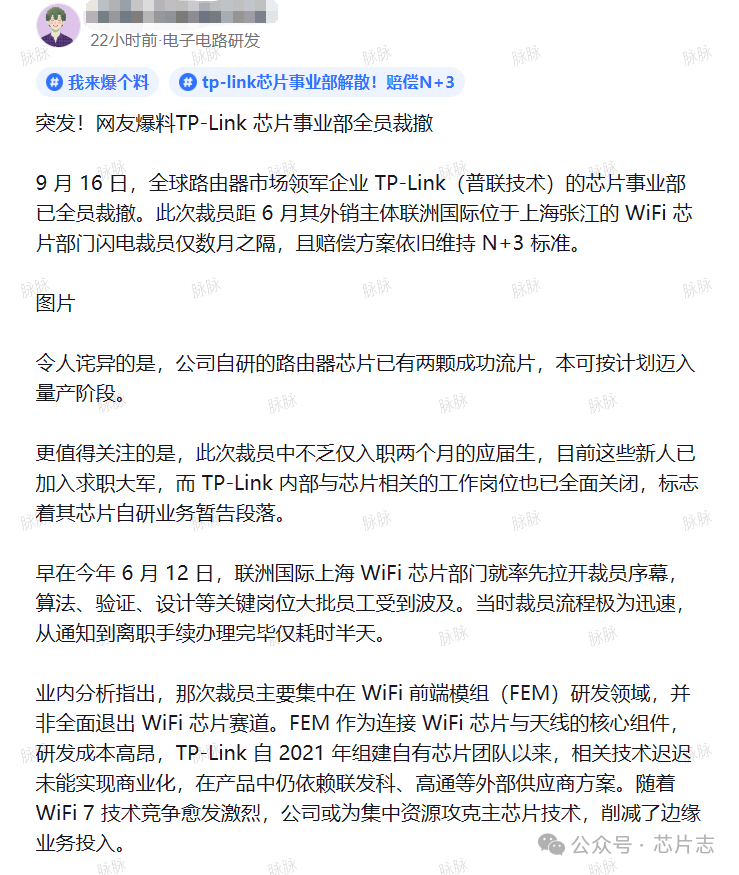
Of course, both rounds of compensation were enviable N+3, and TP-LINK has been praised as a conscientious enterprise by many netizens.
In fact, this layoff storm is not an isolated incident but a reflection of the intense competition in the wireless chip sector.
In the wireless chip field, major companies hold significant market shares and patent layouts. Faced with the strong encroachment of international giants like Qualcomm and Broadcom, domestic chip companies are experiencing increasingly fierce competition. The layoffs at TP-LINK are not an isolated case but reflect the common difficulties faced by domestic companies in the high-end wireless chip R&D field. High R&D costs, long result conversion cycles, and the technological monopoly of international giants have made it difficult for many companies to progress on their self-research paths.
So, in this fierce competition, are there any domestic wireless chip companies that can step up? What technological advantages and unique products do these companies have? Let’s take a look at the following listed companies.
Allwinner Technology: Leader in Multimedia SoC
Allwinner Technology is a leading enterprise in the domestic multimedia SoC chip field, with products covering smart set-top boxes, smart TVs, AIoT, and more. In the first half of 2025, the company achieved revenue of 3.33 billion yuan, a year-on-year increase of 10.42%; net profit attributable to the parent company was 497 million yuan, a year-on-year increase of 37.12%.
The company has performed outstandingly in the wireless connectivity field, with W series product sales exceeding 8 million units in the first half of 2025, and Q2 sales surpassing 5 million units. Wi-Fi 6 chip sales exceeded 1.5 million units in Q2 2025, with a quarter-on-quarter growth of over 120%.
Notably, the company’s 6nm chip has intelligent edge-side computing capabilities, and sales have been accelerating since its commercial launch in the second half of 2024. In Q2 2025, sales of the 6nm chip exceeded 2.5 million units, with annual sales expected to reach over 10 million units.
Espressif Technology: Global Leader in IoT Wi-Fi MCU
Espressif Technology ranks first globally in Wi-Fi MCU shipments, and fifth in the broader Wi-Fi market. In the first half of 2025, the company achieved revenue of 1.246 billion yuan, a year-on-year increase of 35.35%; net profit attributable to the parent company was 261 million yuan, a year-on-year increase of 72.29%.
The company’s first wireless communication chip supporting Wi-Fi 6E has completed engineering sample testing and is planned for mass production in the second half of 2025, primarily targeting the data communication market, with downstream customers concentrated in home routers, gateways, and other scenarios.
Additionally, Espressif Technology has established a strong developer community early on in the open-source ecosystem, reserving a large number of potential customers and developers in recent years. Its ESP32 series chips are known for their high cost-performance ratio and rich peripheral interfaces, making them one of the preferred chips for IoT projects.
Currently, Espressif chips can interface with various large models such as OpenAI’s ChatGPT, ByteDance’s Doubao, and Baidu’s Wenxin Yiyan.
Hengxuan Technology: Expert in Low-Power Wireless Audio Chips
 Hengxuan Technology is a leading enterprise in the domestic AIoT chip field, occupying a core position in TWS headphones, smart wearables, and smart home fields due to its low-power technology, edge-side AI layout, and top customer ecosystem.
In the first half of 2025, the company achieved revenue of 1.938 billion yuan, a year-on-year increase of 26.58%; net profit attributable to the parent company was 305 million yuan, a year-on-year increase of 106.45%.
The company’s products are widely used in the smart wearable field, and in addition to TWS headphones and smartwatches, the company’s chips are gradually extending to low-power wireless application scenarios such as smart glasses and wireless microphones.
Hengxuan Technology is developing a new generation of heterogeneous SoC chips, the 6000 series, to meet the high-performance and low-power requirements of smart hardware in the AI era. The company expects to sample the 6000 series chips in the first half of 2026.
Technically, the company’s new generation of smart wearable chip, BES2800, based on 6nm technology, is rapidly ramping up in customer TWS headphones, smartwatches, and smart glasses. The smartwatch chip has successfully been adopted by new customers such as Xiaotiancai and Songtuo and has achieved mass production.
In the Bluetooth technology field, the new generation of chips supports BT/BLE dual-mode 6.1 protocol, developing an IBRT solution that supports one-to-two and multipoint connections, while the Wi-Fi 6 connection chip has achieved mass production, featuring low power consumption and low latency advantages.
Aojie Technology: Rising Star in Cellular IoT Chip Market
Aojie Technology is a company focused on mobile communication and IoT chips, with products covering various wireless communication technologies such as 5G, LTE Cat4/1/CatM/NB-IoT.
Aojie Technology achieved revenue of 1.898 billion yuan in the first half of 2025, a year-on-year increase of approximately 11%; however, it reported a net loss of 245 million yuan, narrowing by 50.2% year-on-year.
Despite the ongoing losses, the company continues to invest in technology R&D. The new 5G RedCap chip platform, the ASR1903 series, has entered the stage of large-scale production and has been first adopted by the globally leading IoT overall solution provider, Quectel.
This platform complies with the 3GPP R17 standard, supports NR SA/LTE dual-mode, with peak uplink and downlink rates reaching 120Mbps and 226Mbps, respectively, while supporting mainstream 5G frequency bands from 450MHz to 6GHz and 5G SA independent networking.
As one of the few large platform companies with the R&D and design capabilities for both full-standard cellular baseband chips and multi-protocol non-cellular IoT chips, Aojie Technology has significant advantages in full-stack communication technology integration.
Tailin Micro: Leader in Low-Power Bluetooth Chips
Tailin Micro’s main business is the R&D, design, and sales of low-power wireless IoT chips, focusing on low-power Bluetooth, dual-mode Bluetooth, Zigbee, Matter, WiFi, and other short-range wireless communication chip products.
In the first half of this year, Tailin Micro achieved revenue of 503 million yuan, a year-on-year increase of 37.72%; net profit attributable to the parent company was 101 million yuan, a year-on-year increase of 274.58%; the net profit after deducting non-recurring gains and losses was 93 million yuan, a year-on-year increase of 257.53%.
In the first half of the year, Tailin Micro’s newly launched edge-side AI chip entered the stage of large-scale production, with sales in the second quarter reaching tens of millions of yuan; the company’s chips have been shipped in bulk in the overseas smart home field, and Tailin Micro, as the first certified enterprise, has seen its Bluetooth 6.0 chip, which supports new features like Channel Sounding, enter mass production with global customers; the newly launched WiFi-6 multimode chip has also achieved bulk shipments.
Additionally, Tailin Micro has completed the mass production of several advanced process chips, covering Bluetooth 6.0, Star Flash, and other functions. The company has also completed the certification and launch of a new wireless communication module and further provided optimized development tool support.
Future Challenges and Opportunities
For a long time, the wireless chip market has been dominated by international giants such as Qualcomm, MediaTek, and Broadcom.
Although domestic wireless chip companies have made some progress, they still face many challenges. Especially in the high-end wireless chip field, international giants occupy the vast majority of market share due to their strong R&D capabilities and patent barriers.
Moreover, the R&D of advanced technologies like WiFi 7 and 5G requires substantial investment and long-term technological accumulation, which is not something ordinary companies can bear.
However, in niche market segments, Chinese chip companies are finding their development space.
From the market landscape, these five companies are continuously deepening their focus in their respective niche areas, gradually breaking the monopoly of international giants through technological innovation and product upgrades. Especially in emerging fields such as IoT, smart home, and smart wearables, domestic wireless chip companies are gaining more market share due to their rapid market response capabilities and localized service advantages.
In the future, with continuous technological advancements and improvements in the industrial chain, domestic wireless chip companies are expected to play a more important role in the global market.
Regarding domestic wireless chip companies, do you have confidence in their future development? Welcome to share your thoughts in the comments!(Note: The content shared by Zhi does not constitute any investment advice; adults should manage their own risks.)

END

– Review of Previous Exciting Content –
The “Heart” Competition of Lithography Machines: These Five Companies Illuminate the Future of Chips
Chip Etching Equipment: The Domestic Three Swordsmen Support a Piece of Sky
Ranked Sixth! Semiconductor Wafer Leader to IPO on the Science and Technology Innovation Board on the 14th!
Photoresist Concept Soars! Why These Eight Companies?
The Four Most Promising Semiconductor Companies in China
The Rise of 15 Domestic Semiconductor Equipment Manufacturers
China’s Semiconductor Technology Has Changed!
Semiconductors Never Go Out of Style: Five Companies Cross-Industry Mergers Enter the Game!
Who is the “King of Gross Profit” in Semiconductors! Top 10 Listed Companies
These Six Companies Precisely Replace American Chip Giants

Scan to Follow
Master the Global Semiconductor Future Development Direction
Click to see, you are the best!