Hi This is the 3698th article shared by Guoheng Assistant.
Stop guessing, let the data speak.
“Is the strength of your 3D printed sand mold sufficient? Will it wash away during pouring? Can the castings meet the requirements?”
As a foundry owner or engineer, you must have such questions when considering adopting 3D printed sand mold technology. Today, we will thoroughly answer this core question with solid data and case studies.
Let’s get straight to the data: What does 1.0MPa mean?
Here’s a clear answer: The tensile strength of industrial-grade 3D printed sand molds stabilizes between 0.8-1.5MPa, with a core range of 1.0-1.3MPa. This strength level is fully capable of meeting the production needs of most castings.
Let’s translate this data into engineering language:
– Compared to traditional processes: This strength is close to or exceeds that of most handmade and ordinary machine-made sand molds.
– Uniformity advantage: More importantly, the overall strength of 3D printed sand molds is uniform, with no local weak points.
– Practical validation: It can withstand the pouring impact and static pressure of materials like aluminum, magnesium, and cast iron.
What can it specifically do? Detailed by material.
Aluminum and magnesium alloy casting: More than sufficient.
Low pouring temperature (700-750°C), minimal thermal shock to the sand mold.
The strength of 3D printed sand molds performs excellently in this area, making it one of the most mature application fields.
Success case: A certain automotive parts company used 3D printed sand molds for mass production of aluminum alloy intake manifolds, increasing the yield rate from 85% to 96%.
Cast iron casting: Fully meets requirements.
Including gray cast iron and ductile iron (pouring temperature 1300-1400°C).
A strength of 1.0MPa is sufficient to handle the static pressure and scouring force of molten iron.
Application range: From pump housings and valve bodies weighing dozens of kilograms to machine tool bases and engine blocks weighing several tons, there are mature applications.
A large engine manufacturer used 3D printed sand molds to produce cylinder blocks, solving the assembly problem of complex water jacket cores.
Cast steel casting: Conditionally applicable.
High pouring temperature (1500°C), requires special attention.
– Medium and small cast steel parts: Directly usable, no pressure.
– Large heavy castings: Ensure through structural optimization (e.g., adding ribs, properly setting pouring risers).
Practical experience: A hydropower equipment supplier successfully used 3D printed sand molds to manufacture an 8-ton stainless steel impeller casting.
Why is a strength of 1.0MPa “sufficient”?
Precision compensates for strength.
The dimensions of 3D printed sand molds are precise, with small assembly gaps and good overall structural stability, which reduces the requirement for absolute strength to some extent.
Uniformity enhances reliability.
Traditional sand molds may have risks of local strength insufficiency, while 3D printed sand molds maintain consistent strength from the first layer to the last, greatly enhancing reliability.
The philosophy of “just right”.
The strength of sand molds is not better the higher it is. Excessively high strength may lead to poor collapsibility after the casting solidifies, difficulties in sand removal, and even thermal cracking of the casting. 3D printed sand molds achieve the best balance between strength and collapsibility.
Real voices from customers: They validate strength through practice.
“Initially, we were also concerned about strength, but actual tests showed that a tensile strength of 1.2MPa is more stable than our handmade sand molds.”
—— Technical manager of a pump and valve company in Jiangsu.
“For stainless steel castings under 5 tons, with reasonable design, 3D printed sand molds can fully meet the requirements.”
—— General manager of a specialized cast steel factory in Guangdong.
When should special solutions be considered?
Although 3D printed sand molds have a wide range of applicability, special attention is needed in the following cases:
– Extremely large cast steel parts (10 tons).
– Castings with particularly complex structures and extremely thin walls.
– Castings with special surface quality requirements.
For these situations, we can address them through sand mold structural reinforcement design, using high-performance binders, or adopting hybrid manufacturing solutions.
Conclusion: Take the first step with confidence.
If your castings fall into the following categories, you can confidently consider adopting 3D printed sand mold technology:
– ✅ Aluminum alloy and magnesium alloy castings.
– ✅ Various cast iron parts.
– ✅ Medium and small cast steel parts.
– ✅ Complex structures that are difficult to mold traditionally.
– ✅ Small batch, rapid delivery castings.
A strength of 1.0MPa has been validated by countless foundries. It is not only “strong enough” but also brings revolutionary advantages of mold-free manufacturing, unlimited design freedom, and rapid delivery.
Now, it’s time to set aside concerns about strength and personally experience the changes this technology can bring to you.
Need a specific assessment of whether your product is suitable? Feel free to contact us with your part drawings for a dedicated technical feasibility analysis!
-End-
One-stop rapid prototype provider (Clients include: BYD, Great Wall Motors)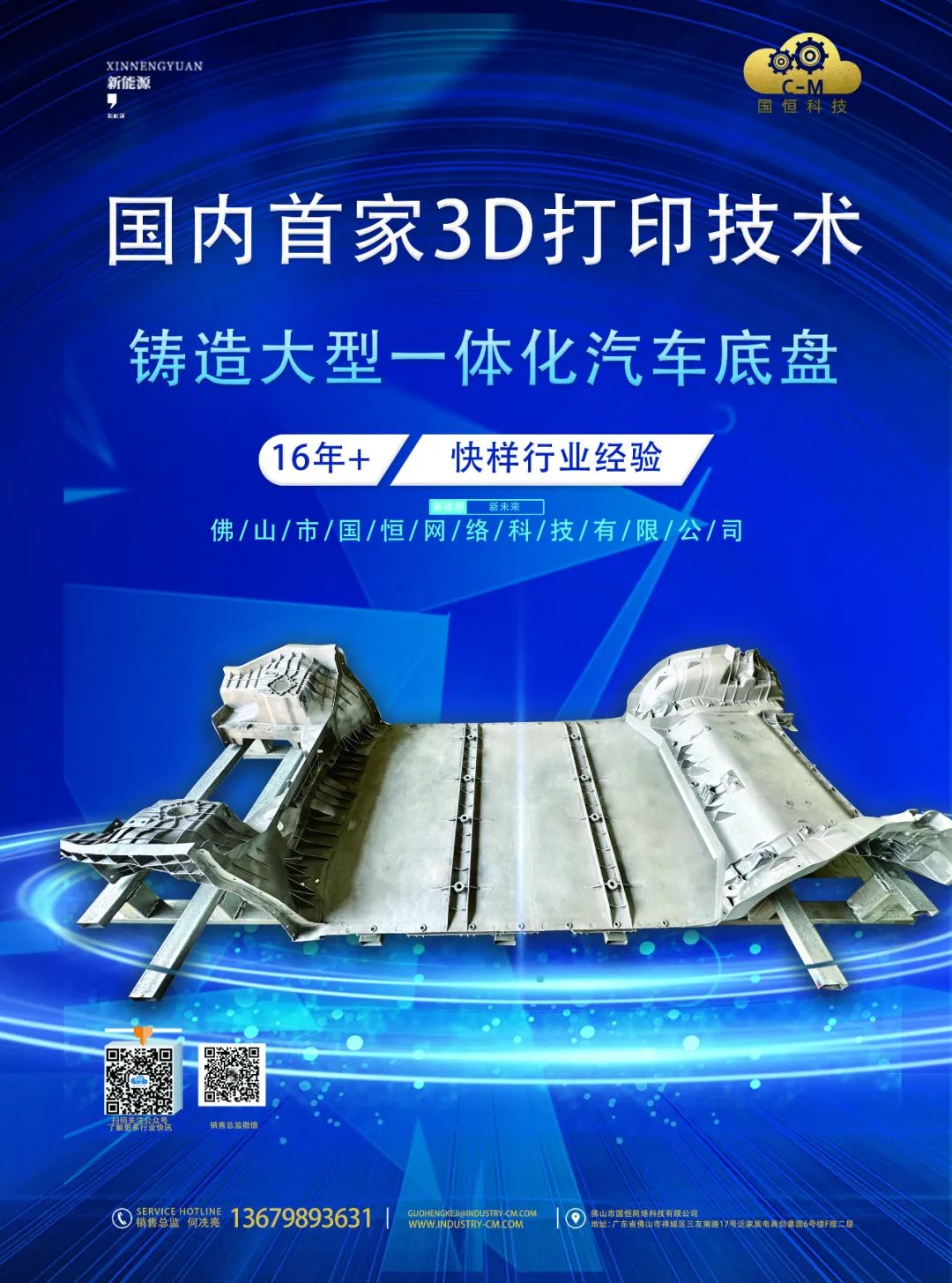
Foshan Guoheng Network Technology Co., Ltd.
Founded by a pioneering technical team in the 3D printing service industry in 2011, the service scale is continuously extending the industrial chain based on different production needs. The platform optimizes production modes through understanding processing technology, providing single-piece and small-batch processing services. Additionally, the platform offers online product technical optimization, synchronous development, rapid manufacturing, and various materials for 3D printing services, providing comprehensive industrial production solutions for customers.
Service hotline: 0757-82268029
13377575429
Address: 2nd Floor, Block F, No. 6, Pan Home E-commerce Creative Park, No. 17, Sanyou South Road, Chancheng District, Foshan City, Guangdong Province