From November 14 to 16, 2025, the 27th China Hi-Tech Fair will be held in Shenzhen. With over 400,000 square meters of exhibition space, 22 specialized exhibition areas will host nearly 5,000 enterprises and industry organizations from over 100 countries and regions, along with more than 200 professional events.
As the host enterprises, several AI robotics companies from the Bay Area will participate, showcasing dozens of globally debuting, domestically leading, and industry-first achievements, highlighting the full-chain strength of AI robotics in the Guangdong-Hong Kong-Macao Greater Bay Area from “technology incubation – scenario validation – commercialization”.
What are the highlights of the application scenarios and innovative fields of AI robotics at the exhibition? Which products are making their debut? Overall, what trends are forming in AI robotics at the Hi-Tech Fair? What challenges lie ahead for AI robotics?
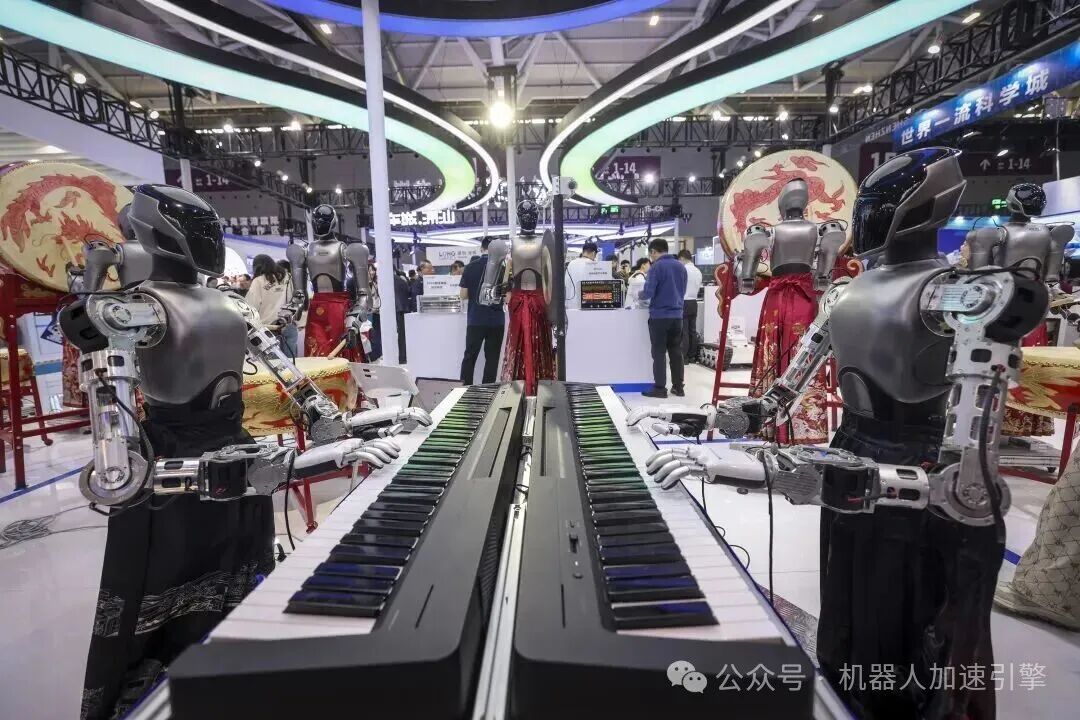
Robot piano performance at the Hi-Tech Fair, photo by Zhu Hongbo, Southern Plus
The Bay Area AI Robotics Industry Chain is Rich in Innovation
This year’s Hi-Tech Fair features AI robotics products visible in almost every exhibition area. After visiting multiple pavilions, reporters found that the participating Bay Area AI robotics companies are diverse, covering complete machine manufacturers, dexterous hands, drive transmission perception core components, computing power infrastructure, and more.
From the perspective of complete machine manufacturers, humanoid robots on display include Yushu, Fourier, Star Motion Era, Leju Robotics, Cyborg Robotics, Zero Dimension, Zhujijidong, Songyan Power, Luming Robotics, Qingbao Engine Robotics, Lingyu Intelligent, and others. Wheel-legged robots are also represented by companies like Micro Technology and Light Year Innovation.
In terms of core components, dexterous hands, grippers, and their core accessories have become one of the highlights of the exhibition area, forming a new trend.
Zhaowei Electromechanical’s bionic dexterous hand and Starry Light Year’s global first high-degree-of-freedom rope-driven dexterous hand have become standout products among many dexterous hand offerings.
Several companies showcased the latest trends in dexterous hand components. For instance, Yuan Sheng Technology’s multi-dimensional tactile sensor MultiDT and large-area tactile sensor HexT are pioneering products in the industry; Daimeng Robotics’ latest DM-TacW series visual tactile sensors endow grippers and other execution terminals with humanoid tactile capabilities, aiding precise control and adaptive interaction in complex scenarios. Experts on-site noted that dexterous hand components have achieved independent domestic production.
Additionally, there have been breakthrough achievements in drive transmission perception components. Suchuan Technology’s lightweight robotic harmonic joints, Tuobang Motor’s maximum rated thrust dexterous hand motor module of the same volume, and Liuxing Technology’s world’s first robotic spatial memory module significantly enhance the autonomous controllability of the embodied intelligent robotics industry chain.
There were also national key projects showcasing computing power infrastructure. For example, the Guangdong Provincial Laboratory of Artificial Intelligence and Digital Economy (Shenzhen) collaborated with Huawei and ecological partners to complete the “Shenzhen debut” of a 384 super-node computing power cluster.
Moreover, the application of technologies such as AI agents and digital employees is gradually pushing digital productivity into a new phase. Tanjiji Technology showcased the intelligent decision-making and execution capabilities of digital employees in complex business scenarios like manufacturing, becoming a prominent highlight of AI application technology innovation at the fair; meanwhile, Wanxing Technology presented various innovative applications such as “AI + video creativity”, “AI + drawing creativity”, and “AI + document efficiency”, showcasing the latest market achievements of “domestic AI + creative software”.
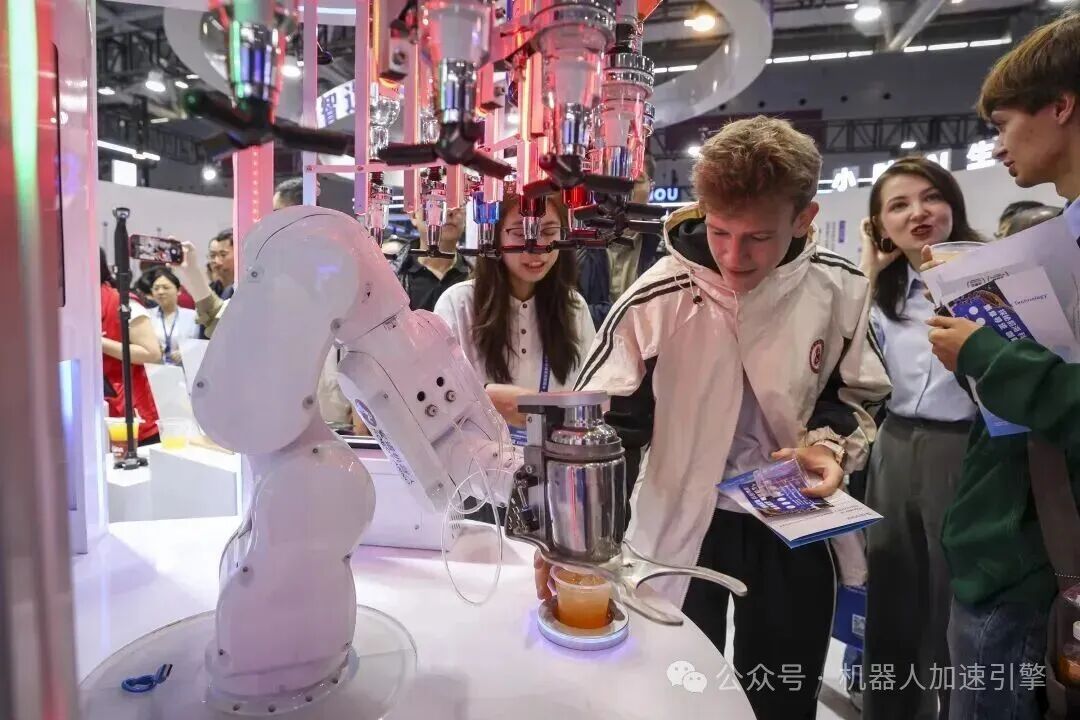
Robotic arm serving drinks at the Hi-Tech Fair, photo by Zhu Hongbo, Southern Plus
Intensive Debuts of AI Robotics Achievements
According to the organizers, over 20% of the products at this Hi-Tech Fair are making their debut, with many Bay Area products being industry-leading, first, or pioneering, especially evident in the AI robotics field.
In addition to the aforementioned Yuan Sheng Technology and Daimeng Robotics launching core sensor accessory debut products, there are also several products making their debut in application scenarios at this Hi-Tech Fair.
In the medical and health field, the Shenzhen Institute of Artificial Intelligence and Robotics (AIRS) collaborated with China Merchants Group to showcase the overall solution for “bronchoscope robot-assisted lung cancer ablation treatment” for the first time, outlining an innovative blueprint for future interventional surgeries. Additionally, Junrou Technology developed the world’s first multifunctional medical electronic skin, while Qingyuan Zhixin launched the internationally leading and domestically pioneering high-throughput organ 3D printer.
In consumer application scenarios, Honor Terminal showcased its self-evolving AI native phone Magic8 series for the first time at the Hi-Tech Fair, equipped with the industry’s first self-evolving AI system. Li Bai Glasses presented the world’s lightest aerospace-grade pure titanium smart glasses, Meixi Micro showcased the world’s first Meixi Micro holographic invisible screen, and New Craftsman Society Robotics introduced the world’s first competitive kung fu robot equipped with human-machine integration millisecond technology, while Shengya Environment presented the world’s first AI intelligent technology fish feed machine, all making their debut in their respective niche fields.
In the field of power operation and maintenance, the first domestic humanoid robot for power scenarios, “Zhixing 1”, developed by Guangdong Power Grid in collaboration with AIRS and other Shenzhen institutions, made its debut at the Hi-Tech Fair. This robot is currently serving the 15th National Games to ensure power supply, supporting the construction of intelligent power grids. In the elderly care sector, the world’s first intelligent wheelchair with autonomous navigation and embodied interaction capabilities, Star Can Xcan, made its appearance, bringing new development space for future intelligent elderly care.
Additionally, companies like Lingque Technology, Shenzhou Eagle Drones, and Quansensing Technology showcased high-altitude cleaning robots for building security, while Iron Eater, Star Can Intelligent, and Kenjing Technology presented grass-cutting robots and exoskeleton robots, respectively, all of which are clearly defined functional robotic products.
Five Development Trends Building Ecological Advantages
What trends are emerging in the application of AI at the Hi-Tech Fair?
Huawei, Tencent, and several national key projects are providing infrastructure that will support the future. The HarmonyOS, Kirin chips, HiSilicon semiconductors, and Ascend AI, all of Huawei’s independently developed cutting-edge achievements, made their collective debut at the Hi-Tech Fair, while Tencent Cloud showcased the industry’s first 3D world generation model. These core underlying technologies will lay a solid foundation for AI development in the Bay Area.
Multimodal integration will accelerate the popularization of AI robotics. Shenzhen-based Shenyuan Artificial Intelligence globally debuted the L4-level intelligent agent mother system Master Agent, which adopts a dual-engine architecture to generate multi-agent clusters in minutes, already implemented in highly regulated industries like finance and healthcare, and recently showcased an AI-generated digital scroll at the opening ceremony of the 15th National Games.
Industry technology continues to “evolve”. Luming Robotics presented Lumos LUS2 and Lu Xiaoming “robot CP”, where LUS2 is the world’s first full-size humanoid robot capable of “1-second ejection”, while Lu Xiaoming is the latest mini biped humanoid robot, and such technological breakthroughs will support future applications.
Vertical penetration in the industry continues to deepen. Shentie Group launched the national debut of the cosmic ray muon intelligent detector; Superpixel developed globally leading AI visual algorithms and product solutions; New Intelligence Future created the world’s leading multimodal real-time AI interaction system Xiao Zhi AI, promoting the development of the Bay Area AI hardware industry cluster; and Ailaisi Light and Shadow Technology’s AI digital human holographic cabin achieves emotional recognition and natural dialogue through holographic projection, adapting to diverse marketing scenarios.
Capitalization pace is accelerating. The Leju Kuafu humanoid robot, which recently participated in the torch relay of the 15th National Games, also exhibited its latest products. Although it did not compete in robot competitions like Yushu, Leju, like Yushu and Zhiyuan, has initiated an IPO, potentially becoming the next robot company listed in Shenzhen after Ubtech and Yujian Technology, which will attract more Bay Area AI robots to the secondary capital market.
“The industry chain is globally leading, and the future prospects are broad”
A prominent feature of the AI robotics exhibition area at this Hi-Tech Fair is the significant presence of both domestic and international audiences. Reporters on-site observed that, in addition to domestic visitors, audiences from Europe, America, Japan, South Korea, and Arab countries showed particular interest in AI robotics-related products.
The future of AI robotics in the Bay Area is also receiving widespread attention. How should this industry develop with high quality in the future?
The attractiveness of the Bay Area AI robotics industry chain is evident. Yuan Sheng Technology was founded by two British students born in 1999, who, seeing the prospects of AI robotics in the Bay Area, established the company in Shenzhen in early 2025, focusing on self-research and product development in embodied intelligent tactile multimodal and electronic skin technologies, quickly completing three rounds of financing within four months. The company’s CTO and co-founder Cheng Yijun, from Hangzhou, Zhejiang, stated that the reason for choosing to start a business in the Bay Area is that the industry chain is globally leading, the industrial collaboration is complete, and product iteration is very fast. Looking ahead, the prospects for the embodied intelligent robotics industry in the Guangdong-Hong Kong-Macao Greater Bay Area are broad.
Overall, Guangdong is the most complete and well-established region in China for the artificial intelligence and robotics industry chain, with the richest application scenarios and advantages in technological innovation, advanced manufacturing, and market application. In 2024, the scale of Guangdong’s core AI industry is expected to exceed 220 billion yuan, firmly ranking among the top in the country. The advantages of Shenzhen’s related industry chain are also prominent, forming a complementary and win-win pattern with cities like Beijing, Shanghai, and Hangzhou.
At the same time, the industry still faces challenges. Industry insiders on-site mentioned that breakthroughs are needed in the independent innovation of high-end chips for edge large models, that startup companies still lack sufficient training data for large models, that the production costs of some cutting-edge exhibits remain high, and that challenges for the commercialization of embodied intelligent robots still exist, along with the absence of a globally recognized AI standardization framework.
Relying on the foundation and potential of the entire industry chain, the Greater Bay Area is expected to provide a “Chinese solution” for the global AI robotics industry cluster.
【Disclaimer】The reposting, excerpting, and images are sourced from the internet, aimed at discussing industry dynamics. If there are any copyright issues or doubts, please contact us promptly, and we will change or delete the relevant content as soon as possible! For consultation on cooperation matters, please scan the QR code to connect via WeChat!