On September 11, 2025, the Advanced Telecommunications Research Institute International (ATR), located in Seika, Kyoto, publicly showcased a milestone research achievement: a humanoid robot equipped with artificial intelligence (AI) successfully performed the Slalom maneuver on a skateboard, achieving real-time motion performance comparable to that of humans.
✅ Project Background:
This research was commissioned by the New Energy and Industrial Technology Development Organization (NEDO) and initiated in 2020, with collaboration from ATR and Kyoto University among other institutions. The goal of the research is to develop robots capable of making instantaneous judgments and executing agile movements like humans. To this end, ATR established a dedicated experimental facility in 2022—the Robot Skate Park—and utilized its self-developed AI system, “Cyborg AI,” as the core control system.
✅ Core Technology: The key technologies demonstrated by ATR include:
-
Imitation Learning Based on Human Physiological Data Researchers recorded human electroencephalogram (EEG) and electromyography (EMG) data while skateboarding to train the AI to mimic human movement decision-making and body control logic.
-
Imitation Ability for Complex Movements The AI processed this data to achieve complex full-body movement imitation, including dynamic balance, center of gravity adjustment, and posture control.
-
Ultra-Fast Prediction Capability “Cyborg AI” can predict approximately 28 hours of future motion data within one second, enabling rapid feedback adjustments. This is key to achieving “real-time control.”
✅ Technological Evolution
In the first public demonstration in 2024, the robot primarily relied on moving its waist up and down to maintain balance. In this demonstration, the robot has added the ability to actively control its upper body, allowing it to:
-
Change posture in forward, backward, and lateral directions
-
Coordinate control of upper and lower limbs
-
Adjust center of gravity in real-time
This enables it to perform more complex movements and navigate challenging terrains while skating.
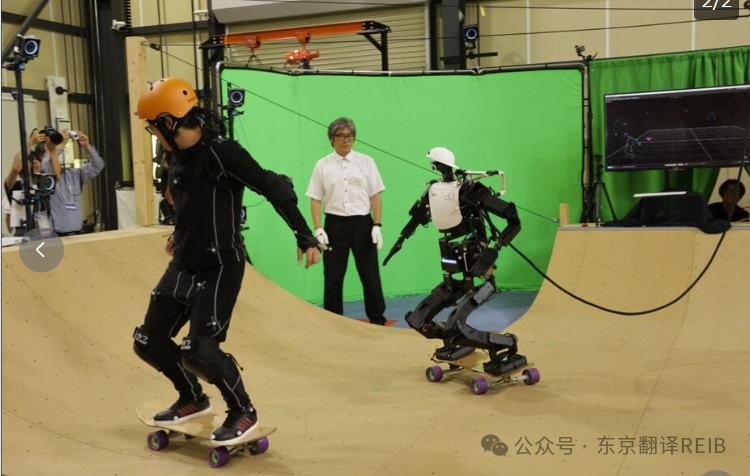
During the demonstration, a humanoid robot, standing 152 cm tall and weighing approximately 40 kg, rode a skateboard on a simulated sloped surface, autonomously performing a zigzag Slalom maneuver. Throughout the motion, the robot adjusted its upper body and center of gravity in real-time, smoothly navigating multiple turns, and the entire process closely replicated the movement patterns of human skating.
✅ Application Directions
Caregiving robots, sports rehabilitation, and robotic motion control in complex environments.