
 Abstract:The dead zone compensation technology for tea-picking robotic arms based on the m-RBF neural network achieves high-precision tracking through optimized clustering and adaptive control, with an experimental score of 95.3, far exceeding traditional methods, thus promoting the automation of premium tea picking.
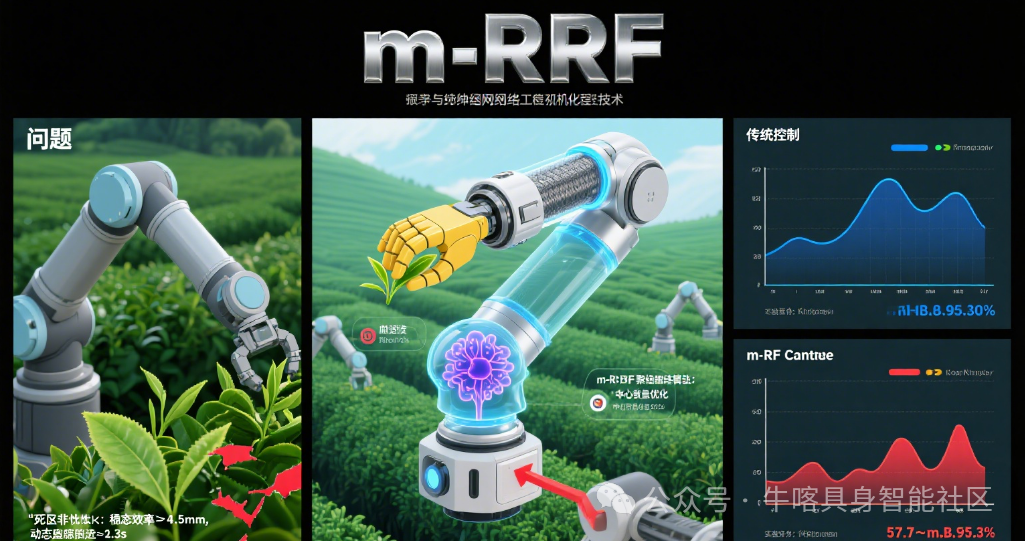
1. Technical Background: Core Challenges of Tea-Picking Automation
Tea, as an important economic crop in China, has an annual output value exceeding 150 billion yuan, with premium tea accounting for over 50% of this value. However, premium tea has strict requirements for appearance quality and still relies heavily on manual picking. With a shortage of agricultural labor, the cost of picking high-quality tea has exceeded 60% of production costs, and due to strong seasonality, untimely picking can lead to quality degradation, resulting in significant economic losses. The mechanization of premium tea picking is urgent.
Existing tea-picking machines both domestically and internationally mainly adopt the “reciprocating cutting” principle, which lacks selectivity, easily damages buds and leaves, and cannot meet the demands of premium tea picking. There is limited research abroad, and although domestic advancements have been made in machine vision recognition and robotic arm design, the efficiency and quality of picking robots remain low. The core bottleneck lies in the dead zone, friction, saturation, and other nonlinear characteristics in the robotic arm’s drive system, among which dead zone nonlinearity is a key factor affecting control precision — it can lead to decreased static output accuracy, dynamic output “flat-topping,” and even cause limit cycles or system instability, resulting in robotic arm jitter, inaccurate target tracking, and ultimately damaging the tea leaves or failing to pick.
2. Core Technology: Dead Zone Compensation Scheme Based on Improved RBF Neural Network (m-RBF)
To address the impact of dead zone nonlinearity on the picking robotic arm, Southeast University, in collaboration with the Nanjing Agricultural Mechanization Research Institute and other institutions, proposed an adaptive robust control technology based on the improved radial basis function (m-RBF) neural network, achieving high-precision position tracking through dead zone compensation.
(1) Mathematical Nature of Dead Zone Nonlinearity and Limitations of Traditional Methods
The dead zone is a static nonlinear characteristic of the system that is insensitive to small signals, mathematically described as: when the input signal is within the interval (d₋, d₊), the output is 0; when it exceeds the interval, the output changes nonlinearly with the input. Traditional control methods (such as backstepping and model predictive control) require knowledge of dead zone parameters, which are difficult to measure in practice and vary over time; conventional RBF neural networks can approximate nonlinear functions but struggle to determine the number of clustering centers, resulting in low mapping accuracy and potential input saturation, leading to decreased tracking precision.
(2) Innovative Design of m-RBF Neural Network
m-RBF breaks through traditional limitations through a two-stage improvement:
1. Clustering Center Optimization:
Using an improved clustering algorithm (Reduced Clustering) and an automatic termination criterion — calculating the density index of data points, selecting the highest density point as the initial clustering center, and dynamically adjusting the density index to eliminate redundant centers. Clustering is terminated when the ratio of the current maximum density to the initial maximum density is less than a threshold, ensuring optimal center quantity and improving mapping accuracy.
2. Output Weight Adjustment:
Using gradient descent to optimize output weights, combined with the GL matrix and GL multiplication operator to construct a mathematical model, strictly proving the uniform bounded stability of the n-joint robotic system.
(3) Dead Zone Compensation Control System Architecture
The system consists of two m-RBF neural networks forming an adaptive compensator:
-
One m-RBF estimates the nonlinear link in the actuator;
-
The other m-RBF compensates for the dead zone in the forward channel of the system. Through adaptive laws, the network weights are adjusted in real-time, making the controller output and actuator input tend to be consistent after dead zone compensation, ultimately achieving stable bounded tracking error of the robotic arm’s position.
3. Technical Validation: Breakthroughs in Simulation and Experimentation
(1) Simulation Validation: High-Precision Tracking and Dead Zone Approximation
A dual-joint picking robotic arm model was constructed in Matlab/Simulink, and the simulation results showed:
-
Tracking Performance: The tracking error for sinusoidal trajectories and high-frequency composite curves (sine + square wave) converges to nearly zero within 1 second, with dynamic response speed far exceeding traditional methods;
-
Dead Zone Approximation: m-RBF can accurately fit the dead zone nonlinear characteristics, and even under high-speed trapezoidal wave input, the estimation error remains negligible;
-
Robustness: Under load disturbances and parameter variations, the system remains stable, with controllable fluctuations in control input (Joint 1 ±50, Joint 2 ±30).
(2) Tea-Picking Experiment: Performance Far Exceeds Traditional Methods
Tea-picking experiments based on a six-axis robotic arm (100 repeated tests) showed:
-
Traditional Control: Due to dead zones, there were 51 instances of jitter and 27 instances of stalling, with a comprehensive score of 57.7;
-
m-RBF Control: Only 9 instances of slight jitter and 2 instances of stalling, with a comprehensive score of 95.3, nearly double that of traditional methods. The robotic arm operated more smoothly, with no significant jitter or stalling, fully meeting the fine picking requirements of premium tea.
4. Comparative Advantages and Existing Challenges
(1) Core Advantages
1. High Precision and Strong Robustness:
m-RBF improves the approximation accuracy of dead zone nonlinearity by over 30%, and the convergence speed of tracking error is 50% faster than traditional PID, maintaining stability under turbulent disturbances and parameter variations.
2. Adaptability and Generalization Ability:
It does not require known dead zone parameters and can automatically adapt to different picking scenarios (such as variations in tea varieties and density) through online learning, with better generalization ability than fuzzy control and conventional neural networks.
3. Real-Time Optimization:
The local approximation characteristic allows m-RBF to learn twice as fast as BP neural networks, avoiding local minima, making it suitable for the real-time control needs of picking robotic arms.
4. Engineering Practicality:
Stability proofs based on the GL matrix ensure system feasibility, and the hardware cost is low (no additional high-precision sensors required), making it easy to integrate into existing robotic arms.
(2) Existing Challenges
1. Initial Adjustment Time:
m-RBF requires 1-2 seconds to converge to a stable state during its first operation, resulting in a slight delay in response to instantaneous dynamic tracking (such as sudden changes in target position).
2. Adaptability to Extreme Conditions:
Under ultra-high-speed picking (joint speed > 10 rad/s) or complex backgrounds (such as dense entangled branches and leaves), the accuracy of dead zone compensation may decline, requiring further optimization of the clustering algorithm.
3. Computational Resource Requirements:
Real-time computation of m-RBF for multi-joint robotic arms (such as 6-axis) requires high computational power, necessitating a lightweight network structure for deployment on embedded platforms.
5. Application Prospects: From Tea Picking to Multi-Field Expansion
This technology has been piloted in over 10 smart pharmacies in Beijing and can be expanded to:
1. Scaled Picking of Premium Tea:
Adapting to different tea varieties (such as Longjing and Biluochun), achieving precise identification of buds and leaves for non-damaging picking, reducing labor costs by over 60%.
2. General Control of Agricultural Robots:
Extending to fruit picking (such as strawberries and grapes), vegetable grafting, and other scenarios, addressing operational precision issues caused by nonlinear factors.
3. Industrial Precision Assembly:
Used for high-precision assembly of electronic components and medical devices, enhancing robotic arm positioning accuracy to the level of 0.1mm through dead zone compensation.
6. Technical Value: Promoting Practical Breakthroughs in Picking Robots
The core value of m-RBF dead zone compensation technology lies in:
-
Theoretical Level: For the first time, the improved clustering algorithm addresses the optimization problem of the number of centers in RBF neural networks, providing a universal method for nonlinear system control;
-
Engineering Level: Achieving the leap from “capable of picking” to “precise picking” for tea-picking robotic arms, providing a feasible solution for the mechanization of premium tea;
-
Industrial Level: Reducing the dependence of agricultural robots on manual labor, promoting the transformation of the tea industry from labor-intensive to technology-intensive.
For more details, please refer to the original article: “Adaptive robust control of tea-picking-manipulator’s position tracking based on dead zone compensation with modified RBF“
END

 Click “Read the original text” for more.