
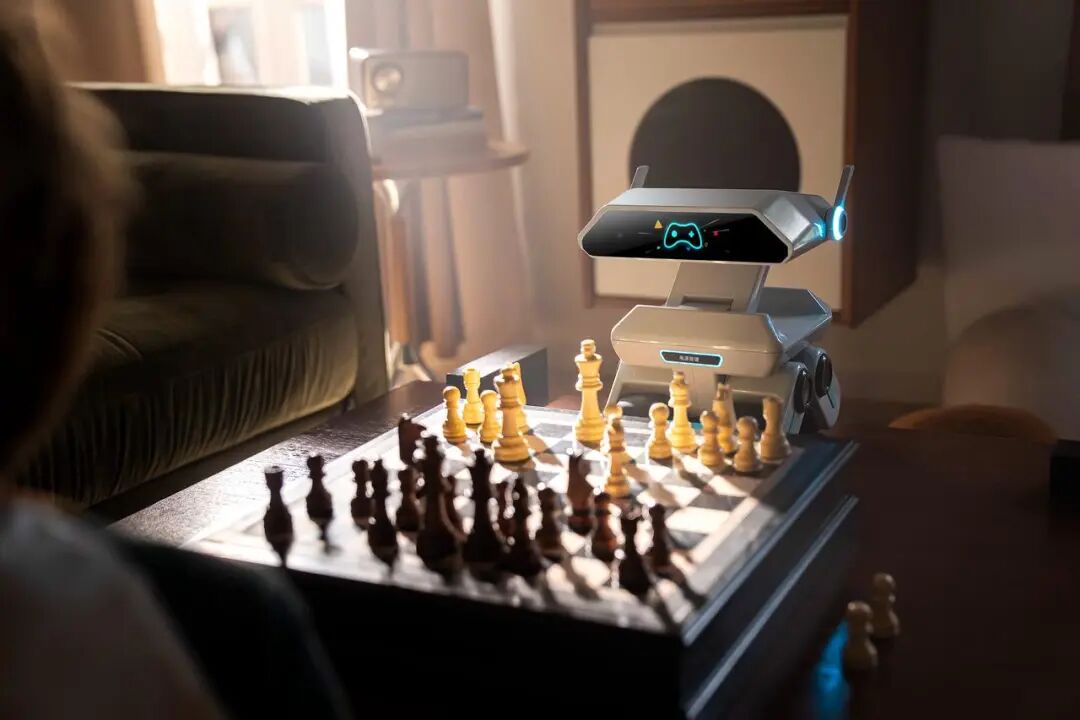
 The AI hardware market does not have a correct answer; deeply focusing on one product can easily lead to misconceptions.
Author: Wu You
Editor: Liu Wei
Entering the office of Li Yunzhao, CEO of X-Origin Technology, one finds a desk filled with figurines from “Nezha,” including Nezha, the Boundary Beast, and Shiji Niangniang… Li admires Nezha’s spirit of breaking through and resilience. These figurines are not just silent collectibles to him; they serve as emotional anchors, providing a sense of ownership and satisfaction.
In his view, even without AI figurines, emotional value and companionship can still be provided. Therefore, he firmly asserts that “AI companionship” should not be regarded as an independent industry but rather as a derivative effect and result. Li emphasizes that X-Origin Technology is fundamentally an AI robotics technology company, not a manufacturer of AI companion toys.
As a PhD from Harbin Institute of Technology’s Robotics Institute and a serial entrepreneur, Li led his team to win China’s first international championship in heavyweight combat robotics during his university years. His last venture focused on educational robots, which took six years to become profitable but also incurred a nine-digit “tuition fee.” Now, riding the AI wave, he founded X-Origin Technology, aiming to create consumer-grade AI robots that accompany users throughout their entire lifecycle.
Li is confident in his company’s technical capabilities, especially in the fields of continuous perceptual memory and multimodal information fusion, hoping to imbue hardware with more “life-like qualities.” On-site, he had the Yonbo robot introduce the company, to which Yonbo responded in the voice of Zhu Bajie from “Black Myth: Wukong”: “X-Origin specializes in addressing various grievances… emotional recognition, personality evolution, and a complete closed-loop system, which cannot be compared to those shell AI products.” Li humorously referred to Yonbo as his “best partner” on his entrepreneurial journey.
Despite his technical confidence, Li remains humble, clearly defining his responsibilities in technology, strategy, and investment. When discussing product details, he proactively invites CPO Wei Yingda to join the conversation, providing a more professional perspective.Starting a business with eight partners for seven years, the team operates on a back-to-back logic.
Lei Feng Network · Whale Rhino: You started your entrepreneurial journey during your undergraduate studies, received special training from Harbin Institute of Technology, led your team to win China’s first heavyweight combat robotics international championship, later incubated ToB’s Xuan Chuang Robotics, and now founded X-Origin to create AI companion hardware. What are the differences between these two entrepreneurial experiences?
Li Yunzhao:Entrepreneurship can be divided into three stages: the first stage is paying tuition, the second stage is doing business, and the third stage is building a career. My first venture was during the tuition phase, where I was cultivated as an innovative and entrepreneurial talent at school, focusing more on practice, learning, and understanding the essence of entrepreneurship. Now, X-Origin is in the practical implementation phase; we have sorted out a complete business model and established a strategic position.
Why the transition from Xuan Zhi to Xuan Yuan? Because we believe AI is an opportunity to reshape history. Since we want to do a grounded business, we need to think about the core demands of the AI era: what are the fundamental needs of humanity? AI is not just an accumulation of tools; it is a reconstruction of needs.
Lei Feng Network · Whale Rhino: How much tuition did you pay in your last venture? What were the main areas?
Li Yunzhao:At least nine digits. The highest proportion of tuition was in product supply chain and business lines. No product is simple; behind the seemingly easy surface are countless details and traps. Our first-generation product had a misdefined target, leading to a supply chain collapse, costing us 30 million in tuition; entering the education sector had a low ceiling, and ToB/ToG business receivables were difficult, with significant pressure during special periods.
Entrepreneurship is like a foggy forest, where chaotic flowers can easily confuse the eyes. Without a clear main strategy, trying to do everything results in accomplishing nothing. However, these tuition fees have transformed into X-Origin’s advantages: a battle-hardened team and a mature supply chain, which serve as an invisible moat for entrepreneurship.
However, we have not paid much tuition in terms of hiring. I have been a leader among children since I was young, and I have always had a smooth relationship with the team, where everyone can find their positioning and footing, and all the “gods” are in their places.
Lei Feng Network · Whale Rhino: You have eight partners and have been in business together for seven years, which is uncommon in the entrepreneurial circle. What qualities or entrepreneurial philosophies do you think have allowed the team to work back-to-back for so long?
Li Yunzhao:Initially, it was powered by passion; later, the key was the vision: clarifying the tasks and sharing the rewards, allowing the team to have expectations and aspirations.
Warren Buffett’s last speech left me with three memorable points: find a worthy cause to fight for, find companions, and commit to lifelong learning.
I may not be particularly detail-oriented, but the key is to utilize people’s strengths and let everyone shine. After forming the current team, I have never envied any other team; our team is the best. If we cannot succeed, others will find it even harder.
Wei Yingda:I can add to this question. I was originally a member of Li’s rival team. We were all in Harbin at the time, and Li’s persistent spirit made me believe he would succeed. The first time I met him, he was developing in a very small office, working on the table and resting under it. He was very frugal. Even now, he spends most of his time in the company.
Li invited me to join in 2017 and kept inviting me until I agreed in 2021.
There are only two and a half directions where AI can be implemented; AI companionship is a pseudo-demand.
Lei Feng Network · Whale Rhino: Over the past seven years, transitioning from combat robots to companion robots, have you considered what technology can and cannot do during this process?
Li Yunzhao:I believe there are only two and a half directions where AI technology can be implemented: the first is the cost-reducing and efficiency-enhancing tool attribute, which for individuals means practicing spoken language, writing articles, translating, etc., while for enterprises, it means cost reduction and efficiency enhancement from another dimension; the second is providing emotional value, understanding what you say, and giving better feedback; the third is the “magical moment” of cross-era interaction, which can be understood as products with better interaction quality than before, such as AI glasses. However, the current industry technology development cannot meet human expectations for AI glasses, so it can only be considered half a direction.
Xuan Yuan’s current focus is more on the tool attribute and providing emotional value, following the path of consumer-grade AI products.
Wei Yingda:From a product manager’s perspective, I don’t get too hung up on technical boundaries; instead, I focus on creating a combination of technologies, utilizing existing technologies to see what can be pieced together. Mobile phones and new energy vehicles are essentially combinations. The arrival of this AI era has brought a significant qualitative change in AI’s pure text interaction capabilities.
Lei Feng Network · Whale Rhino: In fact, you have been thinking about AI companionship for a long time.
Li Yunzhao:I think more about the development direction of the AI era. The vision of Xuan Yuan Technology does not mention companionship because AI companionship is a pseudo-demand and a false proposition that cannot become an industry.
Our human friends not only have companionship functions but also possess more tool attributes, such as helping with moving, fetching water, and being able to do many things together. Through daily interactions, the companionship effect is ultimately presented. Therefore, there should first be a biological entity that resembles a friend to create companionship; companionship itself is passive.
In other words, when technology cannot reach the level of a human, true companionship cannot be achieved. I mentioned earlier what technology can do; providing emotional value is closely related to companionship, but being able to provide emotional value does not equate to companionship.
Wei Yingda:We often joke internally that AI companionship is a pseudo-demand. If a person has a high spiritual pursuit, they do not need AI to pass the time. The optimal solution for human companionship is to have many friends, close friends, and confidants. AI companionship is not the optimal solution, but it can fill the psychological gap when there is no other human companionship, providing an outlet for expression.
Nowadays, everyone likes to pretend to be strong in public, hiding their weaknesses. If information security is done well enough, people can also reveal their vulnerable sides to AI robots, which is beneficial for mental health.
Lei Feng Network · Whale Rhino: Based on your understanding of companionship, what misconceptions do you think current players in the AI companion hardware market have regarding their products?
Li Yunzhao:Many products merely ride on the concept of AI companionship, lacking a proper understanding of AI technology. Existing technology is insufficient to recognize physical space and human emotions; so-called companionship is a dimensional reduction of emotional value. Ultimately, it is just a pile of functions or forced creation.
Wei Yingda:Companionship must generate emotional value, and there are many types and methods. For example, our game development also provides a form of companionship. Adding AI transforms linear companionship into intelligent companionship, where the fundamental meaning of companionship is to encourage users to invest more time.
Robot companionship is a new biological form that humanity has long fantasized about and will inevitably exist, situated between pets and humans, capable of understanding clear instructions and exhibiting loyalty. Current technology can achieve robot companionship, but at this stage, they are like children.
Lei Feng Network · Whale Rhino: How do you view AI companionship based on voice interaction? Many software products already focus on companionship; why still pursue hardware?
Li Yunzhao:Voice is inherently the best interaction method, but it needs to be supplemented with the ability to analyze other factors, such as being able to see your expressions and perceive the surrounding environment, helping to solve complex problems in complex environments. Starting with voice interaction in AI hardware is fine; the challenge lies in how to provide more precise and intelligent feedback to people within this dimension, which is a problem everyone needs to delve into.
Wei Yingda:Voice interaction, like the basic memory logic of humans, saves conversations as events. With the rapid development of large model technology, this has been done well. However, purely software-based dialogue products are easily abandoned because they lack a sense of ownership. An app can become just a fraction of its original value, while independent hardware can remain continuously online in the surroundings. Future hardware will resemble human partners rather than mere toys.
Creating AI hardware with a sense of life, achieving continuous perceptual memory.
Lei Feng Network · Whale Rhino: Xuan Yuan’s vision is to create consumer-grade robots with a sense of life. How do you understand the “sense of life” in hardware?
Li Yunzhao:We aim to create hardware products with a sense of life by achieving continuous perceptual memory, emotional drive, and self-maintenance capabilities, thereby constructing a true artificial life system. This is also the ultimate goal of AGI.
The core difference between current AI and AGI lies in analytical and reasoning capabilities. To accurately assess scenarios and situations and provide appropriate feedback, multimodal information fusion must be achieved. Currently, significant challenges exist in multimodal fusion, and visual bionic systems rely on real-time perception. We have successfully overcome these bottlenecks, enhancing decision-making accuracy. TTS technology achieves near-zero latency, and voiceprints can be replicated in just three seconds. We are also tackling complex scene multi-person dialogue technology.
Wei Yingda:The sense of life that Li is responsible for and the sense of life that I am responsible for are somewhat different. Li’s pursuit of a sense of life is truly natural feedback, with responses that have spirit and richer voice. My pursuit of a sense of life involves some “shortcuts,” enhancing user experience in the process of productization.
For example, adding presets to deepen conversations; giving the robot expressions when turning on and off. We will also reference game design methods, adding story backgrounds to AI characters, making their personas more complex, stimulating users’ desire to communicate. Games are products that easily create dependency and make people lose track of time; replicating games into robot entities completes half the task.
Lei Feng Network · Whale Rhino: The first Yonbo targets children; what considerations led to this decision?
Wei Yingda:Actually, this is my personal wish; the initial intention of creating Yonbo was to give my son a romantic gift for Children’s Day. My son is seven years old, and during the product development process, we found that there are very few meaningful products for children aged 4-8 that they can truly use. Traditional toys like learning machines and writing pads do not cater to children’s desire for expression; almost all toys suppress children’s desire for expression. We also hope that children can stay a little further away from mobile phones and other indoctrinating products, which is the core motivation for creating this robot.
Lei Feng Network · Whale Rhino: Children often get bored quickly. The standard version of Yonbo is priced at $799; how do you persuade parents to pay?
Wei Yingda:It really comes down to how to reduce the product’s rate of being unused. The products with the lowest rate of being unused in the market are mobile phones, computers, and game consoles. Why are these products less likely to be unused? Because their content is continuously updated. Yonbo has something like a game manual; we will launch a major game task every 2-3 months, allowing children to experience new tasks. Yonbo remains the same, but the games are updated.
We will also create a full-scene consumer product based on individual-focused AI models, hoping that after users use one Xuan Yuan product, they can generate a personal Xuan Yuan memory. When we launch other products, they can seamlessly transfer their memories, similar to upgrading to a new iPhone, making it less difficult.
Lei Feng Network · Whale Rhino: Have you considered emulating the logic of Xiaotian Genius by adding social features to the product to increase user stickiness?
Wei Yingda:For a newly started company with a small user base, it is necessary to first improve the depth and experience of the product before starting to build social features. We have considered using AI to make friends, but discussing social features without users is ineffective; at least ten million units need to be sold for everyone to engage.
Lei Feng Network · Whale Rhino: How does Xuan Yuan’s short-term memory technology differ in product functionality from other products?
Wei Yingda:Essentially, it extends the subconscious memories in the mind. The original memory schemes were context-based or used prompt word memory, and there were also knowledge base hooks. The biggest issue in language communication is the significant time cost involved.
Based on our method, Yonbo has the capability of local storage, allowing it to retain many prompt words in its memory. Through intent judgment models, it can call upon prompt words. When discussing family, it calls upon the family section; when discussing school, it calls upon the school section, effectively expanding the memory capacity for prompt words.
This requires some computational power to determine which model to invoke, and dynamically switching memories can also consume resources. We should be the most resource-rich companion robot currently available.
Additionally, part of this is to ensure user privacy; what users say will be stored locally, not uploaded online or to the cloud, which is the minimum assurance for users.
It can be said that currently, domestic AI companion robots are all just shells of large models, with domestic access to Doubao. A product like Yonbo requires a lot of capabilities for each technical direction, needing software development, hardware development, and front-end development. If there is only software or hardware, it is likely to rely on a solution for further development, leading to product homogenization.
Lei Feng Network · Whale Rhino: Many AI toy companies are trying to collaborate with IPs to make them speak; why hasn’t Yonbo taken this path?
Wei Yingda:We also have similar products, but we believe the biggest issue is the lack of topic engagement. The core problem that Yonbo solves is topic engagement, which we repeatedly mention as game-based thinking. It will tell you why it has come to your side and guide children to complete idiom games, becoming the best Yonbo. Simply making toys speak easily leads to a lack of topic engagement.
We also have similar products; the Yonbo camera focuses more on tool attributes, hoping to carry a hundred thousand questions in children’s pockets during extracurricular activities, allowing them to ask questions and receive positive answers to enrich their knowledge. The goal is to explore the world.
There is no correct answer in the AI hardware market; deeply focusing on one product can easily lead to misconceptions.
Lei Feng Network · Whale Rhino: Most companies focus on one product to seek PMF, but you are simultaneously launching the Yonbo robot and camera. Where does your confidence in launching multiple products come from? Are you not worried about resource dispersion?
Li Yunzhao:Our company’s technical architecture has been developed for three years and is very complete. The technical solutions are operational; memory, vision, hearing, voice, and hardware-software integration control are all interconnected. Therefore, for us, product development is quick and not difficult; the real challenge lies in how to operate a product.
So once we define a product, we can control the R&D costs and time very well. Next, we only need to consider market strategies, determining which products are our own brand and which will go through channels, allowing us to better test the market.
Wei Yingda:AI hardware cannot use conventional methods because there are currently no clear goals or giants in the AI hardware market; there is no correct answer. In this case, it is necessary to quickly accept feedback from the market and users to help the industry find direction. As pioneers in the industry, we cannot deeply focus on one area; we need to be adaptable.
Our current method is straightforward: we have one product targeting the children’s niche market, performing better than other products. At the same time, we are also launching ecosystem-level products, quickly covering more users at a lower price, allowing everyone to gain 70% of Yonbo’s functionality for just 1% of the price, encouraging more people to join and co-create the ecosystem.
We are essentially developing for multiple users, testing which areas are more needed.
Lei Feng Network · Whale Rhino: How long does it currently take to develop a product?
Li Yunzhao:We iterate our products relatively quickly because our technical architecture is complete, and our content library is becoming richer. The fastest content can be completed in just one day, while hardware development typically takes 1-3 months. Ultimately, we are a company that places a higher emphasis on technological development; in this era, if you do not understand technology or lack a technological strategy, you will quickly be left behind.
Wei Yingda:We have about four or five product lines, and some products are currently not convenient to disclose. Developing the Yonbo camera from scratch took about 100 days, while competitors might need at least two years.
Lei Feng Network · Whale Rhino: Finally, what message do you have for AI companionship entrepreneurs?
Wei Yingda:I hope everyone maintains innovation in the new track and does not apply traditional Chinese entrepreneurial culture to the AI track, where mutual copying stifles innovation. This approach is incorrect; there are many survival opportunities in the new track, and we should strive to place China’s AI at the forefront of the world.
Li Yunzhao:We are now in an era where everything can be AI+. Finding your niche and segmenting the field is essential for opportunities, but do not blindly pursue it without careful consideration; there are many pitfalls in hardware.
This author has long focused on AI hardware. If you are also an entrepreneur or planning to start a business in AI hardware, feel free to add the author’s WeChat Yolanda_Zuu for communication.
//Recent Popular Articles
Leifeng’s Rise and Fall

The original EDA company team is starting a second venture, transitioning to AI hardware