Click the blue text
Follow us
The CAN bus and I2C are two common serial communication protocols, each with its advantages in different application scenarios. Below are their main features and differences:
CAN Bus (Controller Area Network)
Features:
1. Multi-master communication: The CAN bus allows multiple nodes to send data simultaneously, using an arbitration mechanism to determine which node can send data.
2. High reliability: The CAN bus has error detection and automatic retransmission mechanisms, making it suitable for use in harsh environments.
3. High anti-interference capability: The CAN bus uses differential signaling for transmission, providing strong resistance to interference.
4. Real-time capability: The CAN bus is suitable for applications with high real-time requirements, such as automotive electronics and industrial control.
5. Data frame format: The CAN bus data frame includes standard frames and extended frames, with extended frames supporting longer IDs.
Application scenarios:
Automotive electronic systems (e.g., engine control, body control, etc.)
Industrial automation
Medical devices
I2C Bus (Inter-Integrated Circuit)
Features:
1. Master-slave communication: The I2C bus is typically controlled by one master device, with other devices acting as slaves.
2. Simple and easy to use: The I2C bus requires only two wires (SDA and SCL), making hardware and software implementation relatively simple.
3. Low speed: The I2C bus is generally used for low-speed data transmission, suitable for short-distance communication.
4. Multi-device connection: The I2C bus supports multiple device connections, with each device having a unique address.
5. Data frame format: The I2C bus data frame includes start bits, address bits, data bits, acknowledgment bits, and stop bits.
Application scenarios:
Communication with sensors and peripherals in embedded systems
Consumer electronics (e.g., smartphones, tablets)
Home appliances
Main Differences:
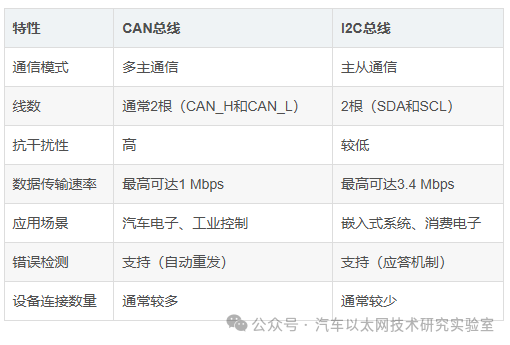
The CAN bus is suitable for scenarios requiring high reliability, real-time performance, and anti-interference capabilities, such as automotive and industrial control.
The I2C bus is suitable for scenarios requiring simple, low-cost, short-distance communication, such as embedded systems and consumer electronics.

*Disclaimer: This article is original or forwarded by the author.If any party’s intellectual property rights are inadvertently infringed, please inform us for deletion.The above images and text are sourced from the internet; if there is any infringement, please contact us in a timely manner, and we will delete it within 24 hours.The content of the article represents the author’s personal views, and the Automotive Ethernet Technology Research Laboratory reposts it only to convey a different perspective, which does not represent the Automotive Ethernet Technology Research Laboratory’s endorsement or support of this view. If there are any objections, please feel free to contact the Automotive Ethernet Technology Research Laboratory.
Original link:
https://blog.csdn.net/qq_35273182/article/details/142833600