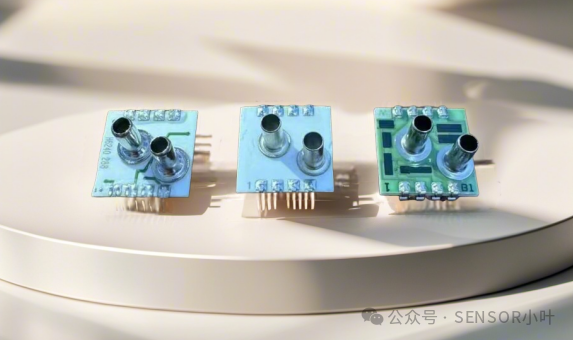
In the article titled “Low Pressure Sensor SRT3000 Driven by Constant Current Source“, the basic parameters of the SRT3000 pressure sensor were introduced. In this issue, I will continue to provide a brief introduction to several common parameters of the SRT3000 pressure sensor, as understanding these parameters helps us accurately select the appropriate sensor for design requirements.
1) Medium Compatibility
Medium compatibility refers to the medium that comes into direct contact with the sensitive area of the sensor, which is generally a liquid or gas. The SRT3000 pressure sensor is compatible with dry, non-corrosive gases. An important point is that the medium must not corrode the sensing diaphragm and the chip casing, as this could lead to reliability issues with the sensor. Each model may have different medium compatibility, and typically, for harsher environments, such as gases that may be corrosive, products with a metallized sensing diaphragm are chosen.
2) Rated Pressure Range
The rated pressure range defined by the pressure sensor specifications indicates the maximum pressure value, which guarantees the normal operation of the pressure sensor. This pressure value defines the full-scale output value of the sensor. Within this range, all specified indicators are guaranteed. Note that each sensor may have different nominal units due to factory calibration, and the SRT3000 pressure sensor is calibrated in mbar.
3) Overpressure Range
The overpressure range refers to the maximum pressure value that can be applied without damaging the performance of the pressure sensor chip. This should not be a regular application pressure value, as the output may already be saturated at this pressure.
4) Burst Pressure Range
The burst pressure value indicates the maximum pressure that can be applied without causing permanent damage to the sensor chip. This should also not be a regular application pressure value. After such a pressure event, it may be necessary to reassess the performance of the sensor.
5) Compensation Temperature Range
The compensation temperature range refers to the temperature range within which the sensor’s indicators can be guaranteed. In practice, this involves temperature drift compensation, and this range is closely related to the user’s application temperature range. For example, if you need the sensor to maintain the accuracy specified in the datasheet at a temperature of 50℃, you need to choose a product with a compensation temperature range above 50℃. The SRT3000 pressure sensor has a relatively wide temperature compensation range, set from -10° to 60°.
6) Zero Drift
Zero drift refers to the output value of the chip when no pressure is applied. It is usually expressed as a percentage of the full scale or in mV, mA, or digital bits. This drift can be easily eliminated during calibration, and it is especially important to perform zero drift calibration when replacing the sensor. The standard zero value for the SRT3000 pressure sensor is: 0.2mV.
7) Linearity
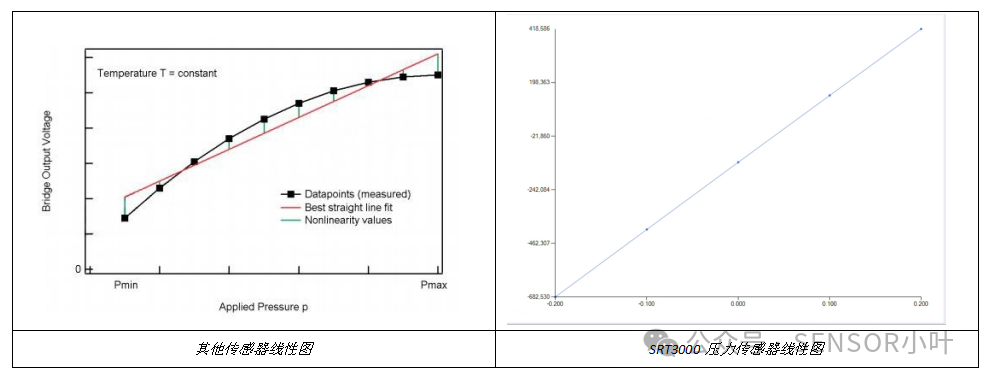
Linearity is a very important concept. Ideally, the output of the pressure sensor and the applied pressure should have a strict linear relationship. However, in practical applications, there may be some non-linear behavior between the output and the ideal line. Non-linear error is used to describe this deviation, and this value is usually calculated using the best fit line method. This is one of the important parameters for measuring error in pressure sensors.
This discussion ends here for this issue, and in the next issue, we will introduce the remaining key parameters.