1. First, let’s pronounce the name correctly, what exactly is RS?
RS = Recommended Standard, which translates to “recommended standard” and is not a patent of any company. The number following it is the version number:
-
232: Released in 1962, it’s the grandparent, mainly for computer COM ports;
-
422: Released in 1975, it’s the uncle, focusing on long distances;
-
485: Released in 1983, it’s the hot favorite, widely used in industrial sites.
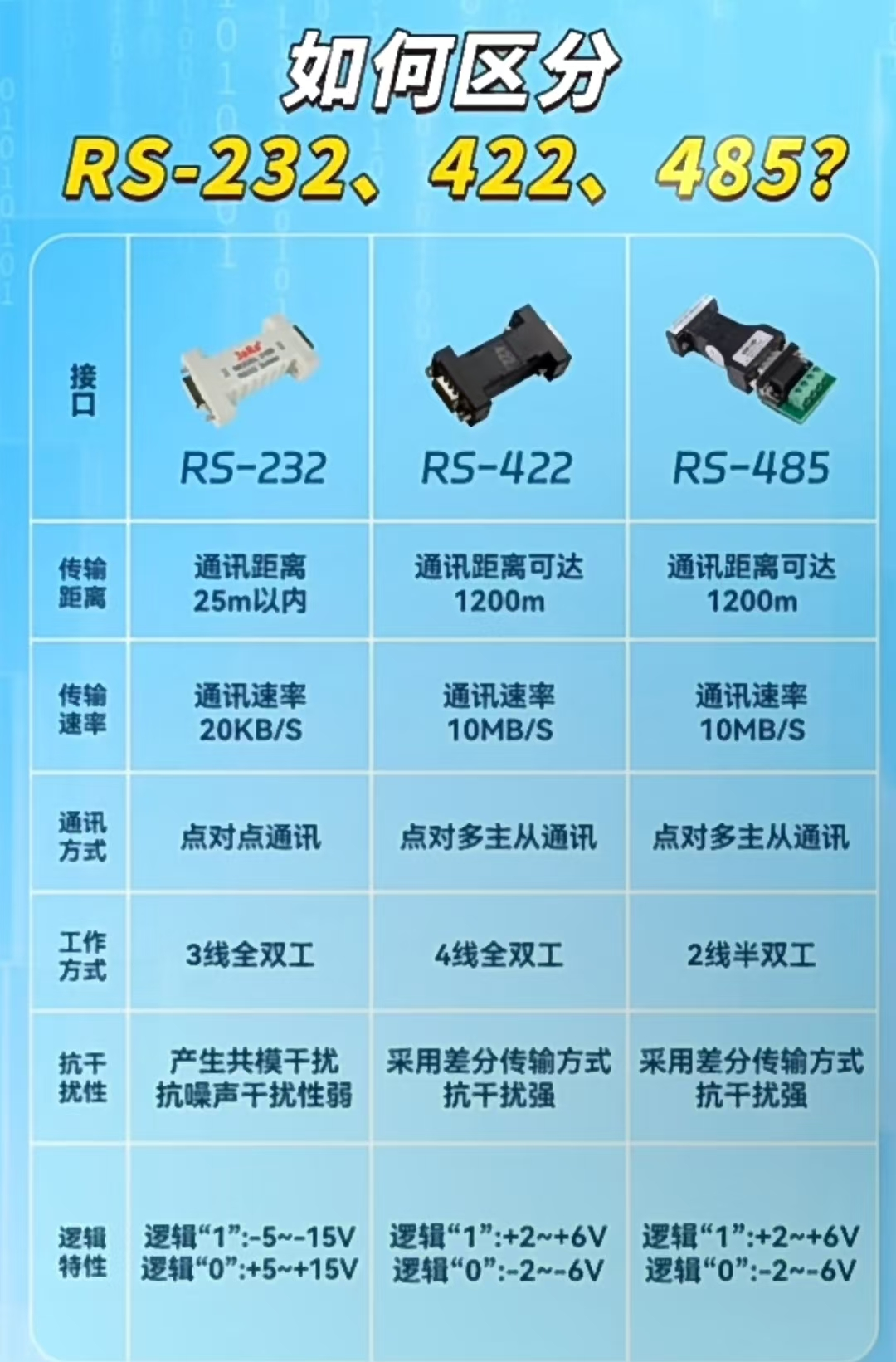
2. A table to quickly understand the 3 core differences
| Dimension | RS-232 | RS-422 | RS-485 |
|---|---|---|---|
| Maximum Distance | 25 m | 1200 m | 1200 m |
| Maximum Speed | 20 kbps | 10 Mbps | 10 Mbps |
| Communication Method | 1 to 1 (point-to-point) | 1 to 10 (master-slave) | 1 to 32 (master-slave) |
| Working Mode | Full duplex | Full duplex | Half duplex (can be full duplex) |
| Signal Lines | 3 lines (TX/RX/GND) | 4 lines (TX+/TX-/RX+/RX-) | 2 lines (A/B) |
| Interference Resistance | Weak (single-ended) | Strong (differential) | Strong (differential) |
| Typical Levels | ±5~±15 V | ±2~±6 V | ±2~±6 V |
Remember the mnemonic: 232 short distance, one-to-one; 422 long distance, one-to-ten; 485 even longer, one-to-thirty-two.
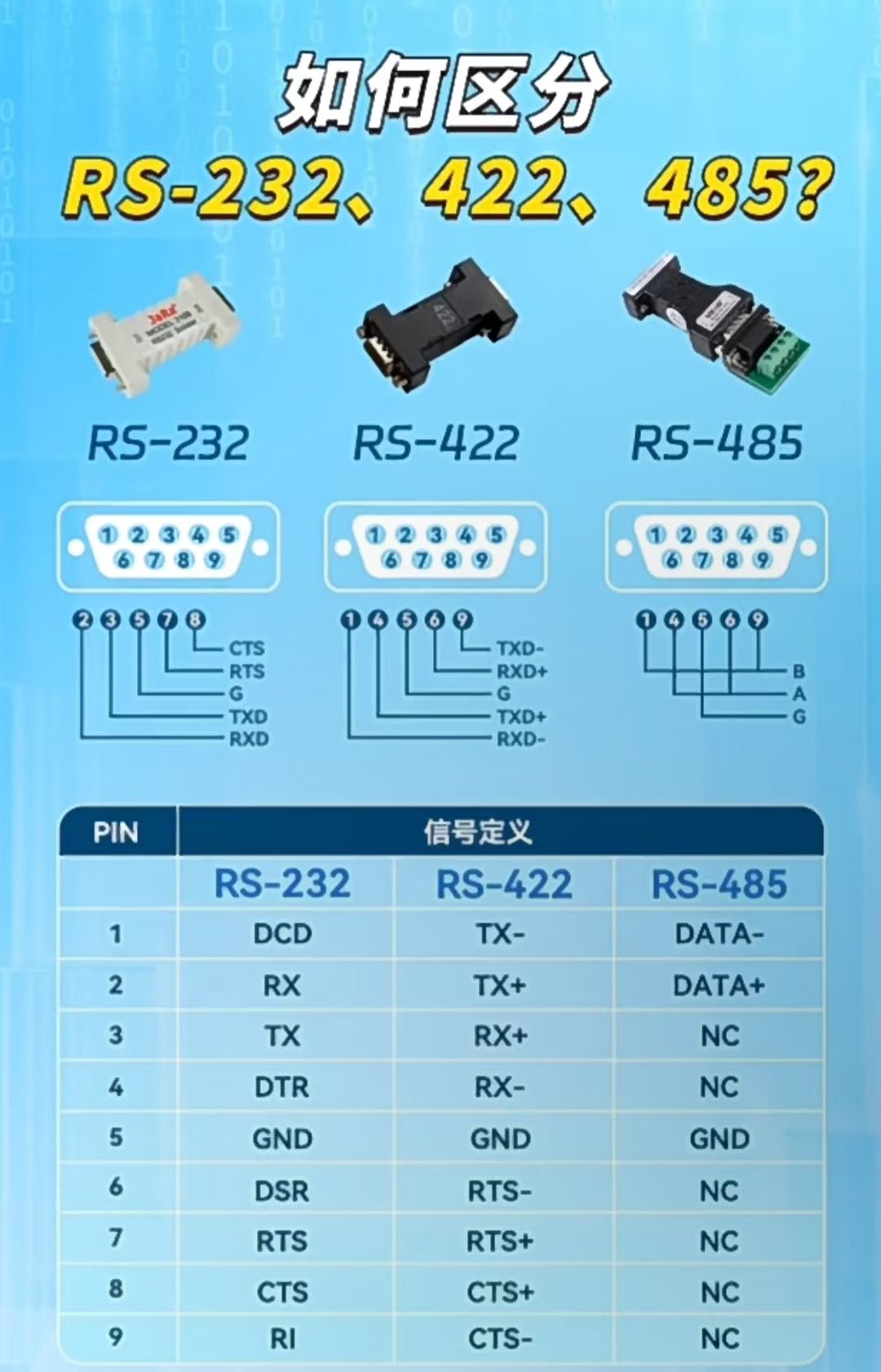
3. Dissecting the interface, what is hidden in the 9 pins?
Many people get confused when they see DB9, so let’s use a diagram:
| PIN | RS-232 | RS-422 | RS-485 |
|---|---|---|---|
| 2 | RXD (Receive) | TX- (Negative Send) | Not fixed |
| 3 | TXD (Send) | TX+ (Positive Send) | Not fixed |
| 5 | GND | GND | GND |
| 4/7/8 | Flow Control RTS/CTS | RX+/RX- | Unused |
Why does 485 only have 2 wires A/B, yet it can still work? The answer: differential! A-B ≥ +200 mV is logic 1, A-B ≤ -200 mV is logic 0. The two wires twisted together cancel out noise, greatly enhancing interference resistance.
5 Major Pitfalls on Site, Each One Costs You Dearly
-
Plugging 232 into a 485 port causes smoke 232 levels ±15 V, 485 chip withstand voltage ±7 V, plugging it in will cause immediate failure.→ Always confirm the interface definition before powering on.
-
Forgetting to add terminal resistors to the 485 bus 1200 m long line signal reflection at the end, causing data corruption.→ Place a 120 Ω resistor at both ends to solve the problem.
-
Reversing A/B connections All devices go offline, only one can communicate.→ Standardize colors: A=green, B=white, no more conflicts on site.
-
Connecting 232 three wires directly, with ground floating Two computers seem to connect, but actually lose 50% of packets.→ Ground must be common, don’t let the signal drift away.
-
Using 422 full duplex as 485 half duplex Result: master sends, all slaves go silent.→ Check the chip model: MAX485 is only half duplex, MAX491 is full duplex.
Selection Mnemonic: When the boss asks how to choose, one sentence to summarize
-
Within 3 meters of the computer: 232, cheap and easy;
-
Within 100 meters, one-to-one: 422, stable against interference;
-
Over 100 meters, one-to-many: 485, industrial standard;
-
Need full duplex and long distance: use 422 with optical isolation module, price triples, but stability is guaranteed.
A real case, a 485 bus saved the entire factory production line
Client site: 12 frequency converters, 800 m apart, Modbus RTU.Problem: Random disconnections every day, rebooting helps.Investigation steps:
-
Using an oscilloscope to check the waveform, found that the signal at the 800 m end was only 0.8 V;
-
Added a 120 Ω terminal resistor, signal increased to 1.5 V;
-
Replaced the main line with 0.75 mm² twisted shielded wire, signal directly at 2.8 V;
-
Added a 485 isolation module at the master station, common mode interference dropped from 2 V to 0.2 V.Result: Continuous operation for 3 months with 0 failures, the boss treated me to barbecue.
Don’t let 232/422/485 confuse you anymore. Remember the mnemonic: 232 point-to-point, 25 m; 422 full duplex, 1200 m; 485 half duplex, one-to-thirty-two. Next time someone asks on site, just throw this article at them!
If you find this useful, please like and share to help more industrial control people avoid detours~ More knowledge will be shared later, remember to follow!
 Previous Articles
6 Ladder Diagrams to Explain PLC from Beginner to Expert!
Only 1 hour? 4 classic cases of Mitsubishi FX series PLC from beginner to practical, learn and use immediately
9 Ways to Start and Stop with One Click Exposed! PLC Interview Killer Technique, the 9th method even veteran engineers haven’t seen
A Must-Read for Electrical Engineers! Comprehensive Analysis of Industrial Sensor Wiring Principles, No More Confusion After Reading
90% of Engineers Can’t Answer This, These 10 “Small Eyes” Are Quietly Deciding the Life and Death of Your Production Line
Revealing Electrical Components, Understand Common Electrical Component Symbols and Real Objects in One Diagram!
3 Minutes to Teach You How to Use Temperature Sensors with Frequency Converters!
Decoding Frequency Converter Panel Symbols, Don’t Press the Wrong Button! Understand in Seconds
18 High-Definition Pictures Every Electrician Must Know, One Diagram in Hand, Walk Confidently on Site!
Do You Know the 10 Common Frequency Converters? This Article Explains It All
Stepper vs Servo, Don’t Waste Money!
Yellow, Green, Red Power Lines + Thermal Relay + Button, Set Up Start and Stop in 3 Minutes!
Common Wiring Principles for Automated Assembly in 5 Diagrams = Electrician Salary Increase Secret
PLC Projects Can Be Up and Running in 3 Days with These 8 Frameworks!
Complete Explanation of 9 Ways to Start and Stop PLC, From “Only Knowing Self-Locking” to “Expert Skills”, Just This Article!
The Difference Between Electricians Earning 5000 and 15000 a Month Is Just 94 PLC Instructions
[Collectible] One Diagram Explains Frequency Converter Terminals! 90% of Electricians Have Fallen into These Pits, Today I’ll Explain It Clearly
PLC’s “Heartbeat” Only Takes Three Steps, Yet 90% of Engineers Are Blocked at the Door
One Diagram to Understand “Multi-Location Control”—Boss at the Front Desk, Electrician at the Machine Tail, Can Start and Stop the Motor with One Click!