
Intelligent Soft Robotic System Based on Triboelectric Multi-Sensor Fusion for High-Precision Object Recognition
Article Overview
Recently, Professor Hu Ning’s team from the School of Mechanical Engineering at Hebei University of Technology proposed an intelligent soft robotic system based on triboelectric nanogenerators (TENG). The research results were published in the internationally renowned journal Advanced Functional Materials under the title “Intelligent Soft Robotic System for Sensing and Recognition via Triboelectric-Based Multi-Sensor Fusion.” Original link: http://doi.org/10.1002/adfm.202517158. Professors Deng Qibo and Hu Ning from Hebei University of Technology, along with Dr. Chen Xin from ETH Zurich and Professor Mu Xiaojing from Chongqing University, are co-corresponding authors of the article. The first author is Associate Professor Gao Lingxiao, a young faculty member at Hebei University of Technology.
Soft robots, due to their structural flexibility and safe interaction characteristics, show great potential in fields such as precision manufacturing, medical rehabilitation, and human-robot collaboration. However, existing systems still face three main bottlenecks: first, limited sensing capabilities make it difficult to simultaneously acquire multimodal information such as pressure, material properties, and dimensions; second, insufficient environmental adaptability leads to unstable signal output under temperature, humidity, or complex stress conditions; third, recognition accuracy is limited, especially in real-time recognition of multiple categories of objects. At the same time, traditional sensors mostly rely on external power supply, which poses problems such as high energy consumption and complex wiring, limiting their application under self-powered conditions. Achieving self-powering, multimodal sensing, and high-precision recognition has become a key challenge in the intelligent development of soft robots. Therefore, developing a new sensing system that integrates self-powering, high sensitivity, and multi-information fusion not only helps enhance the adaptability and stability of soft robots under complex working conditions but also provides a new development path for their applications in intelligent manufacturing, rehabilitation medicine, and automated sorting.
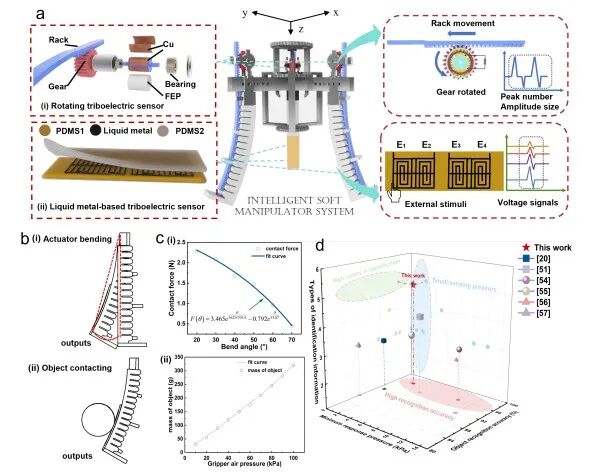
Construction process of the intelligent soft robotic hand system. a) Main hardware structure of the intelligent soft robotic hand: i) Structure and design of the rotating triboelectric sensor; ii) Structure and design of the liquid metal triboelectric sensor. b) Electrical signals generated by actuator motion: i) Signals from the rotating triboelectric sensor during the bending process of the actuator; ii) Signals from the liquid metal triboelectric sensor when the actuator contacts an object. c) Sensitivity response: i) Changes in contact force at different bending angles of the actuator; ii) Changes in the weight of objects that can be grasped under different inflation pressures. d) Comparison of this study with other intelligent soft robotic hand systems in sensor integration methods.
To this end, Professor Hu Ning’s team proposed an intelligent soft robotic system based on triboelectric multi-sensor fusion. This system integrates liquid metal triboelectric sensors and rotating triboelectric sensors into a three-finger flexible gripper, combined with a one-dimensional convolutional neural network (1D-CNN), achieving real-time recognition of 15 types of objects with an accuracy of up to 96.67%. Among them, the liquid metal sensor adopts a biomimetic fingerprint electrode structure, exhibiting excellent flexibility and stability, capable of simultaneously sensing contact position, area, material properties, and pressure information, with a minimum detectable pressure of only 2.5 kPa; the rotating sensor, based on a gear-rack structure, converts mechanical motion into electrical signal output, accurately measuring the bending angle of the gripper and the size of the object. Experimental results show that the signals from both types of sensors are highly complementary in multiple dimensions, significantly improving recognition accuracy after fusion. This research breaks through the dependence of traditional flexible sensors on external power supply and single signal modes, achieving multimodal sensing and high-precision object recognition under self-powering conditions for the first time. This achievement endows the intelligent soft robotic system with higher autonomous sensing capabilities and environmental adaptability, providing a new approach for applications in intelligent manufacturing, medical rehabilitation, and human-robot interaction.
In the future, the research team will optimize sensor packaging and signal compensation models, and introduce advanced machine learning algorithms (such as Transformers) to enhance the system’s intelligence level, promoting its application and industrialization in fields such as intelligent warehousing, automated sorting, medical rehabilitation, and human-robot interaction.
Produced by the Multimedia Center of the School of Mechanical Engineering
Editors | Zhao Tianzhu, Bai Qingyuan, Ran Xiongf
Editorial Board | Zhang Shengjia, Li Junjie, Liu Zezhen
Reviewers | Yang Zhanli, Wang Sudan, Shi Zhenyu
(Submission email: [email protected])