Detailed Explanation of Power Semiconductor Aluminum Wire Bonding Technology: From Principles to Applications
In the field of power semiconductors, aluminum wire bonding serves as the electrical connection bridge between the chip and external circuits, becoming a key process technology to ensure reliable transmission of large currents.
In modern power electronics technology, power semiconductor devices play a core role in energy conversion and control. Whether in the electric drive systems of new energy vehicles, industrial frequency converters, or the conversion devices of smart grids, the efficient operation of power devices such as IGBTs and MOSFETs is indispensable.
As a key process for internal connections in power semiconductors, aluminum wire bonding technology achieves electrical interconnection between chip electrodes and external terminals through simple metal leads, forming the foundation for the reliable operation of high-power devices.
______
1. Technical Principles of Aluminum Wire Bonding
Aluminum wire bonding is a solid-state connection technology based on the principle of ultrasonic welding. The basic process involves: using ultrasonic energy to cause the aluminum wire to undergo plastic deformation, allowing the atoms of the aluminum wire to diffuse with those on the surface of the chip pad under the combined action of pressure and ultrasonic vibration, forming a strong metal bond.
This connection differs from traditional fusion welding as it does not melt the material, but achieves atomic bonding in a solid state, effectively avoiding potential damage to the semiconductor chip from high temperatures.
Power semiconductor devices typically use wedge bonding, which includes several key steps: first, the aluminum wire is passed through a dedicated wedge tool to form the first bond point on the chip electrode; then, while the wedge tool moves to form a wire arc, the lead is drawn to the external terminal (such as a DBC substrate); finally, the second bond point is completed on that terminal, and the lead is cut.
Unlike ball bonding, in wedge bonding, the bonding direction of the lead is parallel to the ultrasonic direction, which not only increases the bonding area but also effectively ensures bonding strength.
A significant advantage of aluminum wire bonding is that it can be performed at room temperature, thanks to the good bondability of aluminum at ambient temperatures, avoiding potential damage to heat-sensitive semiconductor devices from heating processes.
2. Types of Aluminum Wire and Diameter Selection
1. Classification and Characteristics of Aluminum Wire
Based on composition, aluminum wire can be classified into several types, including pure aluminum wire, aluminum-silicon alloy wire, and aluminum-magnesium alloy wire. Pure aluminum wire has excellent conductivity but relatively low mechanical strength. To improve the mechanical properties of aluminum wire, alloying elements are often added:
-
Aluminum-silicon alloy wire (typically containing 1% silicon) is one of the earliest bonding wires used, with mechanical strength higher than that of pure aluminum.
-
Aluminum-magnesium alloy wire (typically containing 0.5% magnesium) significantly improves fatigue resistance while maintaining good conductivity, with an elongation of over 10% and a noticeable increase in breaking load.
It is worth noting that adding 0.5% magnesium mainly improves the mechanical properties of the aluminum wire, with minimal impact on electrical and thermal performance.
In recent years, new composite bonding materials such as aluminum-clad copper wire have emerged, which feature a layer of aluminum approximately 25-35μm thick wrapped around a copper wire, combining the bondability of aluminum with the high conductivity of copper.
2. Wire Diameter Specifications and Current Carrying Capacity
Aluminum wire can be divided into fine aluminum wire and coarse aluminum wire based on diameter:
-
Fine aluminum wire: with a diameter of less than 100μm (approximately 0.7-4mil), mainly used for low-power integrated circuit packaging.
-
Coarse aluminum wire: with a diameter range of 100-500μm (approximately 5-20mil), specifically designed for the high current demands of power semiconductors.
The current carrying capacity of coarse aluminum wire is significantly better than that of fine aluminum wire; for example, a coarse aluminum wire with a diameter of 500μm can carry approximately 23A of direct current. Although a 400μm copper wire can carry about 32.5A of current, aluminum wire remains the preferred choice in most high-power applications due to its cost advantage and mature technology.
The overcurrent capacity of aluminum wire of different diameters can be calculated using the commonly used “Preece equation”: I = A × D^1.5, where I is the fuse current (A), D is the wire diameter (inches), and A is the material constant (typically taken as 22,000 for aluminum wire).
Research shows that the length of the bonding wire is also an important factor affecting its overcurrent capacity—under the same diameter, the longer the bonding wire, the weaker the overcurrent capacity. Therefore, in power module design, it is necessary to optimize the routing path to minimize the length of the bonding wire.
The table below shows the relationship between common coarse aluminum wire diameters and their current carrying capacities.
| Diameter (inches) | Diameter (μm) | Approximate Current Carrying Capacity (A) |
|---|---|---|
| 5 | 127 | Approximately 5-8 |
| 8 | 203 | Approximately 10-15 |
| 12 | 305 | Approximately 18-25 |
| 15 | 381 | Approximately 25-30 |
| 20 | 508 | Approximately 30-40 |
Table: Relationship between common coarse aluminum wire diameters and current carrying capacities (compiled based on general application results)
3. Aluminum Tape Bonding Technology
To meet higher current demands, aluminum tape bonding technology has emerged. Compared to traditional round wire, aluminum tape has a larger cross-sectional area, which not only increases current carrying capacity but also effectively reduces skin effect during high-frequency operation.
Another advantage of aluminum tape bonding is its ability to reduce the thickness of the package, while its larger surface area also aids in heat dissipation, making it widely used in high-frequency, high-current working environments.
3. Why Power Semiconductors Require Aluminum Wire Bonding
1. Economic Efficiency and Process Maturity
Aluminum wire bonding technology is widely used in industry and is mature in process. Compared to gold wire, copper wire, and other bonding materials, aluminum wire has a significant cost advantage. For high-power modules that require a large number of bonding wires, reducing material costs is crucial for product competitiveness.
2. Electrical and Thermal Performance Matching
Power semiconductor devices generate a lot of heat during operation, so heat dissipation performance is an important consideration in the selection of bonding materials. Although aluminum’s electrical and thermal conductivity is not as good as copper, it is superior to many other metals, and its coefficient of thermal expansion (23×10⁻⁶K⁻¹) is relatively matched with semiconductor materials (such as silicon), reducing thermal stress accumulation.
However, the difference in thermal expansion coefficients between aluminum and silicon can still lead to long-term reliability issues. During power cycling, repeated thermal expansion and contraction can cause fatigue damage at the bonding points, ultimately leading to wire breakage or detachment of the contact surface.
3. Process Simplification and Reliability
A significant advantage of aluminum wire bonding is that it can be completed at room temperature without heating, simplifying the process steps and reducing the risk of thermal damage to the chip. Additionally, the naturally formed oxide layer on the aluminum surface can be easily disrupted under ultrasonic action, facilitating the formation of reliable metal bonds.
4. Application Fields of Aluminum Wire Bonding
Aluminum wire bonding technology is widely used in various power semiconductor devices, with the following being some major application areas:
1. Electric Drive Systems of New Energy Vehicles
In the electric drive systems of new energy vehicles, IGBT power modules convert the DC power from the battery into AC power to drive the motor, where aluminum wire bonding technology is the primary means of achieving electrical connections between IGBT chips and terminals.
With the popularity of electric vehicles, the penetration rate of domestic new energy vehicles reached 27.4% in 2022, leading to a continuous increase in demand for high-performance IGBT modules.
2. Industrial Power Modules
In the industrial sector, frequency converters, uninterruptible power supplies (UPS), and smart grid large power control devices extensively use IGBT and MOSFET power modules, which commonly employ coarse aluminum wire bonding technology. Power semiconductor modules are evolving towards smaller size, higher power density, and faster heat dissipation, placing higher demands on bonding technology.
3. New Energy Generation and Rail Transportation
Wind power converters, photovoltaic inverters, and traction converters for rail transportation require highly reliable power semiconductor modules. These applications operate in harsh environments, demanding devices with long-term stability and high reliability. Aluminum wire bonding, due to its mature process and robustness, has become the preferred choice.
5. Mainstream Bonding Equipment Models
There are several aluminum wire bonding equipment models designed specifically for power semiconductors on the market, including the following mainstream models:
-
Germany TPT HB30 Coarse Wire Bonding Machine: Supports 100-500μm aluminum wire, operated via a touchscreen, with the capability to store 100 programs, suitable for laboratory and small batch production.
-
Shenzhen Sanhefa SH3018 Ultrasonic Coarse Aluminum Wire Bonding Machine: Suitable for 100-500μm aluminum wire, with a working voltage of 220V, this cost-effective desktop device is particularly suitable for laboratory use.
-
Shenzhen Kaijiu K500 Series Fully Automatic Ultrasonic Coarse Aluminum Wire Welding Machine: Used for lead bonding of IGBT modules, power MOSFETs, and other power semiconductor devices, supporting applications such as new energy vehicle battery packaging.
4.Models like KS POWER-C POWER-Fusion
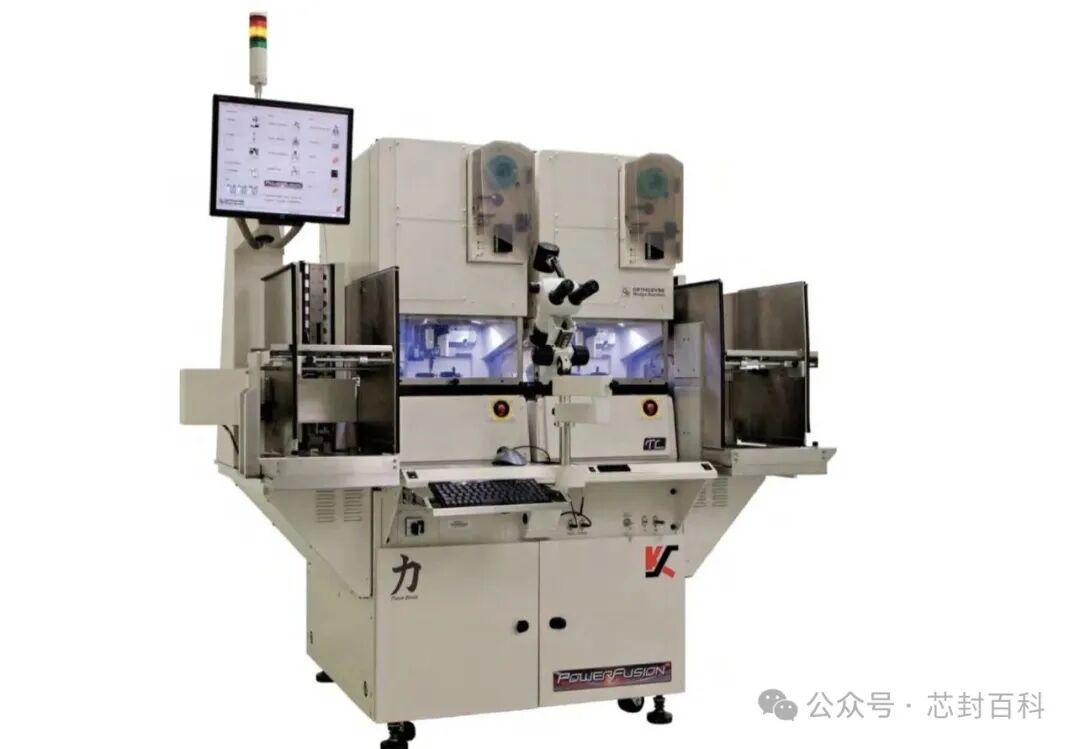
These devices typically use the ultrasonic pressure welding principle, allowing for optimization of bonding quality by adjusting parameters such as ultrasonic power, pressure, and action time. Modern bonding machines are also equipped with quality monitoring systems that can track parameters such as aluminum wire deformation and ultrasonic power in real-time during the welding process, ensuring stable and reliable welding quality.
6. Technical Challenges and Improvement Directions
Despite the maturity and widespread application of aluminum wire bonding technology, it still faces some challenges:
1. Thermal Mechanical Fatigue Issues
The difference in thermal expansion coefficients between aluminum and silicon leads to thermal stress during power cycling, which may result in wire lift or breakage after long-term use. To mitigate this issue, the following measures can be taken:
-
Optimize bonding process parameters (ultrasonic power, pressure, time)
-
Use materials with better fatigue resistance, such as aluminum-magnesium alloys
-
Optimize module structural design to reduce thermal stress concentration
2. Bonding Quality Stability
Bonding quality is influenced by various factors, including material surface conditions, ultrasonic parameter matching, and tool conditions. Measures to improve bonding quality stability include:
-
Implement strict incoming material inspection systems
-
Plasma cleaning of the chip and thick film bonding area before bonding
-
Regular cleaning and maintenance of bonding tools
-
Evaluate bonding reliability through destructive tensile tests and thermal aging tests
3. Limitations of High Current Capacity
As the current capacity of power modules continues to increase, traditional aluminum wire bonding faces bottlenecks. To meet higher current demands, the industry is seeking breakthroughs from multiple aspects:
-
Develop aluminum tape bonding technology to increase conductive cross-sectional area
-
Use new composite materials such as aluminum-clad copper wire to balance conductivity and bonding performance
-
Explore alternatives such as dual-side cooling technology and silver sintering technology to reduce reliance on bonding wires
7. Future Development Trends
Aluminum wire bonding technology continues to evolve and innovate, with future trends primarily reflected in the following aspects:
-
Material Innovation: New aluminum alloys and composite wires (such as aluminum-clad copper) will improve bonding performance, balancing conductivity, mechanical strength, and cost.
-
Process Refinement: Real-time monitoring of the bonding process through intelligent control systems will enhance the consistency and reliability of bonding quality.
-
Expansion of Application Fields: With the development of new energy vehicles, 5G communication, and the industrial internet, the demand for aluminum wire bonding technology in high-temperature and high-frequency applications will continue to grow.
______
Aluminum wire bonding technology, as the “golden bridge” connecting chips to the external world, will remain one of the mainstream interconnection technologies for power semiconductor packaging in the foreseeable future. With the continuous emergence of new materials and processes, this classic technology will continue to thrive, providing solid support for the development of power electronics technology.