
A 3D printing company that is betting everything on the high-speed track.
 Written by|Wu HuaxiuEdited by|Yuan SilaiSource|Hard Technology (ID: south_36kr)Cover Source|Company Website
Ten years ago, 3D printers were merely experimental devices in geek bedrooms. Slow and with limited precision, they were more of a “novel toy” and could hardly take on production tasks. At that time, the industry was dominated by European and American manufacturers, tracing back to Stratasys’s introduction of the FDM molding method in the 1980s, which relied on patent barriers to monopolize the equipment market. It wasn’t until around 2008, when the patents expired, that Chinese manufacturers entered the market, leveraging supply chain advantages. The products at that time were often sold as kits for two to three hundred dollars, reaching global markets through Amazon and AliExpress, but required users to spend dozens of hours assembling them, with efficiency still stuck at the “green train” product stage of 50 millimeters per second.
“The real problem in the 3D printing industry is not whether various models can be printed, but whether the molding speed can be fast enough to enter production,” Shen Kang summarized to 36Kr. He believes that the past decade has seen the industry in a “green train” phase, where products spread in the education and hobbyist markets but have yet to cross the productivity threshold. “If a machine can only print a few parts a day, it is destined to be a toy, not a tool.”
In 2015, Shen Kang left Alibaba and founded Chao Kuo. His judgment was that as long as an emerging industry has enough problems and rapid growth, there will inevitably be breakthroughs. Initially, Chao Kuo, like most manufacturers, relied on low-priced kits for sales, achieving short-term profitability by selling thousands of units on the “Double Eleven” shopping festival in 2017. However, at the peak of the industry’s boom, he cut off the best-selling model and bet everything on “high speed.”
At that time, 95% of global models still used the I3 architecture, which was cheap but heavy. Chao Kuo chose the more challenging delta architecture: three-axis parallel, complex algorithms, but inherently lightweight with potential for speed increase. This decision faced almost unanimous opposition within the company, and R&D often encountered difficulties. Shen Kang recalled, “At that time, no one was optimistic, even partners thought it was a hassle, but if speed doesn’t improve, the industry has no future.”
Three years later, in 2019, Chao Kuo developed its first prototype with significantly improved speed. In 2020, the SR series was globally released, achieving speeds of 150 millimeters per second, proving the feasibility of the high-speed path for the first time. In 2022, the V400 was launched, increasing speed to 600 millimeters per second, officially ushering the industry into the “high-speed train era.” At that time, the “farmers” community began to emerge both domestically and internationally, relying on 3D printing to mass-produce figurines, lamps, and small daily items for sale, with their business logic entirely dependent on the efficiency improvements of 3D printers. What used to take hours to print now only takes a few minutes in 2022.
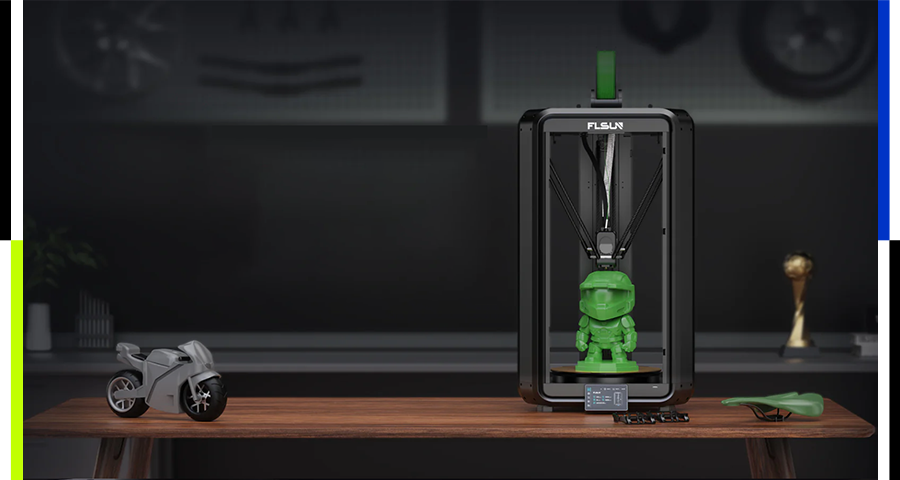
Fast forward to 2024, Chao Kuo released the Xunyingguang S1 Pro, breaking the speed barrier to 1200 millimeters per second, certified by authoritative institutions as the “world’s fastest consumer-grade FDM 3D printer.” The same model that took two hours to print with the previous generation can now be completed in fifty minutes with the Xunyingguang S1 Pro. That year, the S1 Pro quickly became popular in North American and European maker communities, becoming one of the most sought-after high-speed models globally.
In 2025, Chao Kuo launched the Zhuirizhuo T1 Max, aimed at farm production scenarios, with efficiency more than double that of other architectural products, reducing the payback period to three to four months; the Julingzhu V500, a model with a large forming size of 500 millimeters, directly targets the market for sculptures, lamps, and cosplay, capable of printing a 1.5-meter-long Chinese dragon ornament or an entire piece of armor in one go, without the need for assembly.
The challenges brought by high speed require the entire hardware and control chain to be rebuilt. The faster the speed, the more the technical difficulties increase geometrically. Shen Kang told 36Kr that initially, even leveling had to be manually calibrated with A4 paper, but now it can maintain precision and consistency at extremely high speeds, “this is the result of seven to eight years of hard work.”
Chao Kuo’s product evolution has coincided with the industry’s explosive growth. According to Context, in the first quarter of 2025, global shipments of consumer-grade 3D printers increased by 22% year-on-year, surpassing one million units for the first time, becoming the fastest-growing sub-market; meanwhile, shipments of professional and industrial-grade models priced over $20,000 declined. In 2024, China exported 3.778 million 3D printers (excluding components), with a total value of 8.16 billion yuan, a year-on-year increase of 32.75%, with the vast majority being consumer-grade 3D printers, as China produced 96% of the world’s consumer-grade 3D printers.
The demand side is also rapidly evolving. In the past, the main buyers were makers and hobbyists who treated 3D printers as toys; now over 80% of devices are used as tools. The explosive effect of the trendy toy economy has led to the emergence of farms in places like Yiwu, with thousands of units. Printing a 30-centimeter dragon that used to take over ten hours and cost around a thousand dollars can now be completed in just one hour with Chao Kuo’s high-speed machine, priced at over five hundred dollars, shortening the payback period by more than ten times.
This efficiency revolution has directly spawned new industrial forms. Trendy toys are just the starting point; printing lamps, illuminated signs, cosplay gear, medical supports, sculptures, and other scenarios are being validated by small-scale workshops. Meanwhile, as the price of materials like PLA has dropped from 30,000 yuan per ton to less than 20,000 yuan, the printing cost of a mobile phone holder is now less than one yuan, unlocking more possibilities.
In terms of industry structure, Chao Kuo is not the only high-speed manufacturer, but its path contrasts sharply with that of companies like Tuozhu and Chuangxiang Sanwei. Tuozhu entered the market with the backing of DJI and crowdfunding on Kickstarter, gaining popularity overseas with its P/X series; Chuangxiang Sanwei has become a veteran player relying on a rich product matrix and user base. In contrast, Chao Kuo’s scale is not large, but its high-speed strategy was adopted earlier. The continuous iterations of the SR, V400, S series, and T series have allowed it to cross the threshold in speed and stability first, creating differentiation. Shen Kang admits, “The competition brought by high speed is far more brutal than when selling kits, but it is also the only way to move the industry away from its toy attributes.”
In Shen Kang’s view, efficiency has always been the most important metric in the production tools industry. Chao Kuo’s choice to invest eight years in the high-speed path has proven to be the right route. With the Xunyingguang S1 Pro certified as the world’s fastest consumer-grade FDM 3D printer, Chao Kuo’s positioning is gradually shifting from a hardware manufacturer to a technology and efficiency-oriented industry participant.