Author | Maple LeafSource | Zhengshang Review3204 words Reading time 8 minutes
When it does not chirp, it suddenly astonishes!
Huawei has launched the AI “King Bomb”, the first domestic HarmonyOS humanoid robot“Kua Fu” makes a stunning appearance.
“Kua Fu”’s birth not only marks Huawei’s success in the robotics field but also breaks the foreign monopoly in the field of robot operating systems.
Like “Kua Fu chasing the sun”, domestic robot technology has once again broken through, bringing new “light and heat” to the global AI track.
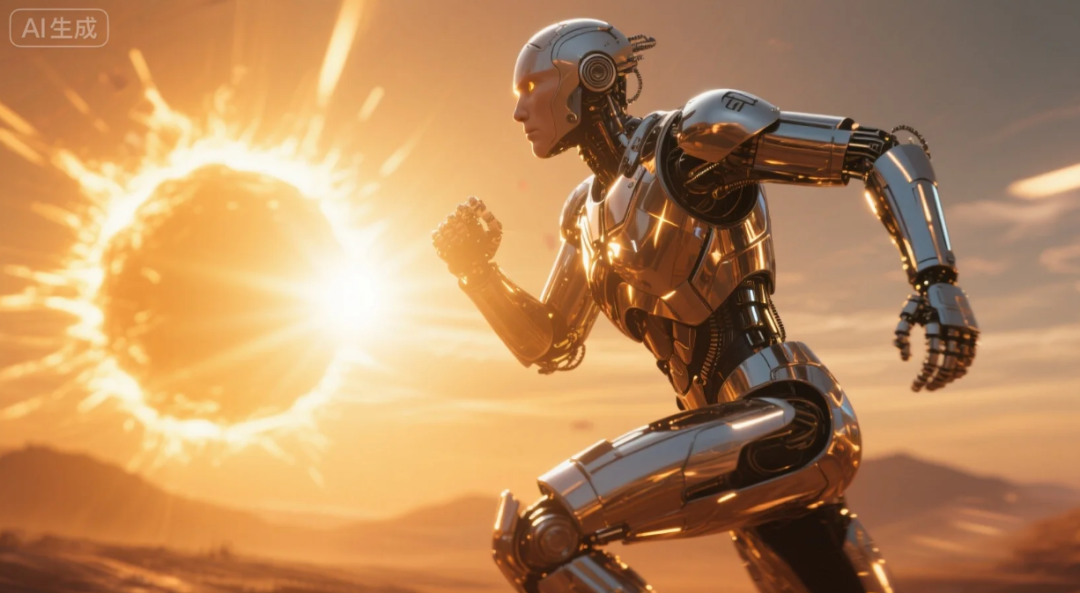
Both Elon Musk and Jensen Huang believe that the next wave of artificial intelligence is physical AI, represented by humanoid robots with embodied intelligence.
Embodied intelligence, which carries the world’s most advanced new materials, AI and other key technologies, hides a thousand-fold growth space. In the future, whoever can grasp the most advanced embodied intelligence technology will undoubtedly be the “trendsetter” of the future industrial economy.
One must admire Huawei’s foresight. While everyone is scrambling for the embodied intelligence market, Huawei is working hard on the underlying technology, “laying a solid foundation”, preventing a repeat of situations like the “chip blockade”.
Performing folk dances, fighting, dancing ballet…… able to run, jump, and fight, constantly breaking through technology advancements, Chinese robots are stunning the world, repeatedly refreshing people’s imagination.
One must be wary of competitors trying to undermine the “big cake” of embodied intelligence, as in this wave of humanoid robots, the “Chinese team” is no longer a bystander but a deep participant, and even hopes to become a leader.
Last year, there were over 140 financing events in the humanoid robot industry globally, with a total amount exceeding 32.8 billion yuan, of which about 12 billion occurred in China, accounting for a staggering 86% of the total, making it the “main battlefield” of this AI boom.
The China Electronics Society predicts that by 2030, the market size of humanoid robots in our country is expected to reach approximately 870 billion yuan.
The future is here, we must seize the day.
The true “take-off point” for humanoid robots is now!

With “Kua Fu” showcasing HarmonyOS, domestic robots break the “neck-holding” dilemma.
Recently, Huawei has once again made headlines with the launch of the first domestic robot based on the open-source fully autonomous HarmonyOS system, “Kua Fu” stunningly debuts.
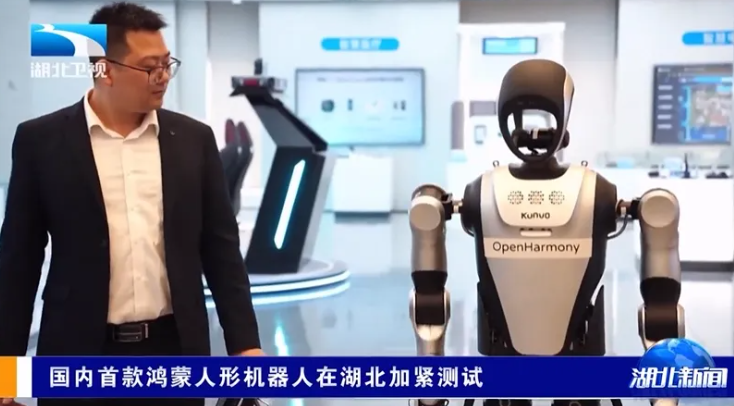
This robot, named after a character from ancient Chinese mythology, not only interacts like a “human”, but also breaks the foreign monopoly in the field of robot operating systems that has lasted for thirty years, accelerating the construction of a fully autonomous and controllable robot ecosystem.
“Kua Fu” stands approximately 1.66-1.7 meters tall, weighs about 45-55 kilograms, uses the latest self-developed HarmonyOS, supports multi-device collaborative interaction, and can control smart home and industrial handling tasks via voice commands, achieving breakthroughs in three major dimensions:
In terms of technology, the HarmonyOS has achieved embodied capabilities for the first time, deeply integrating distributed capabilities with robot motion control, with latency controlled at 8 milliseconds, making the robot safer and more controllable;
Multi-modal interaction upgrades, voice interaction supports context memory for 20 rounds, with tactile feedback precision of 0.1mm, and equipped with 26 high-dynamic joints, making the robot’s limbs more flexible, and with an optimized thermal management mode, it can operate stably even in extremely cold environments;
Energy innovation, bionic joint energy consumption reduced by 40%.
These technological breakthroughs mean that Chinese companies will have more intellectual property autonomy in the field of robotics, no longer completely relying on foreign technology stacks.
“Kua Fu”’s birth not only marks a key step for our country in the field of operating systems, achieving a leap from following to running alongside, but also opens a new chapter for the future of the intelligent interconnection of all things.
After new energy vehicles, China stands once again at the forefront of the technological wave!
Musk once predicted that, the number of intelligent humanoid robots will eventually far exceed the human population. Moreover, each industry will have a large number of robots providing products and services for humans.
We all imagine that one day on the street, the one cooking is a robot, the one patrolling is a robot, and the one delivering packages is also a robot?
This is no longer a science fiction film, but a reality that Chinese humanoid robots are about to bring.

According to a report from CCTV Finance in August this year, the sales of humanoid robots are predicted to exceed 10,000 units in 2025, with a year-on-year growth of 125%.
Data shows that in the first half of 2025, there were 87 financing events in the Chinese humanoid robot industry, with disclosed financing amounts of approximately 10.9 billion yuan, while global humanoid robot financing during the same period was only about 14 billion yuan, with China accounting for nearly 80%.
It is foreseeable that in the future, the market size of China’s humanoid robot industry will exceed one trillion yuan.
DeepSeek predicts that by 2035, the Chinese market will reach 10 trillion yuan.
After all, the annual growth of humanoid robots exceeds 60%, becoming increasingly popular and practical.
Why are humanoid robots becoming popular? It’s simple: humanoid robots can perform a wide range of tasks. From factory handling to customer service in shopping malls, to elderly care, security, and companionship, wherever there is a shortage of manpower, they can go.
Moreover, they can use existing human tools and adapt to various scenarios, which is something wheeled robots cannot compare to.
AI large models and breakthroughs in embodied intelligence technology have transformed robots from being “active” to “capable of working”, finally moving beyond just being a PPT.
At the World Artificial Intelligence Conference in 2025, 150 humanoid robots will be showcased, and almost everyone will realize: the next explosion point is not in the screen, but in the robots walking in the real world.
And the true “take-off point” is now, in 2025, which is also known as the “first year of humanoid robot industrialization”.
Tesla’s robots are already working on the assembly line, and domestic players like Yushu Technology and UBTECH are also ramping up production.
The future is here, and while we marvel at the incredible, the field of robotics is entering a brand new era— commercial.
However, the robot market is quite “realistic”, focusing not on appearance and promotion, but on computing power, algorithms, and engineering capabilities.
This time, China is fully prepared, from underlying technology, capital support, policy dividends to market scenarios, just as new energy vehicles created a myth of wealth for an era, now it’s the turn of robots.

AI is the future, and systems are fundamental. Huawei has once again become the “load-bearing wall” of domestic technology, having long laid out in the underlying technology of systems, and is now “bearing fruit”.
Since the release of HarmonyOS in 2019, it has grown to become the fastest-growing operating system globally.
Not long ago, Huawei launched “the King Bomb”, HarmonyOS 6.0 officially arrived.
It directly overturned the tech circle, AI instantly became “mind-reading”. HarmonyOS 6.0 is incredibly powerful, truly achieving “doing what you think”.
When you want to order takeout, the phone directly pops up restaurant recommendations; while driving, the navigation automatically avoids congestion; various lifestyle apps are fully integrated, allowing you to be “lazy” without worries.
Performance crushes Android, with real-world startup speeds beating iOS, Tencent, Mihayou all fully adapted, 120 frames stable as a mountain, gamers no longer worry about lag.
This smooth speed leaves Android silent, iOS in tears.
Creating a system is challenging due to technological breakthroughs, and building an ecosystem is even harder. But Huawei has talent and depth, backed by domestic APPs united in “support”, this is not just a system, but the “ultimate alliance” of Chinese technology.
Latest data shows that the total number of HarmonyOS ecosystem devices exceeds 1.19 billion units, over 1300 devices have passed OpenHarmony compatibility certification, over 30,000 applications and meta-services cover 99% of high-frequency usage scenarios, with national-level applications like Alipay, WeChat, and Amap completing deep adaptation, forming an application matrix covering 20 industries, including finance, transportation, and healthcare, and it is expected that the HarmonyOS ecosystem will unlock a trillion-yuan industry space.
This achievement is closely related to HarmonyOS’s insistence on an open-source strategy.
By building an open-source ecosystem, HarmonyOS has attracted a large number of developers and enterprises to participate, enriching system functions and application scenarios, forming a strong network effect.
Some netizens even boldly claim: “HarmonyOS may be the system terminator, Android is no longer ‘arrogant’, and Apple is in danger!”

All breakthroughs are not achieved overnight!
High investment leads to high returns, and it is Huawei’s persistent investment in operating systems that has resulted in today’s “fruits of Harmony”.
In the hearts of countless people, Huawei stands as a banner of domestic technology, and its current height is due to its respect for talent and faith in technology.
Since the establishment of Huawei’s Intelligent Automotive Solution BU in 2019, the cumulative R&D investment has exceeded 30 billion yuan.
It is worth mentioning that Huawei invests over 10 billion yuan annually in the smart automotive field, with 70% to 80% allocated to intelligent driving.
In 2024, according to incomplete estimates, its funding investment will exceed 16 billion yuan, with more than 7500 R&D personnel.
Huawei “plants trees”, and everyone enjoys the shade.
As of September 30, 2025, the cumulative delivery of the AITO M8 has surpassed 100,000 units, maintaining the sales champion in the 400,000 level for five consecutive months; the AITO M9 has a cumulative delivery of 240,000 units, maintaining the sales champion in the 500,000 level for 18 consecutive months.
AITO, deeply tied to Huawei, has now become a pride of the domestic new energy high-end market, pushing BBA to retreat, and AITO’s parent company, Seres, has seen a dramatic turnaround in performance.
Seres achieved a revenue of 145.176 billion yuan in 2024, a year-on-year increase of 305.04%; net profit reached 5.946 billion yuan, a substantial year-on-year increase of 342.72%, with the gross profit margin of the new energy vehicle business rising to 26.21%, becoming the core growth point.
In the past decade, Huawei’s cumulative R&D expenses have exceeded 1.11 trillion yuan, demonstrating its firm commitment to technological innovation.
“Kua Fu”’s successful debut is a reflection of Huawei’s long-term layout in the robotics field.
Huawei has collaborated with 16 companies, including Leju Robotics and Tuosida, to build an ecosystem, investing 1 billion yuan to support HarmonyOS AI innovation through the “Tian Gong Plan”.
In today’s increasingly fierce global technological competition, the birth of “Kua Fu” has solved a series of “neck-holding” problems for the Chinese robotics industry.
From core components to operating systems, from motion control algorithms to intelligent interaction systems, the Chinese robotics industry is undergoing a comprehensive process of self-replacement.
Perhaps like new energy vehicles, the ultimate solution for the entire humanoid robot market lies in China.
Only by being self-reliant can we thrive!
Every technological advancement is like a light ignited in the darkness, bringing convenience and direction to people.

The views in this article are solely those of the author and do not represent the position of this platform.
Dear readers, the public account has changed its push rules. If you still wish to receive our articles promptly, please remember to set the Peking University Zongheng public account as a star.  Click on the public account “Peking University Zongheng” in the lower left → click on the top right “…” → select “Set as Star Mark ⭐️”.