Click the blue text above to follow us
Introduction
Due to the extensive geographical distribution and high operational pressure of power transmission lines, they are prone to faults. Therefore, monitoring and protection of these lines are crucial for the reliable operation of power systems. Research shows that faults in transmission lines can affect the stability and reliability of power systems, leading to costly power outages and safety risks. Accurately locating faults within a vast network is a time-consuming and labor-intensive task; in many cases, power companies are forced to shut down entire segments of the grid to trace fault locations, resulting in prolonged outages and economic losses. This highlights the urgent need for efficient, automated, and real-time fault detection, classification, and localization (DCL) technologies.
Article Details
01
Basic Information
Article Title:Design and Development of Wi-Fi and GPS-Based Smart Monitoring and Fault Detection System for Three-Phase Power Transmission Line Using Arduino
Author Information:Sarweash Rao Tharma Raja, Mohd Firdaus Mohd Ab Halim, Syed Muhammad Naufal Syed Othman, Mohd Hafiz Bin Jali, from Universiti Teknikal Malaysia Melaka (UTeM) (Malaysia), etc.
Article Link:https://doi.org/10.4236/jpee.2025.139023
02
Research Content and Results
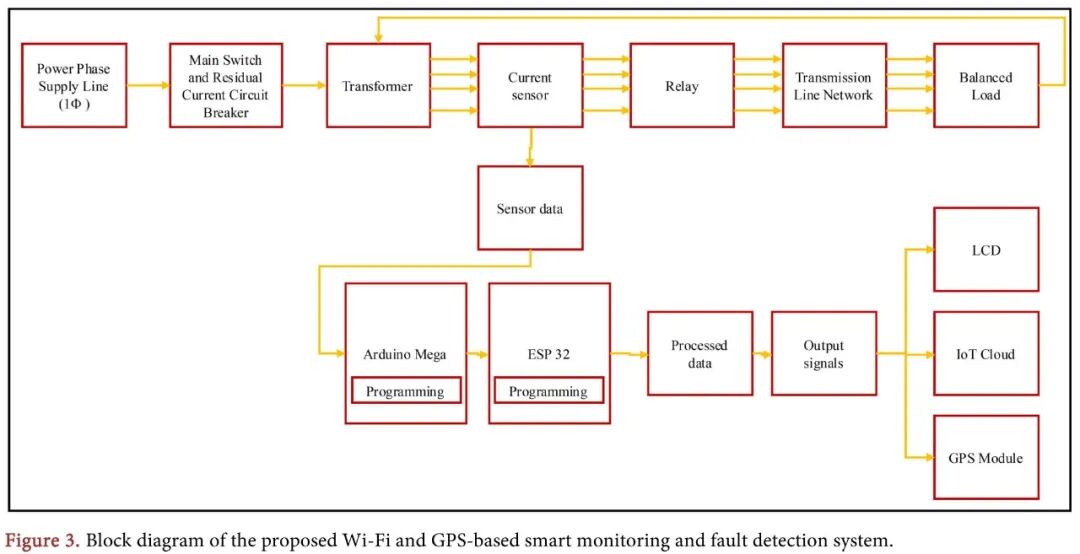
Rapid and accurate detection, classification, and localization of faults in overhead transmission lines are crucial for minimizing outage time and enhancing the resilience of power systems, especially when these lines often traverse remote and environmentally fragile areas. In this paper, the researchers utilizedArduino and Internet of Things(IoT) technologies to propose a smart monitoring system for fault detection, classification, and localization (DCL) based onWi-Fi andGPS. Specifically, the researchers developed a hardware prototype using a scaled single-phase four-wire configuration to simulate three-phase behavior. This smart monitoring system integrates anArduino Mega for sensor data acquisition, anESP32 module for wireless communication, and aNEO-6MV GPS module for geolocation. Real-time current readings are captured via anACS712 sensor and transmitted to theArduino IoT cloud platform for remote monitoring. The system also sends real-time fault alerts to responsible engineers and load dispatch centers via cloud notifications, indicating the type of fault, affected phase, and precise location. The research results show that the system successfully identified24 different fault scenarios, including single-line-to-ground faults (SLG) in four different areas and double-line-to-ground (DLG) faults, achieving a 100% detection, classification, and localization accuracy in960 tests. Overall, the smart monitoring system proposed in this study provides a scalable and cost-effective solution for innovative transmission line fault management, enhancing grid reliability and reducing outage time.。
Article Citation & Reading:
Raja, S.R.T., Ab Halim, M.F.M., Othman, S.M.N.S. and Jali, M.H.B. (2025) Design and Development of Wi-Fi and GPS-Based Smart Monitoring and Fault Detection System for Three-Phase Power Transmission Line Using Arduino. Journal of Power and Energy Engineering, 13, 343-370.
https://doi.org/10.4236/jpee.2025.139023


More Exciting Recommendations

Prediction Method for Summer Precipitation in the Tibetan Plateau Based on Anomalies in Sea Surface Temperature of the Indian Ocean | SCIRP Paper Recommendation

Research on the Synergistic Health Effects of Ginger and Turmeric | SCIRP Paper Recommendation

Analysis of Paper Submission Status – Publication Process

SCIRP Journal Paper Template (General Version)




Love Life, Love Research
Scan to follow us for more exciting content
Wechat ID: 15994263975
QQ: 3384378078
Submission Email:[email protected]
Cooperation Contact:[email protected]