
Current Status and Prospects of Sand Mold 3D Printing Technology in Casting
Li Mingbo
(Shandong Jinan 250101, Shandong Jigang Taihang Alloy Co., Ltd.)
Abstract: Sand mold 3D printing technology significantly enhances the manufacturing capability and production flexibility of complex castings through digital, moldless forming. This paper systematically reviews the core principles of this technology, its application areas, and compares it with traditional sand casting, focusing on its technical advantages in complex structure manufacturing, customized production, and collaborative research and development. Research shows that sand mold 3D printing can reduce the sand mold manufacturing cycle by 70% and achieve a material utilization rate of over 90%. However, the high equipment investment cost (over 3 million yuan per unit) and the lack of standardization remain bottlenecks for industrial development. Compared to traditional casting processes, its moldless casting characteristics reduce the cost of small batch production by 70%, but the economic feasibility for large-scale production has yet to be overcome. In the future, it is necessary to promote the transition of 3D printing technology from “innovative demonstration” to “large-scale application” through intelligent algorithm optimization, the development of low-cost domestic equipment, and collaboration across the industrial chain, providing core support for the high-end and green upgrade of the casting industry.
Keywords: Sand mold 3D printing; binder jetting; moldless casting; digital casting; aerospace
The global manufacturing industry faces the dual challenges of carbon neutrality goals and Industry 4.0, with high-end, intelligent, and environmentally friendly manufacturing being the main directions for the transformation and upgrading of traditional manufacturing. As a fundamental link in mechanical manufacturing, casting has issues of high energy consumption and significant pollution.[1] According to the International Foundry Association (IFA), carbon emissions from traditional sand casting account for over 23% of total emissions in the machinery manufacturing industry, with a waste sand recovery rate of less than 35%, resulting in over 200 million tons of waste sand accumulating globally each year. At the same time, the accelerated product iteration speed and the surge in customization demand have made the long mold-making time (accounting for 30% to 50% of the production cycle) and insufficient process flexibility in traditional casting processes more pronounced, which limits the development of the casting industry to some extent.
Against this backdrop, the sand mold additive manufacturing technology based on binder jetting has shown core advantages. Through moldless rapid forming (reducing cycle time by ≥70%), digital-driven process chain integration, and a low-carbon production model with over 90% material utilization, it effectively addresses the “high carbon lock-in” and “insufficient flexibility” dilemmas in the casting industry. However, high equipment investment, insufficient process stability, and lack of collaboration in the industrial chain severely restrict the large-scale application of this technology. Therefore, by comparing the process flow, material costs, and technical indicators of sand mold 3D printing with traditional casting, and analyzing typical industrial cases, this paper proposes future development paths that are of great significance for improving the production efficiency and quality of the casting industry.
1 Overview of Sand Mold 3D Printing Technology
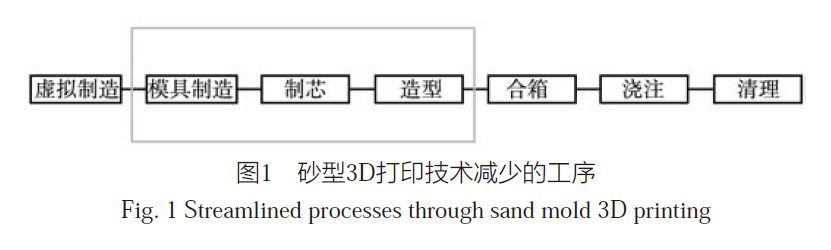
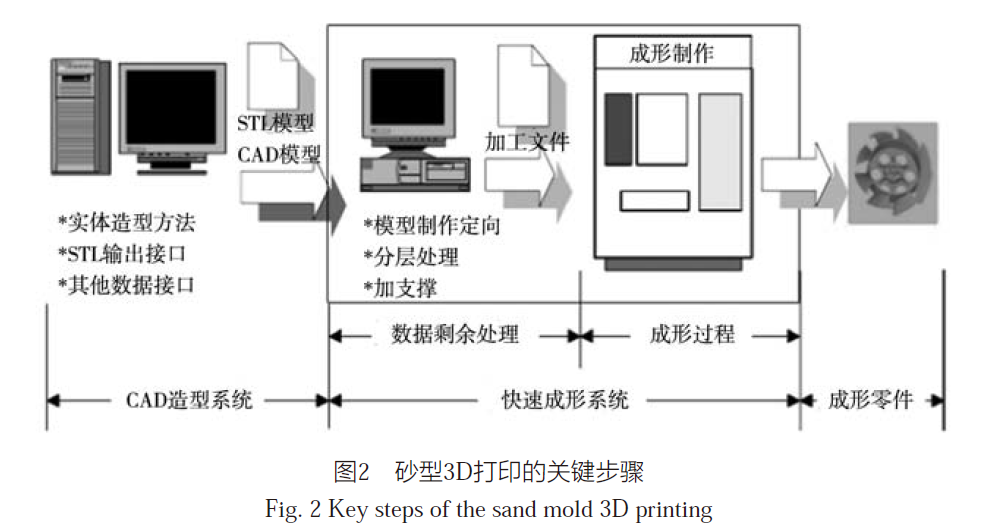
Sand mold 3D printing technology is a sand additive manufacturing technology based on binder jetting fabrication (BJF), which directly creates sand mold patterns from digital models. The traditional casting process has been reduced from seven steps to five (see Figure 1), overturning the multi-step process of “design-mold making-shaping-casting”. The key processes of this technology are shown in Figure 2.
1.1 Three-Dimensional Model Design
Use professional 3D modeling software to design the three-dimensional model of the casting, leaving allowances; focus on optimizing complex features that are difficult to achieve with traditional processes, such as thin-walled structures, internal flow channels, and cavities.
1.2 Sand Mold Parting Design
Based on the geometric shape of the casting, pouring process, sand mold design, and pouring system setup, perform parting design to split the model into modular sand cores and sand molds that meet the requirements, allowing for one-time forming, reducing the labor intensity of later mold core assembly, and improving casting efficiency.
1.3 Slicing Processing
Convert the three-dimensional model of the part into layered slicing files, generating planar shape and size data for each layer. Typically, the layer thickness is set to 0.2-0.5 mm to ensure a sand mold surface roughness of Ra ≤ 6.3 μm.
1.4 Process Simulation Optimization
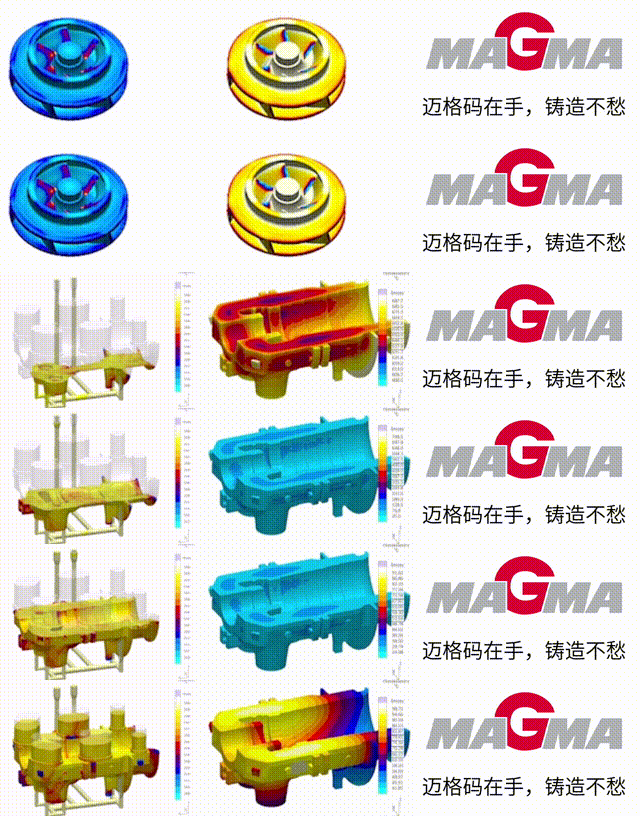
Use Magma or ProCAST software to simulate the filling and solidification process of molten metal, adjusting the size of the pouring gate and the position of the riser. For example, in casting a cylinder head, a heating riser is used in the thicker areas at the top to compensate for shrinkage[2] and set up cold iron on the combustion chamber surface to accelerate the local cooling speed of the casting, improving the internal quality, dimensional accuracy, and mechanical properties of the casting. Key parameters of the pouring system are optimized: internal pouring channel cross-sectional area error control ±5%, riser thermal reserve elimination rate >90%, filling speed fluctuation range <15%, achieving a casting defect prediction accuracy of ≥85%.
1.5 Sand Mold Printing Formation
Import the designed three-dimensional model data into the 3D printer and load the printing materials (sand and binder) into the printer’s material bin. Set relevant parameters (such as layer height, fill rate, etc.), and under computer control, the nozzle precisely sprays the binder to adhere the sand particles. After completing one layer, the working platform of the 3D printing device descends a certain height, continuing to print the next layer until the entire sand mold printing is complete.
1.6 Post-Processing
After the sand mold printing is complete, post-process the mold: clean up the un-cured loose sand (i.e., support structure) to obtain the required mold, and polish the surface[3] to improve precision and surface quality. If necessary, perform heat treatment or surface coating on the sand mold, which can then be used for pouring metal.
2 Technical Advantages of Sand Mold 3D Printing Technology in the Casting Field
2.1 Design Freedom
Forming of complex structures: Traditional sand casting must “accommodate” the process, making it difficult to produce complex shapes such as internal cavities and curved channels. For example, the cooling channels of engine blocks are often simplified to straight lines, affecting heat dissipation efficiency. However, sand mold 3D printing can directly print lightweight structures of hollow sand molds based on digital models[4], maintaining strength and meeting the production of complex structural parts.
Personalized customization: For some small batch, customized casting production needs, sand mold 3D printing has unique advantages: it can quickly design and print corresponding sand molds according to customer requirements, avoiding the cumbersome processes of mold opening and modification in traditional mold manufacturing, thus meeting different customer personalization needs.
2.2 Shortened Production Cycle
Simplified mold manufacturing: Traditional sand casting requires first making molds, then using the molds to manufacture sand molds. The design, manufacturing, and debugging processes of molds often consume a lot of time and labor. Sand mold 3D printing technology can directly convert the product’s CAD design files into sand molds, quickly and accurately producing complex structural components that meet design requirements, thus shortening the production cycle.
Rapid iteration and modification: In the product research and design phase, if it is found that the casting design needs modification, traditional sand casting requires remaking molds, which is costly and time-consuming; sand mold 3D printing only requires modifying the digital model on the computer and reprinting the sand mold, quickly achieving design iteration and modification, accelerating product research and development.
2.3 Improved Precision and Quality
High dimensional accuracy: 3D printing technology can achieve integrated design of cores, significantly reducing the number of core assemblies, thus lowering dimensional errors caused by assembly operations and improving the forming accuracy of castings[5]. The printed sand mold has a smooth surface, improving the surface quality of the casting and reducing subsequent processing volume.
Good internal quality: 3D printed sand molds can achieve uniform density, avoiding defects such as local looseness and sand inclusion that occur in traditional sand casting, thus improving the internal quality of the casting. At the same time, by precisely controlling and optimizing the solidification process of the casting, defects such as shrinkage cavities and porosity can be reduced.
2.4 Cost Effectiveness
High material utilization: Compared to the traditional sand mold manufacturing process, 3D printed sand mold casting is printed on demand, using only the required materials, thus reducing waste generation. In addition, during the printing process, material distribution can be precisely controlled based on the sand mold structure and strength requirements, further improving material utilization.
Reduced labor costs: Traditional casting relies on manual operations (such as mold making and modification), which are costly. Sand mold 3D printing achieves automated production, reducing labor costs, minimizing operational errors, and improving production stability and consistency.
2.5 Environmental Protection
Reduced waste emissions: Traditional sand casting generates a large amount of waste during mold manufacturing and sand mold processing, such as discarded mold materials and waste sand, causing environmental pollution. Sand mold 3D printing generates less waste, and the remaining materials can be recycled, meeting green environmental requirements.
Improved production environment: Sand mold 3D printing does not require the use of large amounts of chemical reagents and binders, reducing pollution to the environment and harm to the health of operators. At the same time, the automated production method also reduces dust and noise generation, improving the production environment.
3 Current Application Status of Sand Mold 3D Printing in Casting
3.1 Manufacturing Complex Structural Components
Sand mold 3D printing technology can not only directly print complex sand molds and cores without molds but also enhance design freedom, optimize casting process design, and improve the forming quality and performance of castings.
Traditional casting manufacturing methods struggle to achieve the production of complex structural components, while sand mold 3D printing technology can directly convert the product’s CAD design files into sand molds, achieving rapid and precise manufacturing of complex structural components that meet design requirements through the stacking of multiple layers of sand powder and binder, satisfying the development needs for lightweight, green, and intelligent equipment. For example, the brackets for 6G communication satellites[6], skin lattice structure panels, drone shells, and turbine blades, which require lightweight, high strength, and resistance to extreme conditions.
3.2 Customization and Rapid Response Production
Sand mold 3D printing does not require molds and supports small batch, customized production, especially suitable for emerging market demands, allowing for flexible manufacturing of products according to customer needs, capable of producing personalized aluminum alloy castings. For industries that require flexible design and production of aluminum alloy castings, such as medical devices and consumer goods, sand mold 3D printing technology has significant advantages, quickly meeting the diverse customization needs of the market, enhancing product market competitiveness, and reducing production costs and inventory pressure. For example, missile shells and naval gun mounts produced using a combination of 3D printed sand cores, traditional manual modeling, and gravity casting; GIS power combination switches produced using 3D printed sand cores, steel molds, and low-pressure casting processes.[7-8].
3.3 Collaborative R&D of Materials and Processes
Sand mold 3D printing technology can be combined with new product development to explore new uses and performance of aluminum alloy materials; by 3D printing special structures and compositions of sand molds, it can be used to study the performance and structural characteristics of aluminum alloy materials; through the development of multi-material composite sand molds and starch-modified bio-based binders, and functional integration innovation (i.e., achieving multiple parts and functions in the same component), it provides strong support for the development of new aluminum alloy parts. For example, the casting of engine cylinder heads optimized through 3D printing reduced the development time from 28 days to 9 days, increased material utilization from 67% to 92%, and reduced surface roughness Ra value from 12.5 μm to 6.3 μm.[9].
3.4 Rapid Sand Mold Manufacturing and Traditional Process Innovation
Sand mold 3D printing technology can quickly prepare complex-shaped aluminum alloy casting sand molds without going through cumbersome steps such as model design, production, and mold frame pressing, effectively saving time, costs, and resources, while improving the quality and performance of components. Compared to traditional casting processes, sand mold 3D printing achieves “five no’s” production (no molds, no cranes, no heavy labor, no dust, no temperature difference), enhancing efficiency and promoting the green transformation of casting.
4 Comparative Analysis of Sand Mold 3D Printing and Traditional Casting
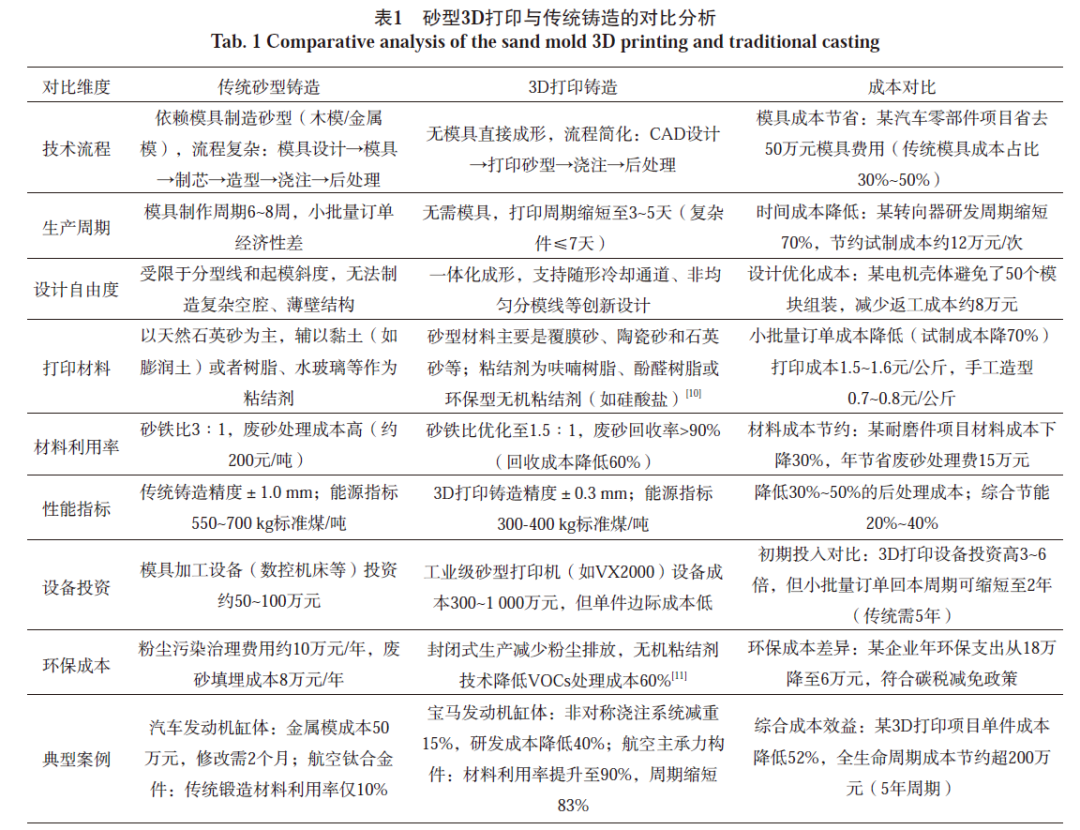
Comparative analysis of 3D printed casting and traditional sand casting in terms of technical processes, production cycles, design freedom, and printing materials is detailed in Table 1.
5 Technical Challenges and Bottlenecks of Sand Mold 3D Printing in the Casting Field
5.1 Technical Challenges
Printing accuracy and surface quality: The accuracy and surface finish of sand mold printing directly affect the quality of castings. The layer thickness of sand mold printing is usually 200-500 μm, which still lags behind traditional casting processes, especially when using steel molds, resulting in insufficient smoothness and affecting casting quality.
Material performance matching: The materials for sand mold printing (such as silica sand and clay sand) must strictly match printing requirements, possessing good flowability, adhesion, and thermal stability. Significant differences in material properties can lead to insufficient sand mold strength or poor permeability if improperly selected, resulting in decreased casting quality.
Support and post-processing difficulties: 3D printing can manufacture complex sand molds, but thin-walled and suspended structures require additional support materials, increasing costs for sand cleaning and polishing steps.
5.2 Material Challenges
High material costs: 3D printing-specific sands (such as coated sands) are expensive, with imported materials costing up to 2,000 yuan per ton. Although domestic materials are gradually being promoted, costs still exceed those of traditional sands.
Difficulties in recycling: Unused sand powder and waste sand need to be recycled. Although thermal regeneration can reduce costs, the equipment for thermal regeneration is expensive (e.g., 2.8 million yuan for thermal regeneration equipment), and the process is complex (crushing, magnetic separation, roasting), with a high technical threshold. The performance of regenerated sand (such as angularity coefficient and strength) must strictly match printing requirements to avoid affecting sand mold strength and casting quality.
Insufficient material diversity: The existing types of sand mold printing materials are limited, making it difficult to meet the diverse needs of different castings such as high-temperature alloys and aluminum alloys.
5.3 Cost Challenges
High equipment prices: The cost of industrial-grade sand mold 3D printers exceeds one million yuan per unit, and they require supporting smart factories[12], increasing initial investment.
High operational and maintenance costs: Equipment requires professional maintenance (such as nozzle replacement and laser calibration), and some processes (such as roasting) have high energy consumption. Labor costs for model design, sand mold cleaning, etc., account for more than half of total costs, increasing application costs and difficulties.
Bottlenecks in the economic feasibility of large-scale production: 3D sand mold printing has significant advantages in small batch customization scenarios, but traditional casting is more efficient and cost-effective for large-scale production. Additionally, large castings are limited by the forming size of the equipment, requiring segmented printing, which increases costs.
5.4 Process Challenges
Difficulties in parameter control: Sand mold printing requires precise control of binder dosage, layer thickness, and curing time to avoid insufficient sand mold strength and excessive gas generation, increasing the scrap rate. For example, an increase of 1% in binder can cause cracking, and a layer thickness deviation of 0.05 mm can lead to deformation. New operators have a scrap rate exceeding 50%. Process stability: Variations in material batches and changes in environmental temperature and humidity can affect printing quality, leading to insufficient process stability.
Complexity of post-processing: Printed sand molds require powder cleaning, curing, and assembly, with low automation levels, increasing time and labor costs. For example, each box printed requires 10 hours, and cleaning the sand powder still takes 8 hours, with assembly errors exceeding 0.5 mm resulting in complete batch scrapping.
5.5 Market and Industry Challenges
Low market acceptance: The traditional casting industry has insufficient awareness of 3D sand mold printing technology, and small and medium-sized enterprises are hesitant due to high costs and complexity.
Insufficient standardization and certification: The quality standards and certification systems for 3D printed sand molds are not well established, affecting their application in fields such as aerospace and new energy vehicles.
Lack of collaboration in the industrial chain: 3D printing technology involves many links such as materials, equipment, and software, with poor collaboration among various links in the industrial chain, and a shortage of digital casting talent, restricting the rapid implementation of this technology.
5.6 Environmental and Sustainable Development Challenges
Difficulties in waste sand treatment: Unused sand powder and waste sand need to be recycled. The expensive environmental protection equipment for thermal regeneration poses a burden for small and medium-sized enterprises.
Some processes (such as roasting and laser sintering) have high energy consumption, inconsistent with the concept of green manufacturing.
Material sustainability: The existing sand mold materials (such as silica sand) are limited in resources, necessitating the development of more environmentally friendly and sustainable alternative materials.
6 Future Development Trends and Innovation Paths
3D sand mold printing + casting technology, as a combination of additive manufacturing and traditional casting processes, has shown tremendous potential in the manufacturing industry in recent years.
6.1 Material Diversification and Environmental Protection
Material innovation: Developing composite sands such as ceramic sands and coated sands that can meet the casting needs of different metals, such as titanium alloys for aircraft castings and aluminum alloys for automotive castings. For example, turbine blades for aircraft now require special sand materials that can withstand temperatures 300 °C higher than ordinary sand.
Eco-friendly materials: New regulations require foundries to reduce wastewater and exhaust emissions by 30%, thus promoting sand manufacturers to develop biodegradable binders. For instance, a company recently launched a plant-based binder that reduces carbon emissions by 60% when burned.
6.2 Intelligent and Efficient Equipment
Multi-laser head acceleration and green light technology: New printers equipped with four laser heads can print 2 tons of sand molds in 24 hours, three times faster than older models. Green light technology successfully prints 0.2 mm thin heat sinks for reflective metals like copper and silver. Domestic equipment: Domestic manufacturers have reduced the price of sand mold printers by half and decreased power consumption by 40%.
6.3 Intelligent and Large-Scale Applications
Process intelligence: Optimize printing parameters (such as binder distribution and temperature control) through AI algorithms, constructing a knowledge graph of casting processes, defects, and materials to enhance printing accuracy and stability. AI technology will also penetrate equipment operation, material development, and process monitoring, achieving fully automated process optimization.
Large-scale production: 3D sand mold printing is transitioning from prototype manufacturing to large-scale production. For example, BMW and General Motors have adopted sand mold 3D printing technology for large-scale production of engine components, significantly shortening production cycles.
6.4 Industrial Chain Collaboration and Standardization
Improving the industrial chain: The 3D printing industrial chain includes upstream materials, midstream equipment and services, and downstream application fields. Domestic companies are breaking the dependence on imports of core materials such as metal powders and lasers, promoting domestic alternatives.
Standardization construction: As the industry scales up, the standardization and certification system for sand mold 3D printing will gradually improve, promoting its widespread application in high-end fields.
6.5 Cost Reduction and Market Popularization
Cost reduction and efficiency increase: Through material regeneration technologies (such as closed-loop regenerated sand systems) and equipment localization, the costs of sand mold 3D printing will gradually approach those of traditional casting, promoting its popularization among small and medium-sized enterprises.
Consumer-level applications: Sand mold 3D printing technology is expanding from the industrial sector to the consumer market, such as cultural creativity, sand table modeling, and archaeological restoration, and may further penetrate the personalized customization market in the future.
7 Conclusion
Sand mold 3D printing technology, with its core advantages of moldless, high precision, and rapid response, is driving innovation and transformation in the casting industry[14]. Compared to traditional processes, its design freedom has significantly increased, with material utilization rising from 60% to over 90%, and waste sand regeneration rates exceeding 85%. In the field of complex structures, this technology has achieved integrated forming, reducing the R&D cycle by 60%; in terms of costs, small batch trial production costs have decreased by 70%, but equipment investment and specialized material costs remain the main obstacles for small and medium-sized enterprises. Future technological development should focus on three main directions: first, intelligent upgrades through AI algorithms to optimize process parameters and reduce trial and error costs; second, breakthroughs in domestic production to develop low-cost equipment and eco-friendly materials (bio-based binders); third, industrial collaboration to build a distributed network of “cloud design + local manufacturing” to promote the recycling of old sand and process standardization. Only by breaking through economic bottlenecks and improving the industrial ecosystem can sand mold 3D printing technology truly become the core engine for the transformation and upgrading of the casting industry, helping “Made in China” move towards efficiency, precision, and greenness.
References:
[1] Li Tiancai, Liu Yi, Cao Jiwei, et al. Research and Application of Sand Mold 3D Printing Technology in Aluminum Alloy Casting [J]. Materials Review, 2024, 38(S2): 382-386.
[2] Shi Shukao, Li Songshan, Xiang Qingchun, et al. Process Optimization of a Dual-Phase Stainless Steel Closed Impeller Investment Casting [J]. Casting, 2025, 74(3): 370-375.
[3] Yang Xiaoping, Li Yinghui, Li Tiancai. Research and Application of 3D Printing Sand Mold Hardening Technology [J]. Casting, 2025, 74(3): 288-297.
[4] Xu Jingying. Research on Casting Process Based on 3D Printed Multi-layer Shell Hollow Sand Molds [D]. University of Science and Technology Beijing, 2024.
[5] Ai Yumeng, You Zhiyong, Liu Shilong, et al. Development and Verification of Low-Pressure Casting Process for Shells Based on Sand Mold 3D Printing Technology [J]. Casting, 2024, 73(8): 1159-1164.
[6] Yu Ruilong, Chang Cheng, Wang Yan, et al. Interpretation of Raw Material Standards for Sand Mold 3D Printing [J]. Casting, 2023, 72(11): 1506-1510.
[7] Wang Liang, Liu Zhongling. Optimization of Low-Pressure Casting Process for Aluminum Alloy Transmission Housing [J]. Casting, 2025, 74(2): 203-210.
[8] Li Hongqiang, Zhu Guang, Li Peigen, et al. Simulation Analysis Assisting GIS Aluminum Alloy Support Cylinder Casting Process Design [J]. Casting, 2025, 74(2): 263-268.
[9] Liu Shiyuan, Yang Chenglong, Huang Xuefeng, et al. Research on the Optimization of Low-Pressure Casting Process for Cylinder Heads Based on 3D Printing Technology [J]. Casting, 2022, 71(10): 1295-1298.
[10] Su Zhidong, Feng Zhou Rong, Li Caihong, et al. Research and Application of Raw Sand for 3D Sand Mold Printing of Large Casting Steel Parts [J]. Casting, 2021, 70(10): 1178-1182.
[11] Zhang Yan, Qin Xusheng, Su Bailin. VOCs Treatment and Application in the Casting Industry [J]. Casting Engineering, 2022, 46(1): 12-17.
[12] Lu Yun, Zhang Ying, Ma Yaling, et al. The Shared Innovation Center 3D Printing Smart Factory Disrupts Traditional Casting [J]. Enterprise Management, 2023(10): 64-69.
[13] Yan Dandan. Research on the Shape Control Technology of Multi-Material Composite Sand Mold 3D Printing [D]. University of Science and Technology Beijing, 2023.
[14] Ma Tao, Li Zhe, Cheng Qin, et al. Analysis of the Application Prospects of 3D Printing Technology in the Field of Sand Casting [J]. Modern Cast Iron, 2019, 39(2): 38-40, 50-51.
Published in: Casting.2025.10.1411-1416.