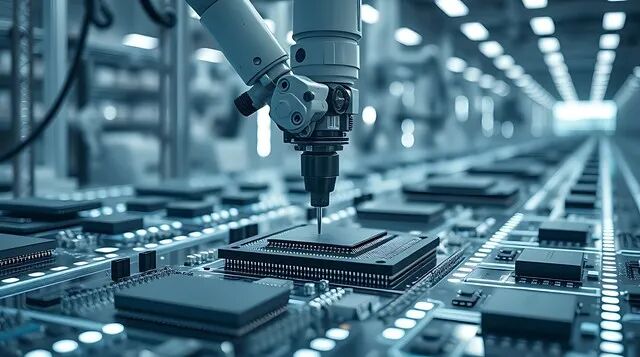
1. Semiconductor and Its Equipment Industry
(1) Overview of the Semiconductor Industry
Semiconductor devices achieve the control of current transmission through the design of materials and structures, and based on this, various efficient signal and energy processing circuits are constructed, connecting the two fundamental elements required for the development of human society—information and energy. This is the fundamental reason for the widespread application of semiconductors in today’s society, and it injects continuous momentum into the thriving of this industry.
Overall, mainland China has become the largest semiconductor consumption market in the world and an important investment market for semiconductors globally. However, the domestic supply capacity in several links of the supply chain is relatively low, and there is a phenomenon of dependence on foreign sources for some high-end semiconductor devices and equipment.
Currently, the semiconductor industry in mainland China is actively exploring various innovative technological routes, mainly including new processes (laser annealing and modification, atomic layer etching, atomic layer deposition, ultra-low energy ion implantation, etc.), new structures (homogeneous integration, heterogeneous integration, bonding stacking, optoelectronic integration, Chiplets, etc.), and new materials (high mobility materials such as germanium for logic chip channel filling, ferroelectric materials for NAND Flash chip manufacturing, indium gallium zinc oxide materials for DRAM chip manufacturing, etc.), thus achieving breakthroughs from nothing to advanced processes.
Laser technology is continuously demonstrating its application potential in the aforementioned advanced scenarios and is becoming an important tool to support breakthroughs in cutting-edge technologies for a considerable period in the future. For example, the Taiwan Semiconductor Research Institute announced at IEDM 2021 the use of nanosecond green laser annealing technology to achieve multilayer germanium single crystal channels, while utilizing USJLA equipment to activate ultra-shallow junction impurities, thereby preparing multilayer FinFET structure chips, ultimately achieving heterogeneous integration with silicon chips. Similar technological breakthroughs will further enhance the importance and demand for laser semiconductor processes and related equipment.
(2) Structure of the Semiconductor Industry
The semiconductor industry consists of upstream software and hardware materials and equipment supply, midstream design and production, and downstream module manufacturing and application.
Software, materials, and equipment are prerequisites for the design and production of semiconductor devices, and their supply stability is directly related to the overall output efficiency and innovation capability of the industry.
(3) Investment Trends in the Semiconductor Industry
In recent years, the semiconductor industry has shown significant growth, with the scale of industry investment remaining high; coupled with the fact that semiconductors have become one of the focal points of current international technological competition, major countries/regions around the world have generally adopted a series of measures, including financial subsidies, to promote the development of the local semiconductor industry, further driving up the overall investment scale of the industry. Data from institutions such as IC Insights shows that global semiconductor industry capital expenditures have consistently maintained at around $160 billion.
According to SEMI reports, mainland China will become the main region for global semiconductor capacity expansion in the coming years. From 2022 to 2026, mainland China plans to operate 44 new wafer fabs, accounting for 40.37% of the global new operating wafer fabs. For integrated circuits with high technical content, the capacity in mainland China is also rapidly increasing. Data from Knometa Research indicates that from 2022 to 2026, the global share of integrated circuit capacity in mainland China will rise from 18.2% to 22.3%, and it is expected to surpass Taiwan in 2026 to become the largest integrated circuit supply region in the world. The capacity growth in mainland China will bring a large demand for equipment and a certain amount of replacement demand for existing stock.
(4) Development Status of the Semiconductor Equipment Industry
Equipment is the main investment target in the semiconductor industry, typically accounting for 75% to 80% of total capital expenditure in the industry. With the increase in capital expenditures in the semiconductor industry and the growing demand for equipment due to the increase in advanced process steps (IBS data shows that the equipment investment for a capacity of 10,000 wafers has increased from 430 million yuan in the 90nm era to 4.3 billion yuan in the 3nm era), the market size of semiconductor equipment is accelerating its expansion.
Since 2016, the growth in demand for end products such as smartphones and wearable devices, along with the continuous upgrading of semiconductor manufacturing processes, has driven the overall growth trend of global semiconductor industry investment. In 2023, the demand for consumer electronics products weakened, and the previous large-scale capacity expansion led to some future demand being released in advance, resulting in a contraction in the global semiconductor equipment market size. SEMI data shows that global semiconductor equipment sales in that year amounted to $106.25 billion.
However, as wafer fab construction projects progress steadily, capacity expansion, and technology migration occur, the equipment market has experienced a brief downturn before resuming its growth trend; coupled with the drive of AI development, new process technologies required for new types of logic, memory, power devices, and advanced packaging such as 3D stacking and heterogeneous integration will promote equipment iteration and replacement, further increasing the market size of equipment. In 2024, global semiconductor equipment sales are expected to reach $117.14 billion.
Since 2021, mainland China has maintained its position as the largest single market for semiconductor equipment. By 2024, the market share in mainland China is expected to reach 42.30%, with sales amounting to $49.55 billion.
2. Challenges Faced
(1) Limited Long-term Funding and High-end Talent Supply
The semiconductor equipment industry is a typical capital and technology-intensive industry, with a long-term high demand for funding and high-end talent. Due to the late start of the domestic semiconductor equipment industry, the competitive advantages have not yet been fully established, leading to a mismatch between investment risks and capital returns, and a lack of high-end technical talent in the industry, which restricts the rapid development of the industry to some extent.
(2) Insufficient Industry Validation Opportunities
Overseas equipment suppliers and customers have formed numerous successful cases through long-term validation and collaboration, and the mature overseas supply chain helps semiconductor manufacturers quickly break through process research and development bottlenecks, control yield, and accelerate industrialization. In contrast, the domestic semiconductor equipment industry is in a latecomer position, with limited production line validation opportunities, and it is necessary to actively align with products benchmarked against foreign manufacturers, making production line validation more challenging. Currently, domestic equipment manufacturers are actively seeking industrial cooperation opportunities by leveraging the development window period of supply chain reshaping, capitalizing on advantages such as high customization, local stable supply, rapid response, and cost-effectiveness.
(3) The Industry Chain is Still in the Early Stages of Transformation
The development of the semiconductor equipment industry is based on upstream supply support, downstream demand traction, and coordinated development within the industry. Currently, the industry chain is still in the early stages of transformation, and the domestic supply system for core components relied upon by semiconductor laser process equipment has not yet reached a complete state. The penetration rate of related technologies such as advanced processes and heterogeneous integration in downstream applications is still in the climbing stage, and the supporting domestic high-end equipment is still in the breakthrough phase, leaving room for optimization in the industrial development environment.
For more industry research and analysis, please refer to the official website of Sihan Industry Research Institute, which also provides industry research reports, feasibility reports (project approval, bank loans, investment decisions, group meetings), industrial planning, park planning, business plans (equity financing, investment cooperation, internal decision-making), special research, architectural design, and overseas investment reports and other related consulting service solutions.

 About Us Sihan Industry Research Institute Chinasihan.comLeader in Chinese Industry ResearchBuilding a Future City of InnovationCustomized Contact Information for Report Orders: · Contact Number:4008087939 0755-28709360 · Customer Service WeChat:g15361035605 · Customer Service QQ:454058156 · Email:chinasihan@126.com
· Official Website: Chinasihan.com