Click the blue text to follow us
School
In today’s era of industrial automation entering the “robotics age”, the collaborative technology of PLC (Programmable Logic Controller) and industrial robots has become the “core standard” for intelligent manufacturing production lines. Understanding robots alone or only knowing PLC is insufficient to meet the demand for composite talents in enterprises — mastering the dual skills of “PLC control + robot linkage” not only allows one to easily break through the salary ceiling but also makes one a coveted asset for companies. By 2025, the demand for related positions will exceed 1.2 million, presenting a vast career opportunity!
1

Technical Binding:
PLC is the “brain commander” of industrial robots
The reason industrial robots can accurately perform complex tasks such as welding, palletizing, and sorting is fundamentally due to the logical scheduling and collaborative control of PLC:
✅ Motion command linkage: PLC sends position coordinates and action rhythm commands to the robot. For example, in an automotive welding line, Siemens PLC controls KUKA robots to perform continuous actions of “spot welding – arc welding – inspection” with an error of ≤0.02mm;
✅ Multi-device collaboration: PLC coordinates the linkage between robots, conveyor belts, fixtures, and vision cameras. For instance, in a 3C electronics production line, PLC synchronously controls the robot to pick and place materials, conveyor belt transportation, and visual positioning to achieve “unmanned sorting”;
✅ Emergency fault handling: PLC monitors the robot’s operating status in real-time. Once a jam or signal anomaly occurs, it immediately triggers an emergency stop and alarm mechanism to ensure production line safety. After implementation in a certain automotive factory, downtime due to faults was reduced by 60%.
When companies recruit, “PLC programming + robot linkage debugging” has become a core hard indicator. Those who only understand robot operation earn 30%-40% less than composite talents with “PLC + robot” skills.
2

Job Scarcity: 1.2 Million Shortage, Companies are Competing
With the explosive growth in the installation of industrial robots (the domestic installation of industrial robots is expected to exceed 1 million units by 2025), the shortage of composite talents in “PLC + robots” continues to expand, with core positions in high demand:
1️⃣Robot PLC Debugging Engineer: Monthly salary 15K-28K, responsible for communication configuration between robots and PLC, program linkage, and production line debugging. A certain new energy company offers a “base salary + project bonus” model, with an annual salary reaching 350K +;
2️⃣Automation Production Line Solution Designer: Monthly salary 25K-40K, leading the design of “PLC + robot” production line architecture, such as robot motion trajectory planning and PLC logic writing for lithium battery module assembly lines. Senior designers can earn over 500K annually;
3️⃣ Robot System Integration Engineer: Monthly salary 18K-35K, interfacing with customer needs, combining PLC control with robot applications, and completing customized production line transformations, with project commissions reaching up to 50% of salary.
These positions not only offer high salaries but also cover popular fields such as automotive, new energy, semiconductors, and logistics, providing limitless employment options.
3

Salary Doubling:
Single Skill vs. Composite Skills, The Difference is Obvious
In the field of industrial robots, the combination of skills directly determines the salary ceiling, with significant salary premium effects for “PLC + robots”: Those who only master robot operation have a low entry threshold and are easily replaceable, with monthly salaries generally ranging from 8K-12K for 1-3 years of experience, and can increase to 12K-18K with 3-5 years of experience, but career development is prone to bottlenecks; those who only know PLC programming, while having a wide range of application scenarios, lack the core ability for robot linkage, with monthly salaries around 10K-15K for 1-3 years of experience, and can reach 15K-25K with 3-5 years of experience, but salary growth is slow; while composite talents mastering both “PLC + robots” can achieve monthly salaries of 15K-28K with 1-3 years of experience, and even soar to 25K-40K+ with 3-5 years of experience, and their promotion speed is 2-3 times faster than those with single skills, making it easier to become technical backbones or project leaders in companies. Data from a certain recruitment platform shows that the resume response rate for such composite talents is as high as 89%, far exceeding that of single-skill job seekers.
4

Transformation with No Barriers: Different Backgrounds Can Achieve Success
The learning threshold for the “PLC + robot” skill combination is low and highly adaptable, allowing practitioners from different backgrounds to achieve career leaps:
✅ Traditional Electrician Transformation: 38-year-old electrician Xiao Li transitioned from a workshop equipment maintenance position to a robot PLC debugging engineer by systematically learning PLC programming and robot linkage debugging, with a salary increase from 9K to 22K, responsible for debugging the new energy battery production line;
✅ Mechanical Major Graduate: A 24-year-old mechanical design graduate, adding PLC + robot skills, started with a salary of 16K at an intelligent equipment company, responsible for designing robot workstations, and was promoted to project supervisor after 3 years, with an annual salary of 320K;
✅ Robot Operator Upgrade: Former robot operator Xiao Zhang, who only knew basic teaching programming, had a salary of 10K. After learning PLC, he could independently complete communication debugging between robots and PLC, doubling his salary to 21K and becoming a core technical staff member on the production line.
5

Career Path:
From Technical Backbone to Industry Expert, Unlimited Development
Learning “PLC + robots” opens up a multidimensional promotion channel of “technology + management + entrepreneurship”:
1️⃣ Technical Deepening Route: Robot PLC Debugging Engineer → Automation System Architect → Robot Control Technology Expert, focusing on the design of PLC + robot collaborative solutions for complex production lines, becoming an industry technical authority;
2️⃣ Project Management Route: Debugging Engineer → Project Engineer → Robot Production Line Project Manager, coordinating the entire factory’s “PLC + robot” automation transformation projects, with dual increases in salary and influence;
3️⃣ Entrepreneurship Route: Leveraging project experience to establish a robot system integration company, undertaking production line transformation projects in automotive, new energy, etc., with annual profits reaching millions (for example, a company focused on robot welding line integration, relying on PLC control technology, has annual revenue exceeding 8 million).
Professional Empowerment, Directly Addressing Industry Needs
School
Quickly Master the Core Skills of “PLC + Robots”
To efficiently enter this high-paying track, choosing the right training platform is crucial! Our institution focuses on cultivating composite talents in “PLC + industrial robots”, with core advantages directly addressing industry pain points:
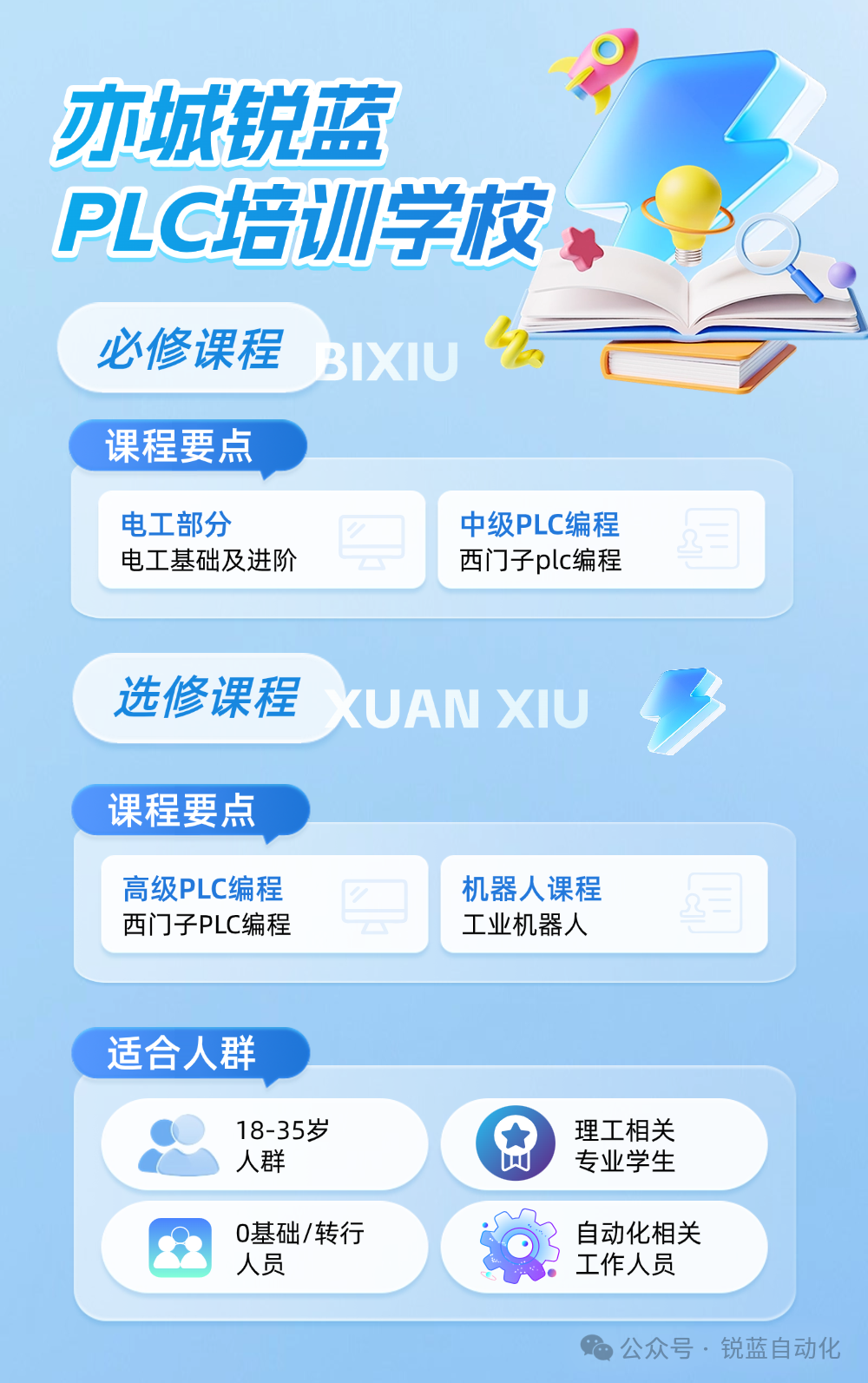
Modular course design: From basic PLC programming, robot motion control, to bus communication (Profinet/EtherCAT), and multi-device collaborative debugging, step by step, even beginners can easily get started;
Practical instructors: All instructors have over 10 years of industrial robot project experience and are skilled in teaching practical techniques for “PLC program writing + robot teaching linkage + fault troubleshooting”, aligning with real enterprise needs;
END

School
NEWS
RuiLan Automation丨Scan to follow us