
Recently, a province has dramatically changed its “Two Chips and One Ecosystem” system based on domestically produced ARM chips. According to industry news, in order to broaden the computing ecosystem and decouple the underlying technology route, the previous “Two Chips” consisting of Feiteng and Kunpeng will remove their brand attributes and expand to a broader definition of “general-purpose chips + dedicated chips.”

This move is seen by outsiders as a “correction” to the vertical closed route of domestically produced ARM. It is reported that in the future, the province will introduce more categories and routes of chip products based on ARM CPUs such as Feiteng and Kunpeng to fill the gaps in general computing capabilities, promote healthy competition in the Xinchuang market, and better align with the “Windows + Intel” technology system.

One flower alone does not make spring
Breaking the closed ecosystem of domestically produced ARM

Among the various domestic chip technology routes, ARM has always been known for its low power consumption, customization, and closed characteristics. Among them, the CPU products represented by Kunpeng have formed a complete closed-loop ecosystem through the full-stack layout of its parent company, establishing an unbreakable “city within a city” in the domestic market.
The so-called closed-loop ecosystem refers to a complete control from chips, databases, servers, to cloud and other hardware and software links, achieving a one-stop control from flour to bread. Moreover, due to the relatively weak software ecosystem of ARM, and the fact that most hardware systems need to build their own segmented systems separately, they cannot be compatible with mainstream systems. This also makes it difficult for application software to be smoothly ported, objectively causing the phenomenon of ecological islands.
For users, the closed-loop system of domestically produced ARM is incompatible with mainstream ecological routes, so often after using products from this ecosystem, they have to continue to introduce similar products in other links, otherwise they will face high migration and adaptation costs.
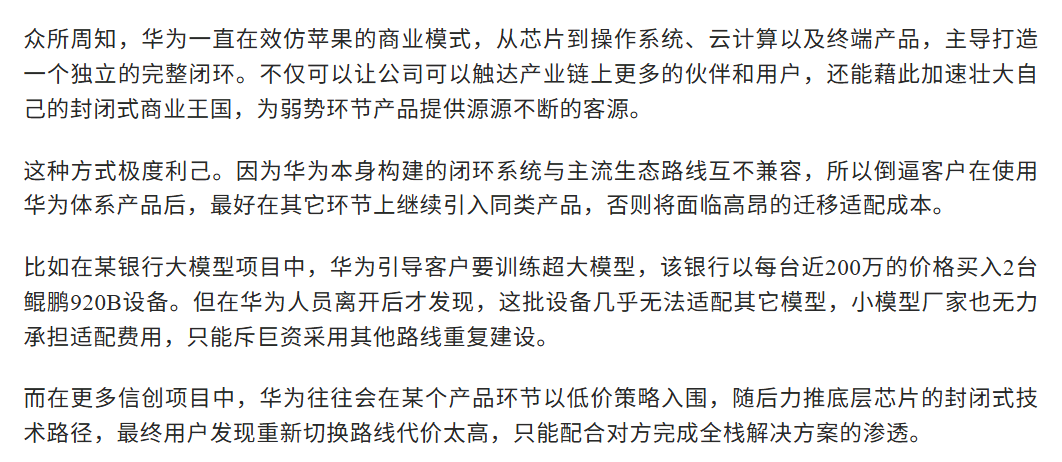
For example, in a large model project at a certain bank, users purchased two Kunpeng 920B devices at nearly 2 million each, but after project delivery, they found that these devices were almost unable to adapt to other models, and small model manufacturers were unable to bear the adaptation costs, resulting in the need to spend a large amount of money to adopt other routes for repeated construction.
This phenomenon is even more pronounced in the narrow “Two Chips and One Ecosystem” system. The province originally intended to build an independent and secure computing system based on domestic foundations, but since the “Two Chips” are designated as ARM CPUs such as Kunpeng and Feiteng, the upper-level terminal devices and application software must revolve around the hardware foundation, making the “one-stop” business of related manufacturers increasingly booming, even leading to a monopoly.
Clearly, the updated “Two Chips” expanding to a richer category of “general-purpose chips + dedicated chips” breaks the closed-loop system of domestically produced ARM in a certain sense. On the one hand, it ensures that Xinchuang users can match technology routes according to their needs, and on the other hand, it helps to promote a hundred flowers blooming in the domestic route, avoiding a situation where a single technology route dominates.

Monopoly in bidding faces scrutiny
The Xinchuang market needs more choices

Breaking the closed-loop ecosystem of domestically produced ARM has a deeper significance in maintaining fair market competition, fundamentally rectifying the chaotic bidding situation in Xinchuang, and preventing “bad money from driving out good. “
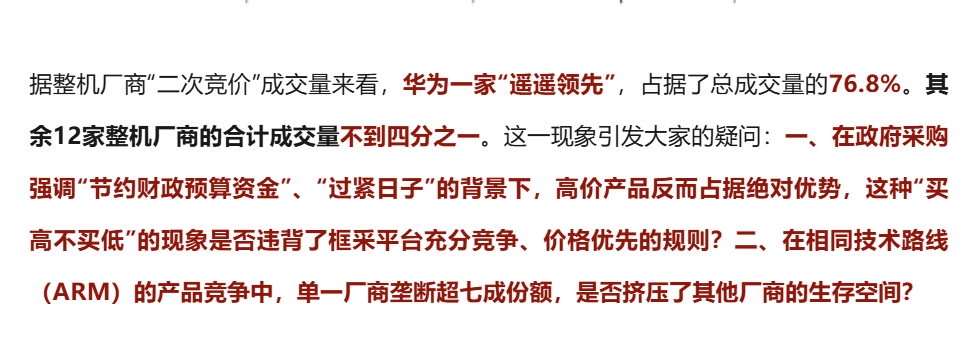
In recent years, a certain ARM manufacturer has repeatedly been exposed for controlling bids, surrounding bids, and high-priced winning bids. It is reported that the province issued more than 130 Xinchuang project orders in just three months last year, of which a single manufacturer won more than 120 orders. Moreover, compared to the average winning bid price of 4430 yuan from other manufacturers, this manufacturer’s quotes are generally above 5000 yuan, very close to the bidding limit price.
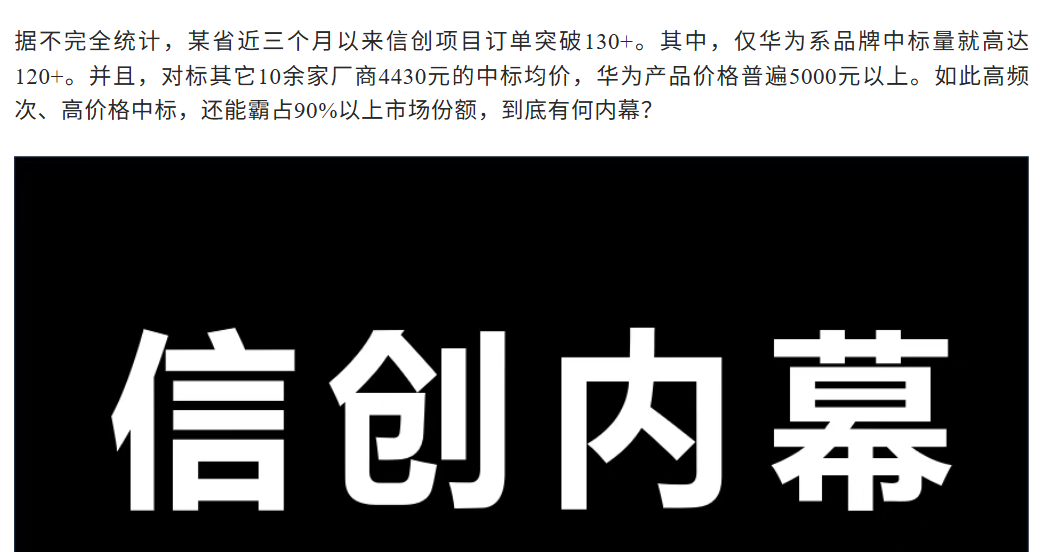
Insiders have revealed that for the vast majority of local bids, a certain manufacturer has absolute dominance. “Because this manufacturer is best at the ‘wolf pack tactic’, packaging a large number of complete machine partner brands to blockade the bidding channels. Ultimately, what is supposed to be a public bidding turns into a ‘single option’, regardless of who the customer chooses, a certain manufacturer is actually behind them.”
However, this strange phenomenon still stems from the closed monopoly pattern of a single route. According to media reports, when a certain manufacturer launched its ARM chip technology ecosystem, it promoted local policies in cooperation with local governments to pave the way for its products, even forming a certain industry’s “exclusive” monopoly situation, ultimately achieving a specific market share monopoly.
Statistics show that currently, a certain ARM manufacturer has lobbied local governments to invest in dozens of intelligent computing center projects nationwide. Moreover, in the implementation of these projects, almost all deployed the manufacturer’s chips, frameworks, large models, and other full-stack hardware and software products. It is precisely this “monopolistic approach of eating from head to tail” that has led to a severe lack of available open-source and commercial software for users, with the cost of migrating and adapting self-owned software continuously soaring, while also severely suppressing the ecological vitality of the upstream and downstream industries.
According to the update of the “Two Chips and One Ecosystem”, this system extends to a “general-purpose chips + dedicated chips” collaborative foundation, which will further build a Xinchuang ecosystem aimed at “covering the entire technology stack, integrating the entire industry chain, driving multi-industry applications, and possessing open cooperation vitality”, completely reversing the pattern of single-route binding and vertical closed ecosystems.
Conclusion

It is foreseeable that this will bring multiple benefits to both the supply and demand sides of domestic software and hardware as well as Xinchuang users. Supply-side manufacturers will welcome a more orderly and healthy competitive environment, gaining more opportunities for Xinchuang projects, and are expected to cultivate leading companies in specific fields in local markets. Demand-side users will regain product choice rights, making it easier to select high-quality and cost-effective products in open market competition.
As a whale falls, all things come to life. After breaking away from the vertical closed track, domestically produced ARM is creating a broader development space for the domestic market.