From passive response to proactive thinking, AI agents are becoming the core engine driven by enterprise data In the wave of rapid development of artificial intelligence technology, we are witnessing the rise of a brand new intelligent form — AI Agent. This is no longer a passive “question-answering machine,” but an intelligent system with autonomous perception, decision-making, planning, and execution capabilities, which is becoming a key bridge connecting underlying technology with complex business needs.
1. AI Agent: The Paradigm Shift from “Tool” to “Partner”
1.1 What is an AI Agent?
An AI Agent is an artificial intelligence system capable of autonomously perceiving the environment, making decisions, and executing actions to achieve specific goals. The essential difference from traditional AI lies in its goal-oriented and proactive nature.
Analogous understanding: If traditional AI is likened to a “question-answering machine” (it answers whatever you ask), then the AI Agent is like a “professional data analysis team” (capable of proactive thinking, planning, and completing complex data analysis tasks).
1.2 Core Features: Four Dimensions of Capability

2. Technological Integration: The Underlying Driving Force Behind the Explosion of AI Agents
The emergence of AI Agents is not accidental, but a necessary result of the integration and innovation of multiple technological fields.
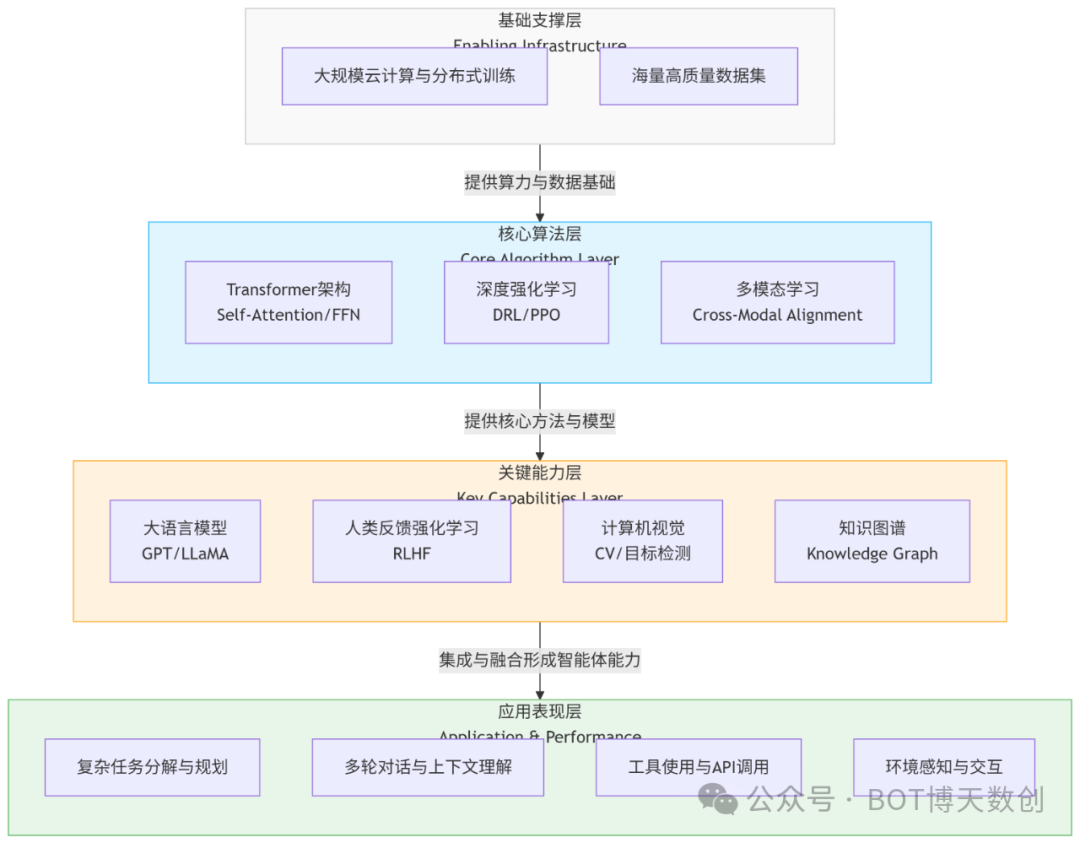
2.1 Breakthrough Progress of Large Language Models (2017-2023)
The Revolution of Transformer Architecture (proposed by Google in 2017): laid the foundation for modern AI architecture, enabling models to handle long sequence data and capture deep semantic relationships.
The Evolution of the GPT Series:
From GPT-1 to ChatGPT: The parameter count increased from 117 million to 175 billion, demonstrating astonishing language understanding and generation capabilities.
Expansion of Multimodal Capabilities: From pure text processing to unified handling of various data types such as images, code, and audio.
2.2 The Catalytic Role of Mature Reinforcement Learning
Milestones in Deep Reinforcement Learning:
AlphaGo (2016): Defeated top human players, showcasing AI’s potential in complex decision-making.
AlphaStar (2019): Achieved top human level in StarCraft II, demonstrating multi-task decision-making capabilities.
Reinforcement Learning from Human Feedback (RLHF): Enables AI to better understand human intentions and values, which is one of the key technologies behind ChatGPT’s success.
2.3 Integration of Other Key Technologies
Advancements in Computer Vision: Technologies such as object detection and image segmentation allow the Agent to “see” and understand visual information.
Multimodal Learning: Integrates various information sources such as text, images, and speech to build a more comprehensive environmental understanding.
Knowledge Graphs and Semantic Understanding: Provide the Agent with background knowledge and common-sense reasoning capabilities.
3. The Core Working Loop of AI Agents: Perception → Cognition → Action → Feedback
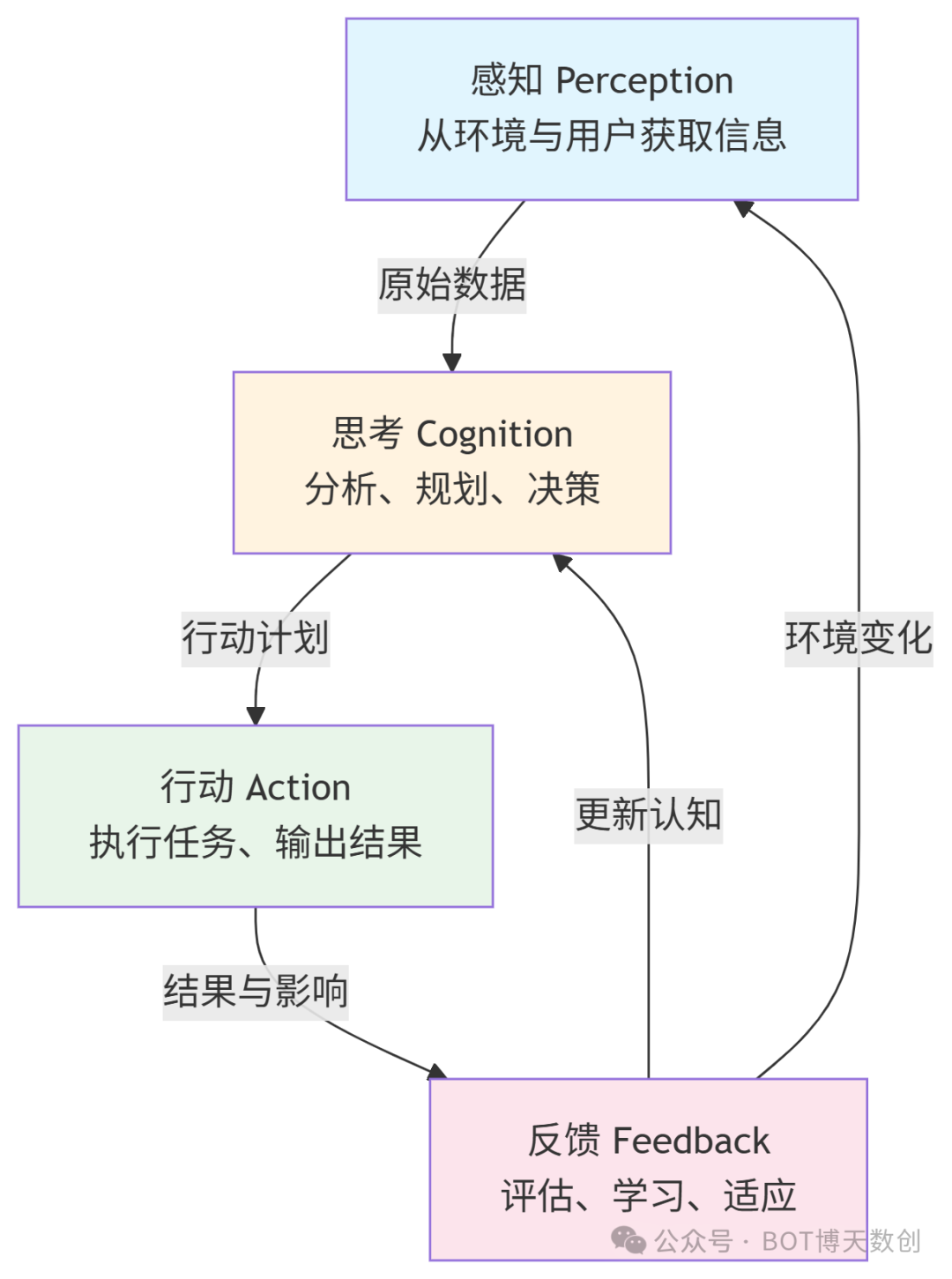
AI Agents interact with the environment and complete tasks through a continuous loop process:
3.1 Perception Stage
The Agent acquires environmental information through sensors (or API interfaces), including:
Data source status monitoring
User query parsing
System environment detection
3.2 Cognition Stage
The Agent processes and analyzes the perceived information:
Short-term memory: Maintains context information for the current task.
Long-term memory: Retrieves relevant information and historical experiences from the knowledge base.
Reasoning and decision-making: Develops action plans based on goals.
3.3 Action Stage
The Agent executes the decision results:
Invokes tools and APIs (database queries, model execution, etc.)
Generates analysis reports and visual results
Collaborates with other Agents or humans
3.4 Feedback Stage
The Agent evaluates the action results and learns:
Result quality assessment
Strategy effectiveness analysis
Experience knowledge storage
4. Architecture Analysis: The Four Core Modules of AI Agents
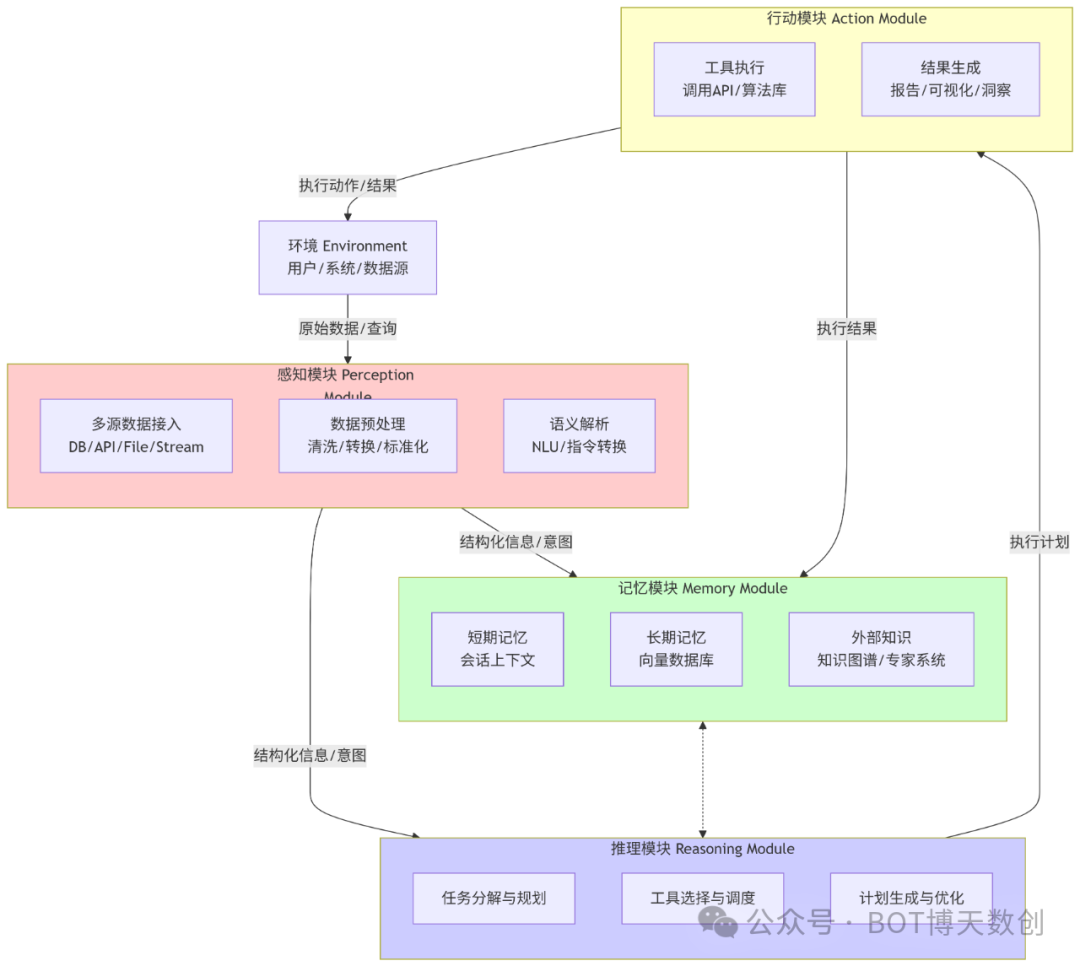
Modern AI Agents typically include the following key modules:
4.1 Perception Module
Multi-source data access: Databases, APIs, file systems, real-time streaming data
Data preprocessing: Cleaning, transformation, normalization
Semantic parsing: Converting natural language into machine-executable instructions
4.2 Memory Module
Short-term memory: Management of current session context
Long-term memory: Historical knowledge and experience stored in vector databases
External knowledge: Industry knowledge bases, domain expert systems
4.3 Reasoning Module
Task decomposition: Breaking down complex problems into executable sub-tasks
Tool selection: Choosing appropriate analysis methods and algorithms from the tool library
Plan generation: Developing optimal execution paths and alternatives
4.4 Action Module
Tool execution: Invoking data analysis tools and algorithm libraries
Result generation: Creating visual charts, reports, and insights summaries
Interactive collaboration: Confirming with users, collaborating with other Agents
The application of AI Agents in the field of data analysis is on the brink of explosion. From automated report generation to deep business insights discovery, from real-time anomaly detection to predictive analysis, AI Agents are redefining the way we understand and utilize data.
The future is here — how enterprises embrace this technological transformation and build their own AI Agent capabilities will be key to maintaining a competitive advantage in the data-driven era..