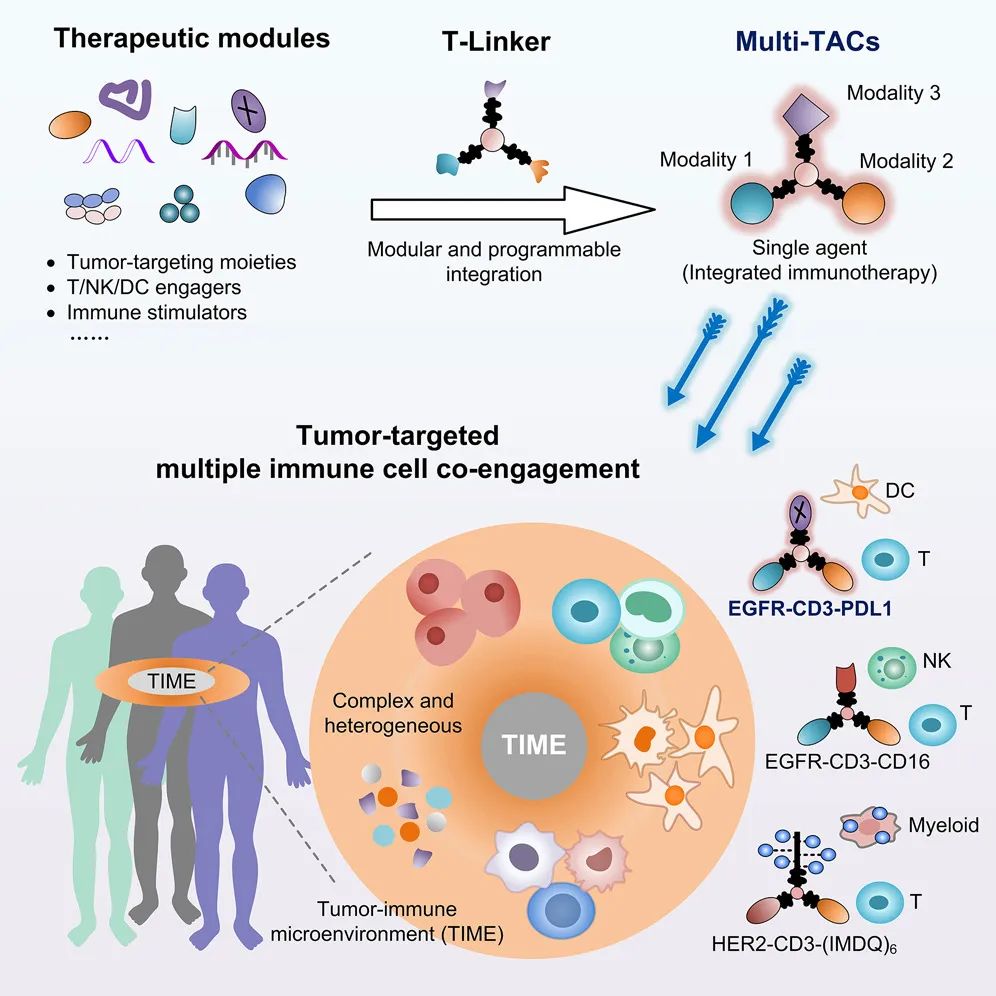
The core technology of Multi-TAC is the triple orthogonal linker (T-Linker), which efficiently and modularly connects various therapeutic molecules, including tumor-targeting modules, immune cell recruitment modules, and immune stimulation modules. Researchers first confirmed the good safety and biocompatibility of T-Linker through in vitro experiments. Subsequently, they constructed EGFR-CD3-PDL1 Multi-TAC to simultaneously recruit T cells and dendritic cells (DCs) and target EGFR-positive non-small cell lung cancer (NSCLC) cells. Experimental results showed that EGFR-CD3-PDL1 Multi-TAC significantly enhanced T cell and DC activation, promoting antigen-specific T cell proliferation and tumor cell killing. In various humanized mouse models, EGFR-CD3-PDL1 Multi-TAC also exhibited excellent anti-tumor effects, significantly inhibiting tumor growth and reshaping the anti-tumor immune microenvironment. In summary, this study developed a T-Linker technology that achieves the synergistic action of multiple immune cells in the tumor microenvironment, providing new ideas and technical support for the further development of immunotherapy.
Recommended Reading Original:
Multimodal targeting chimeras enable integrated immunotherapy leveraging tumor-immune microenvironment.
Although immunotherapy has revolutionized cancer treatment, its efficacy is affected by multiple factors, particularly those derived from the complexity and heterogeneity of the tumor-immune microenvironment (TIME). Strategies that simultaneously and synergistically engage multiple immune cells in TIME remain highly desirable but challenging. Herein, we report a multimodal and programmable platform that enables the integration of multiple therapeutic modules into single agents for tumor-targeted co-engagement of multiple immune cells within TIME. We developed the triple orthogonal linker (T-Linker) technology to integrate various therapeutic small molecules and biomolecules as multimodal targeting chimeras (Multi-TACs). The EGFR-CD3-PDL1 Multi-TAC facilitated T-dendritic cell co-engagement to target solid tumors with excellent efficacy, as demonstrated in vitro, in several humanized mouse models and in patient-derived tumor models. Furthermore, Multi-TACs were constructed to coordinate T cells with other immune cell types. The highly modular and programmable feature of our Multi-TACs may find broad applications in immunotherapy and beyond.
Edited by: Qiu Xinyan
Reviewed by: Wang Le