1. Introduction
In recent years, with the rapid development of e-commerce and the logistics industry, warehousing systems are facing increasing pressure regarding efficiency, accuracy, and cost. Traditional warehousing operations mainly rely on manual labor, which not only involves high labor intensity and error rates but also struggles to adapt to order fluctuations and rapid response demands. Against this backdrop, robotic automation technology has gradually become a key driving force for upgrading smart warehousing, effectively enhancing the overall efficiency of warehousing operations through human-robot collaboration and multi-robot coordination.
The application of robotic automation in warehousing has evolved from early single automated devices (such as AGVs) to today’s integrated and flexible systems. For example, Amazon’s Kiva robot system has successfully implemented “goods-to-person” picking, significantly increasing order processing efficiency; many domestic logistics companies have also introduced Autonomous Mobile Robots (AMRs) and collaborative robotic arms for handling, sorting, and stacking tasks. These technologies not only reduce reliance on human labor but also achieve real-time optimization of warehousing processes through data interconnectivity.
In practical applications, robotic automation systems typically adopt the following collaborative models:
- Human-Robot Collaboration Model: Robots are responsible for repetitive, high-intensity tasks (such as moving heavy objects), while personnel focus on exception handling, decision optimization, and other tasks requiring flexible judgment, forming a complementary relationship.
- Multi-Robot Coordination Model: A scheduling system is used to achieve path planning and task allocation for multiple robots, avoiding conflicts and maximizing equipment utilization.
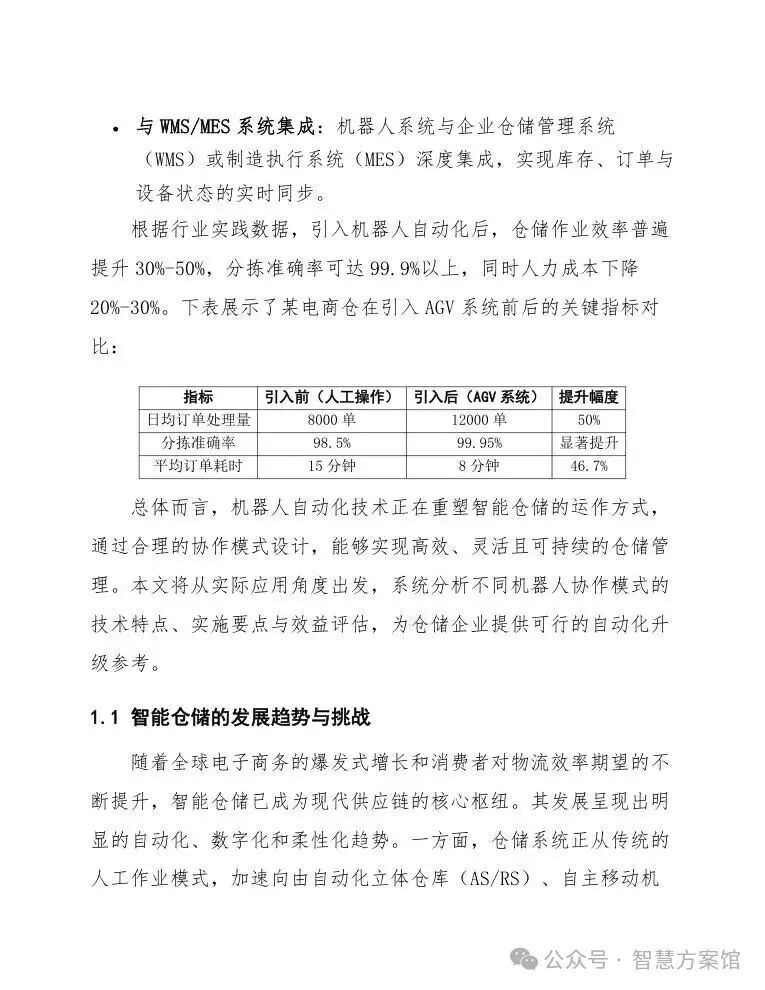
- Integration with WMS/MES Systems: The robotic system is deeply integrated with the Warehouse Management System (WMS) or Manufacturing Execution System (MES) of the enterprise, achieving real-time synchronization of inventory, orders, and equipment status.
According to industry practice data, the introduction of robotic automation has generally improved warehousing operation efficiency by 30%-50%, with sorting accuracy reaching over 99.9%, while labor costs have decreased by 20%-30%. The table below shows a comparison of key indicators before and after the introduction of the AGV system in a certain e-commerce warehouse:
| Indicator | Before Introduction (Manual Operation) | After Introduction (AGV System) | Improvement Rate |
|---|---|---|---|
| Average Daily Order Processing Volume | 8000 orders | 12000 orders | 50% |
| Sorting Accuracy | 98.5% | 99.95% | Significant Improvement |
| Average Order Processing Time | 15 minutes | 8 minutes | 46.7% |
Overall, robotic automation technology is reshaping the operational methods of smart warehousing. Through reasonable design of collaborative models, it can achieve efficient, flexible, and sustainable warehousing management. This article will systematically analyze the technical characteristics, implementation points, and benefit assessments of different robotic collaborative models from a practical application perspective, providing feasible automation upgrade references for warehousing enterprises.
1.1 Development Trends and Challenges of Smart Warehousing
With the explosive growth of global e-commerce and the increasing expectations of consumers for logistics efficiency, smart warehousing has become a core hub of modern supply chains. Its development shows a clear trend towards automation, digitization, and flexibility. On one hand, warehousing systems are accelerating their transition from traditional manual operation models to integrated systems composed of Automated Storage and Retrieval Systems (AS/RS), Autonomous Mobile Robots (AMRs), Automated Guided Vehicles (AGVs), and Internet of Things (IoT) technologies. Market data indicates that the smart warehousing market is expected to continue expanding at a compound annual growth rate of over 15% in the next five years, directly reflecting the industry’s urgent demand for efficiency improvement. On the other hand, increasing market demand fluctuations, shorter product life cycles, and a rise in personalized orders pose unprecedented challenges to the responsiveness and flexibility of warehousing.
Although automation technology has brought significant efficiency improvements, its large-scale application is also accompanied by a series of practical challenges. The primary challenge lies in the high initial investment and the uncertainty of return on investment (ROI). Deploying a complete robotic automation system involves hardware procurement, system integration, software development, and infrastructure modification, which can be costly and deter many small and medium-sized enterprises. Secondly, the integration and interoperability between different brands and types of robots, automation equipment, and traditional Warehouse Management Systems (WMS) is a key bottleneck. If systems cannot communicate and share data seamlessly, it can easily lead to “automation islands,” which in turn reduces overall operational efficiency.
Moreover, in a highly automated environment, the safety and reliability of human-robot collaboration must be addressed as a core issue. Ensuring that robots and workers can safely and efficiently collaborate in shared spaces requires precise sensor technology, reliable collision avoidance algorithms, and clear operational procedures. Finally, the system’s flexibility and adaptability are also significant challenges. The variety of SKUs, order structures, and business volumes in warehousing may change frequently, and a rigid automation system may struggle to adapt to this dynamic demand, potentially leading to low equipment utilization or an inability to handle sudden business peaks.
Therefore, exploring practical robotic collaborative models aims to transform these challenges into manageable operational parameters, becoming a key to successfully implementing smart warehousing. The goal is not to pursue complete “unmanned” operations but to optimize the collaborative relationship among humans, robots, and systems to achieve optimal resource allocation and continuous improvement of overall efficiency.
1.2 Core Value of Robotic Automation in Enhancing Warehousing Efficiency
In smart warehousing systems, the core value of robotic automation technology mainly lies in its ability to significantly optimize operational processes, reduce reliance on human labor, enhance operational accuracy, and achieve efficient resource allocation. Traditional warehousing models often face challenges such as high labor costs, significant efficiency fluctuations, and difficulty controlling error rates, while robotic systems can achieve 24/7 uninterrupted operation through modular and scalable operational units, effectively responding to order peak fluctuations and significantly shortening order processing cycles. For example, using Autonomous Mobile Robots (AMRs) for goods-to-person picking can reduce single order processing time by approximately 30%-50%, while increasing picking accuracy to over 99.9%.
Robotic systems can also dynamically adjust warehousing resource allocation through real-time data collection and analysis. For instance, in the processes of inbound, shelving, inventory counting, sorting, and outbound, robots can rely on WMS (Warehouse Management System) and AI scheduling algorithms to achieve path optimization and task collaboration, avoiding operational conflicts and resource idling. The following table compares key indicators before and after the introduction of robotic automation systems in a certain e-commerce warehouse:
| Operational Indicator | Traditional Manual Model | Robotic Collaborative Model | Improvement Rate |
|---|---|---|---|
| Average Daily Order Processing Capacity | 8000 orders | 15000 orders | 87.5% |
| Cost per Item Picked | 3.2 yuan | 1.5 yuan | 53.1% |
| Inventory Counting Efficiency | 6 hours/time | 1.5 hours/time | 75% |
| Order Error Rate | 0.8% | 0.05% | 93.75% |
Additionally, robots demonstrate significant advantages in environmental adaptability. For example, in low-temperature warehousing or heavy material handling scenarios, AGVs (Automated Guided Vehicles) and robotic arms can replace manual labor to perform high-intensity, repetitive tasks, ensuring the safety of operators and extending effective working hours. Through visual recognition and IoT sensor technology, robots can monitor product status and warehousing environments in real-time, providing timely alerts for anomalies and further reducing loss risks.
From a cost structure perspective, while robotic automation requires upfront investment, its long-term economic benefits are significant. In addition to directly reducing labor costs, the system also possesses scalability and compatibility, allowing for flexible adjustments in the number of robots and functional modules according to business scale, avoiding repeated investment due to business growth. Practical experience has shown that, with standardized shelves and processes, robotic systems can achieve ROI within 1-2 years and continuously drive warehousing operations towards lean and intelligent development.
1.3 Framework of Collaborative Models Discussed in This Article
This article aims to explore a framework of collaborative models centered around the actual integration and operation of robotic automation systems in smart warehousing environments. The core goal is to construct a layered, collaborative, and scalable operational system to enhance the overall efficiency, accuracy, and flexibility of warehousing operations. This framework is not merely theoretical but is based on currently mature technologies and deployable systems, aiming to provide warehouse operators with a clear implementation blueprint.
The framework consists of three key levels: the task decision layer, the collaborative scheduling layer, and the physical execution layer. These three levels are interconnected from top to bottom, ensuring coherence and consistency from macro order management to micro action execution.
The task decision layer serves as the “brain” of the framework, primarily responsible for receiving order instructions from upper-level Warehouse Management Systems (WMS) or Enterprise Resource Planning (ERP) systems, and for task decomposition and prioritization. For example, when the system receives a batch of customer orders containing multiple products, this layer intelligently breaks down the orders into specific picking, handling, and verification sub-tasks, generating the optimal task sequence based on factors such as order urgency and product storage location. Its core function is to ensure that all task instructions are clear, executable, and aligned with overall operational goals.
The collaborative scheduling layer acts as the “nervous system” of the framework, playing a crucial role in connecting the upper and lower levels. It receives task sequences from the task decision layer and dynamically allocates them to the most suitable robots or workstations. The core of this layer is to achieve efficient collaboration and resource allocation among multiple types of robots (such as AGVs/AMRs, robotic arms, and sorting robots). For instance, it needs to address practical issues such as how to avoid conflicts between multiple AGVs on their paths and how to seamlessly switch picking tasks from one busy robotic arm to another idle robotic arm. This layer is typically implemented by an intelligent scheduling system (such as a Robot Control System, RCS), which monitors the status and location of all devices in real-time, performing real-time path planning and task reassignment.
The physical execution layer is the “limbs” of the framework, composed of various automated robotic devices responsible for the physical execution of tasks. Devices at this layer directly interact with the warehousing environment (shelves, products, packing stations). The key requirement is to reliably and accurately complete instructions and provide real-time feedback on execution status (such as “task completed,” “equipment failure,” or “low battery”) to the collaborative scheduling layer.
To more clearly illustrate the information flow and collaborative relationships among the three levels, the following table provides specific examples of functions and interactions:
| Level Name | Core Function | Main Components/Technologies | Interaction Examples with Upper and Lower Levels |
|---|---|---|---|
| Task Decision Layer | Order reception, task decomposition, priority planning | WMS/ERP interfaces, task planning algorithms | Receives: Order from WMS for “Outbound 100 units of Product A.” Issues: Sends instruction to the collaborative scheduling layer to “pick 100 units of Product A from Area A shelf and transport to Packing Station B.” |
| Collaborative Scheduling Layer | Task allocation, path planning, conflict resolution, status monitoring | Robot Control System (RCS), multi-agent scheduling algorithms, digital twin technology | Receives: Picking and handling instructions from the task decision layer. Allocates: Assigns AGV-01 to go to Area A and schedules robotic arm-05 to perform picking. Feedback: Reports task progress or anomalies to the task decision layer. |
| Physical Execution Layer | Physical execution of instructions | AGVs/AMRs, automated guided vehicles, picking robotic arms, automated sorting machines | Receives: Instructions from the scheduling layer to “move to coordinates (X,Y)” or “grab specified products.” Executes: AGV travels along the planned path, robotic arm completes the grab. Feedback: Sends signals to the scheduling layer such as “arrived at destination,” “picking completed,” or “battery low.” |
The feasibility of this framework is reflected in its modular design, allowing enterprises to implement it in phases according to their needs and existing infrastructure. For example, initially, they can deploy AGVs in the physical execution layer for material handling, paired with a basic collaborative scheduling system; as business complexity increases, they can gradually introduce intelligent optimization algorithms from the task decision layer and more advanced types of robots. This progressive implementation path reduces initial investment risks and integration difficulties, ensuring the practical value of the framework. In summary, the collaborative model framework discussed in this article aims to provide a practical action guide for building efficient, flexible, and sustainably evolving smart warehousing systems.
2. Overview of Smart Warehousing Robot Systems
The smart warehousing robot system is the core operational unit of modern logistics centers, primarily composed of three categories of robots working collaboratively: Autonomous Mobile Robots for material handling, picking robots for order sorting, and stacking robots for goods stacking. These robots achieve task allocation and path planning through a unified central scheduling system and utilize IoT sensors to collect real-time data on inventory locations, equipment status, and environmental conditions. A typical system configuration includes 50-200 AMRs (Autonomous Mobile Robots), capable of processing 800-1200 order units per hour, with goods-to-person workstation efficiency improved by over three times compared to traditional manual models.
The system achieves centimeter-level positioning through multi-sensor fusion technology, using a combination of laser radar and visual recognition to avoid dynamic obstacles. The distribution of robot charging stations supports 15-minute fast charging for 8 hours of continuous operation. The table below presents key technical parameters of the three core types of robots:
| Robot Type | Load Capacity | Navigation Accuracy | Working Efficiency | Applicable Scenarios |
|---|---|---|---|---|
| Shelf Handling AMR | 500-1500kg | ±10mm | 24/7 operation | High-density storage areas |
| Articulated Picking Robot | 1-5kg | ±0.1mm | 20 hours/day | Piece-picking workstations |
| Truss Stacking Robot | 200-800kg | ± |
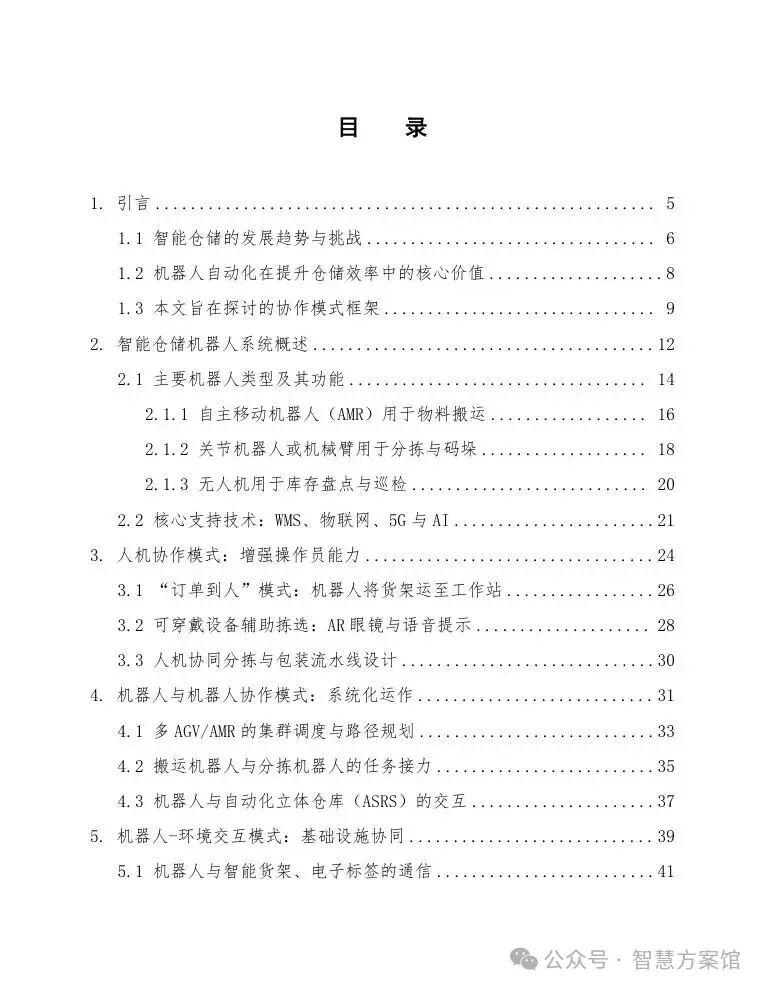
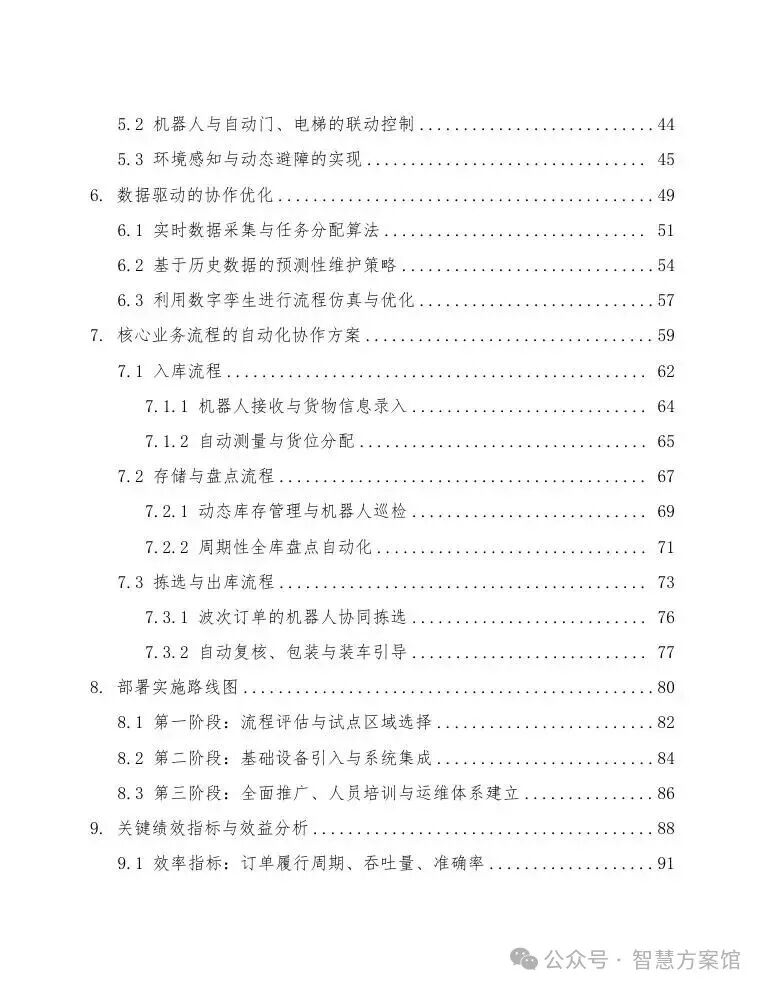
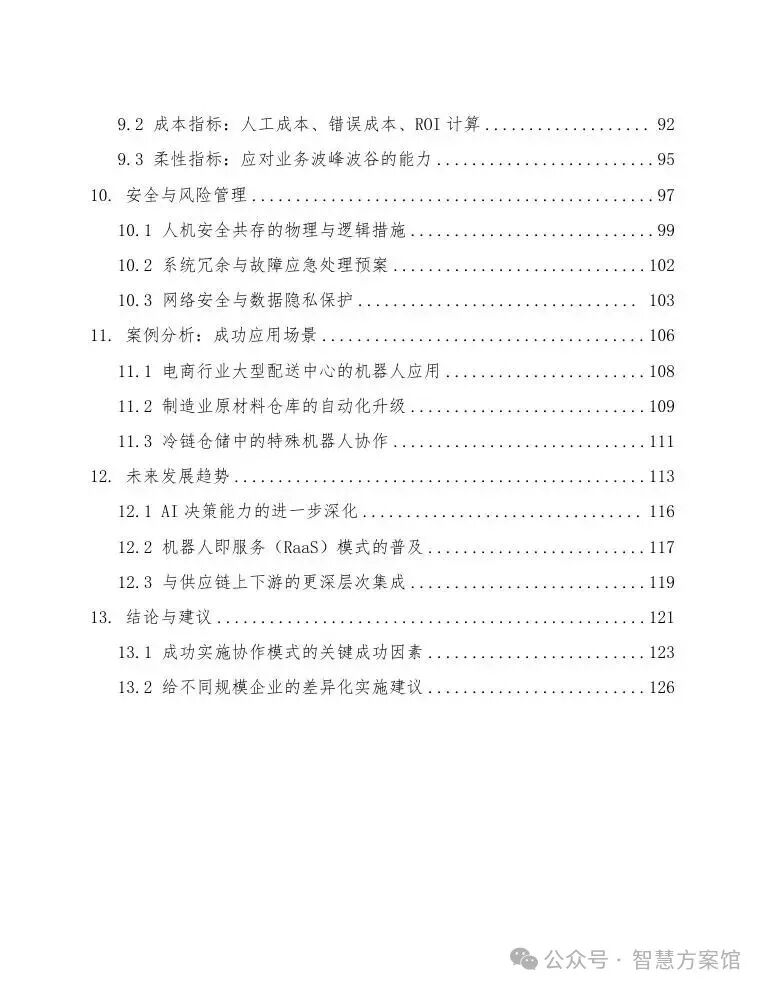
The following are original screenshots of the proposal; you can join the knowledge community to access the complete document.


Welcome to join the Smart Solutions Community, where you can read and download all plans in the community.