🔍 Article InformationAuthor:Yun LiuJournal:Journal of Hospitality and Tourism ManagementPublication Date:2025DOI:https://doi.org/10.1016/j.jhtm.2025.05.009Title:From failure to forgiveness: Proactive recovery strategies for service robots in hospitality
🤖 Research BackgroundWith the widespread application of service robots in hotels, restaurants, and other scenarios, robot service failures occur frequently. Traditional research has mostly focused on “passive recovery,” which addresses issues only after customer complaints. This study introduces the concept of “proactive recovery” for the first time and explores its role in enhancing customer forgiveness.
🎯 Research Questions
-
Does proactive recovery promote customer forgiveness more effectively than passive recovery?
-
Does perceived sincerity play a mediating role in this process?
-
Do failure attribution (who caused the failure) and consumption context (whether it is private) moderate this process?
🧠 Theoretical Foundation and HypothesesSocial Exchange Theory:Proactive recovery conveys additional investment from the company, stimulating reciprocal behavior from customers, thus making it easier to obtain forgiveness.Attribution Theory:Failure attribution affects customer responses to recovery strategies.Private Consumption Theory:Privacy needs influence customer acceptance of robot interventions.
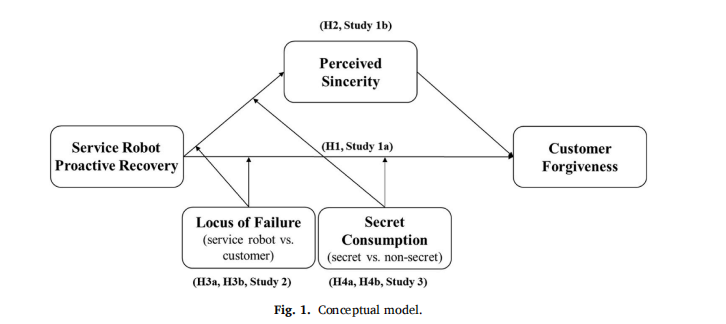
Research Hypotheses:
-
H1:Proactive recovery → Higher customer forgiveness
-
H2:Perceived sincerity mediates the above relationship
-
H3a/b:Failure attribution moderates the main and mediating effects
-
H4a/b:Consumption context moderates the main and mediating effects
🧪 Overview of Experimental DesignFour experiments were conducted, all using scenario simulation methods, with participants recruited through the Credamo platform.
| Experiment | Design | Sample Size | Main Purpose |
|---|---|---|---|
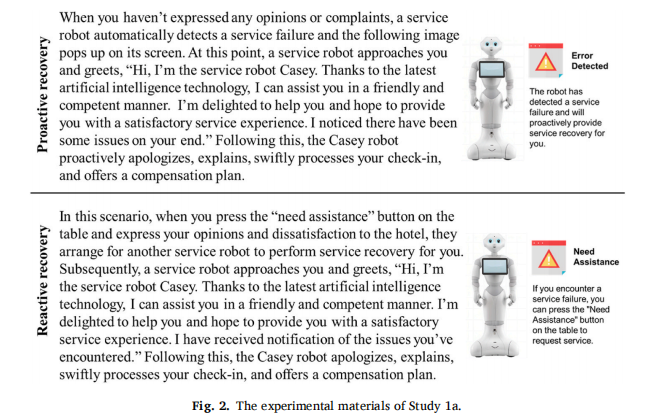
| 1a | Single Factor (Proactive vs. Passive) | 135 | Validate main effect H1 |
| 1b | Single Factor + Mediation Test | 146 | Validate H1, H2 |
| 2 | 2×2 (Recovery Method × Failure Attribution) | 256 | Validate H3a, H3b |
| 3 | 2×2 (Recovery Method × Consumption Context) | 255 | Validate H4a, H4b |
📊 Measurement Tools and Scale SourcesAll variables were measured using a 7-point Likert scale:
| Variable | Number of Items | Source | Example Item |
|---|---|---|---|
| Customer Forgiveness | 5 items | Kim et al. (2019) | “I am willing to forgive this service failure” |
| Perceived Sincerity | 3 items | Tang & Gray (2018) | “I believe the robot’s recovery is sincere” |
| Perceived Proactive Recovery | 3 items | Song et al. (2023) | “The robot proactively identified the problem” |
| Failure Attribution | 1 item | Dao & Theotokis (2021) | “Who is responsible for this failure?” |
| Consumption Context | 1 item | Self-compiled | “Was your dining situation public or private?” |
📈 Statistical Methods
-
Manipulation Check:Independent samples t-test
-
Main and Interaction Effects:One-way/two-way ANOVA
-
Mediation and Moderated Mediation Effects:Hayes PROCESS Model 4 & 8, Bootstrap=5000
-
Common Method Bias Check:Harman’s single factor test (all <50%)
✅ Main Results
-
✅ H1 Supported: Proactive recovery significantly enhances customer forgiveness
-
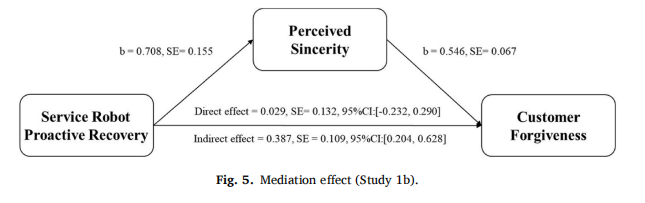
✅ H2 Supported: Perceived sincerity plays a mediating role
-
✅ H3a/b Supported: Proactive recovery is more effective only when the robot causes the failure
-
✅ H4a/b Supported: Proactive recovery is more effective only in non-private consumption contexts
💡 Theoretical Contributions
-
Introduced the concept of “proactive recovery by service robots,” expanding service recovery theory
-
Identified failure attribution and private consumption as key moderating variables
-
Extended private consumption theory from interpersonal interactions to human-robot interaction scenarios
🏨 Practical Implications
-
For Manufacturers:Should develop robots with autonomous monitoring and decision-making capabilities
-
For Hotels/Restaurants:
-
If the robot causes the failure → adopt proactive recovery
-
If the customer causes the failure → proactive/passive recovery is indifferent, recommend a more considerate recovery approach
-
In private contexts (e.g., business meetings) → avoid excessive intervention, respect privacy
⚠️ Research Limitations and Future Directions
-
The sample mainly comes from the Asia-Pacific region, requiring cross-cultural validation
-
Did not consider other sources of failure (e.g., other customers, employees)
-
Did not explore the specific impact of failure severity and recovery content
📌 ConclusionProactive remediation by robots not only enhances customer forgiveness but also demonstrates a sense of “sincerity” that surpasses human capabilities in appropriate contexts. In the future, robots with “high emotional intelligence” will become a key force in upgrading services in the hotel and restaurant industry.
English Literature Reading Full Process: A One-Stop Guide from How to “Search” Literature to How to “Manage” and “Read” It


END
Click to follow, send “Service robots “ to obtain the full PDF