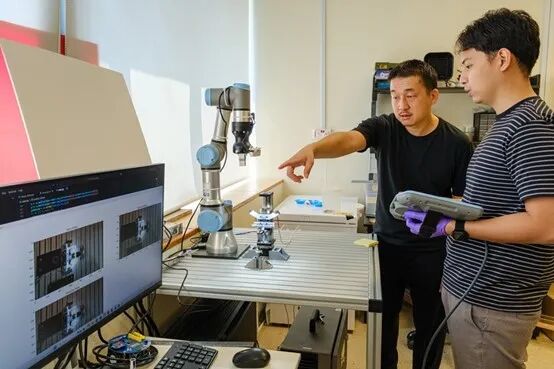
Scientists at Nanyang Technological University (NTU Singapore) have developed the world’s first automated “factory assembly line” for cyborg insects.
NTU Singapore
Editor’s Note:
Cyborg insects, also known as “cybernetic insects,” refer to insects implanted with miniature electronic devices.

With support from the Japan Science and Technology Agency (JST), this new robotic prototype system can automatically install miniature electronic “backpacks” on Madagascar hissing cockroaches, transforming them into insect robots.
This new assembly method significantly shortens preparation time and reduces human error, marking a significant step towards the large-scale application of insect robots in complex disaster environments.
Led by Professor Hirotaka Sato from the School of Mechanical and Aerospace Engineering (MAE) at NTU Singapore, the automated system can install a single insect electronic “backpack” in just 1 minute and 8 seconds.
This is approximately 60 times faster than the traditional manual method, which typically takes over an hour. When processing four insects simultaneously, the total time does not exceed 8 minutes, achieving an efficiency approximately 30 times that of manual labor.
“
Professor Hirotaka Sato stated: “Our innovation makes the large-scale application of cyborg insects more feasible. Manual operations are time-consuming and rely on skilled operators, while the automated system can stably and efficiently prepare insect robots, which is crucial for time-sensitive tasks such as post-disaster search and rescue.”
“
When the insects complete their tasks or need to rest for an extended period, the electronic “backpack” can be safely removed without causing harm to them.
Working Principle of Insect Robots
Unlike traditional robots, cyborg insects are guided by weak electrical stimuli conducted through implanted electrodes connected to a lightweight circuit board on their backs, allowing them to move naturally using their own limbs.
The AI assembly system utilizes computer vision and proprietary algorithms to accurately identify the optimal electrode implantation points on the cockroach’s back.
Compared to earlier versions, the newly designed generation of electronic “backpacks” further enhances the efficiency of stimulating the insects while reducing the voltage requirements of the device by 25%. The saved electrical efficiency can effectively extend the battery life while reducing the risk of overstimulation.
In laboratory tests, cyborg insects demonstrated the ability to execute sharp turns of over 70 degrees, with a maximum speed reduction of 68%.
Four cyborg insects explored over 80% of an obstacle-filled test area in just 10.5 minutes, showcasing their efficient mobility in complex environments.
Although this assembly line is still in the prototype stage, cyborg insects equipped with the first-generation backpacks have already been applied in real-world scenarios.
Practical Applications
On March 30, 2025, a team of 10 cyborg insects was deployed to Myanmar in collaboration with the Singapore Civil Defence Force (SCDF) as part of their “Lionheart Operation” task force.
This humanitarian aid was in response to the devastating 7.7 magnitude earthquake that occurred on March 28, which resulted in over 3,000 deaths.
This marks the first use of cyborg insects in humanitarian operations and the first deployment of insect robots in real-world scenarios.
Compared to traditional robots, which often struggle to access many disaster areas and have relatively short operational times, this rescue operation validated the immense application potential of insect-based robots in searching for survivors at disaster sites.
“
Professor Hirotaka Sato pointed out: “Based on our experience from the field deployment, it is now crucial to create infrastructure that supports large-scale production and deployment. Our assembly line is the first step towards achieving this goal, and we believe it will pave the way for more reliable applications of electronic prosthetics (robots), such as defect detection in large civil structures.”
“
Professor Hirotaka Sato is internationally renowned for his pioneering work on cyborg insects. His groundbreaking research was recognized by TIME magazine as one of the “50 Best Inventions of the Year” and by MIT Technology Review as one of the “10 Breakthrough Technologies.”
Looking ahead, his research team plans to optimize the assembly system and collaborate with local partners to further validate its reliability and feasibility for large-scale industrial applications.
This project is supported by the Japan Science and Technology Agency (JST) under the “Moonshot R&D Programme.”
ENDSource | NTU Official Website
Translation | MarinaEditing | EmilyReview | Otto


 For more exciting content, please scan to followNTU Office in China WeChat Official Account“Nanyang Technological University Singapore”
 Click “Read the original text”to enter the official website