The 3rd National Skills Competition (hereinafter referred to as “National Competition”) will be held from September 19 to 23 in Zhengzhou, Henan Province, with Guangdong Province sending116 contestants to participate in all106 events of the competition. Unlike previous years, this year’s competition features a gathering of corporate craftsmen from Guangdong, doubling the number from the last competition.
Let’s take a look at the preparation site of the corporate craftsmen
and see how they manage production and preparation simultaneously

“Robot Diagnosis and Treatment” Training Record
Industrial Robot System Operation and Maintenance Project
Industrial robots are known as the “jewel in the crown of manufacturing.” How can we ensure that robots do not “get sick” or “throw tantrums”? This relies entirely on the efforts of industrial robot system operators.
01
Prescribing for Robots
In the production workshop of Guangzhou Fengshen Automobile Co., Ltd. (hereinafter referred to as “Guangzhou Fengshen”), thousands of industrial robots are busy operating, with the automation level of the welding production line approaching 100%. Such a high level of automation has led to a sharp increase in the demand for industrial robot system operators.
The contestant representing Guangdong in theIndustrial Robot System Operation and Maintenance Project, Deng An, is a senior maintenance electrician from this company. Since graduating from Guangdong Mechanical Technician College in 2011, Deng An has dedicated himself to the automotive industry, and after 15 years of hard work, he has grown from a junior maintenance electrician to a technical backbone.
“I am mainly responsible for the maintenance of industrial robots, which closely aligns with the content of this competition,” Deng An said, noting that the competition content is closely related to his daily work and is highly practical. Through participating in the competition, he has been exposed to more advanced technologies.
The Industrial Robot System Operation and Maintenance Project is of critical significance in the current wave of intelligent transformation in the manufacturing industry. With the advancement of Industry 4.0 and smart manufacturing, the application of industrial robots in production is becoming increasingly widespread. However, the stable operation of robots relies on professional operational support.The project mainly assesses contestants’ skills in installation, debugging, maintenance, fault diagnosis, and troubleshooting of industrial robot systems, requiring contestants to have a solid theoretical foundation and rich practical experience.
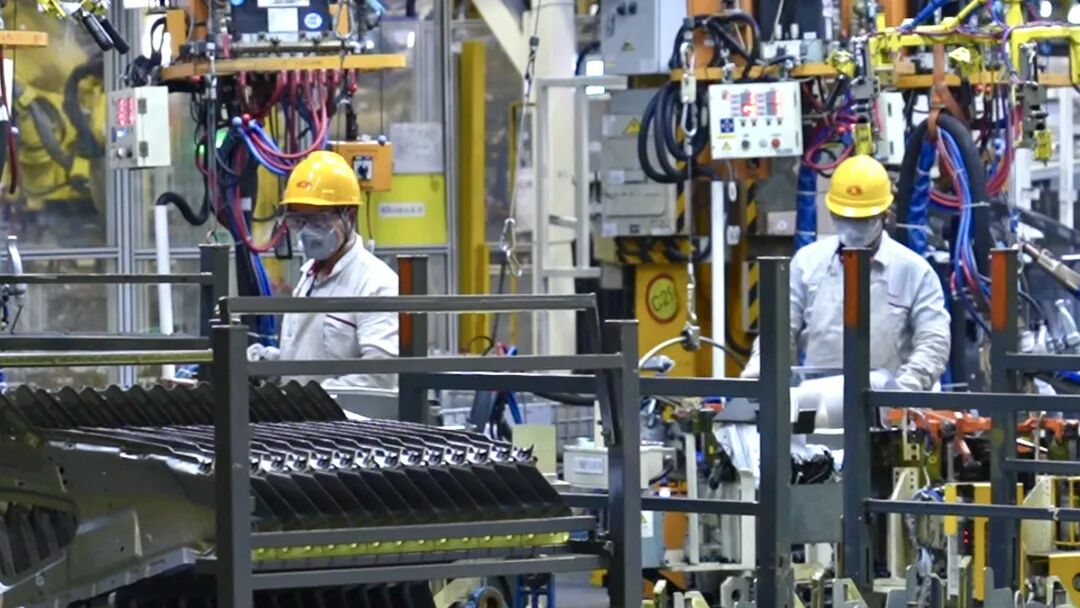
Production preparation on the front line
02
From Workshop Maintenance Worker to National Competition Contestant
From the perspective of Guangdong Province, many companies, such as Guangzhou Fengshen, have long recognized the importance of cultivating high-skilled operational talents and have established a comprehensive talent training system.
Having rooted in the automotive industry for 15 years, Deng An has grown from an ordinary junior maintenance electrician to a senior maintenance electrician. The secret lies in continuous participation in competitions—he has won first place in the company’s industrial robot competition twice and first place in the Dongfeng Group industrial robot competition, rapidly enhancing his skills and benefiting his robot operation and maintenance work.
Guangdong enterprises gradually cultivate employees’ basic skills, inherent skills, and advanced skills, while encouraging employees to accumulate experience and grow rapidly through practical problem-solving on-site.
“Technical strength is productivity!” Yang Yaohui, head of the manufacturing headquarters of Dongfeng Nissan Passenger Vehicle Company and chairman of Guangzhou Fengshen Automobile Co., Ltd., told reporters that this National Competition, starting from the needs and pain points of enterprises, provides a reference for enterprises to improve their talent training strategies and gives skilled talents the opportunity to exchange ideas with top contestants nationwide, which helps enhance the overall quality of the skilled workforce. The development of Guangdong Province in the field of industrial robot system operation and maintenance is a microcosm of its promotion of the intelligent transformation and digital transformation of traditional industries. By strengthening the deep integration of industries and actively cultivating high-skilled talents that align with industry development, it has become a backbone force in industrial upgrading.
Contestants like Deng An, while showcasing Guangdong’s skill level on the stage of the National Competition, will also further promote technological exchange and innovation, injecting new vitality into the development of manufacturing in Guangdong and even the whole country.
Skills Competition in the Digital Wave
Industrial Internet Technology Project
In the current era of rapid digital economic development, the industrial internet, as a key infrastructure connecting all elements of industry and the entire industrial chain, is becoming the core engine for the transformation and upgrading of the manufacturing industry. Let’s take a look at how contestant Zheng Fei from RootCloud Co., Ltd. navigates skills in the digital wave.
01
Comprehensive Competition Focused on “Digital Skills”
“This competition aligns with national vocational standards, covering everything from equipment installation to platform development, all of which are hard skills urgently needed by enterprises.” As a contestant in the Guangdong Province Industrial Internet Technology Project, Zheng Fei, a senior product manager in the education department of RootCloud, builds a solid foundation for competition preparation based on enterprise practical standards, aiming to showcase the professional qualities of industrial internet technology talents on the competition stage.
The Industrial Internet Technology Project is essentially a comprehensive competition centered around “digital skills”—from technical architecture construction to data value mining, from device collaborative control to business model innovation, every aspect tests contestants’ skill reserves and integration capabilities across different dimensions.
The competition aligns with the vocational standards for industrial internet engineering technicians, assessing content such as the installation of ready-made IoT devices, industrial network configuration and debugging, industrial equipment communication debugging, industrial data collection, and industrial internet platform integration and development.
At the preparation site, Zheng Fei has built a “real” industrial production assembly line. It simulates the processes of drug production, including feeding, filling, testing, and packaging into storage. This simple assembly line reflects the transition of Guangdong’s industrial automation towards digital transformation.
“The main content assessed in the competition is to achieve digitization and intelligence based on equipment automation, with the core content being the full-process circulation of data elements, such as how to ‘upload’ PLC data to the cloud. It can be said that this competition mainly assesses the integration of new technologies with traditional production equipment,” Zheng Fei stated.
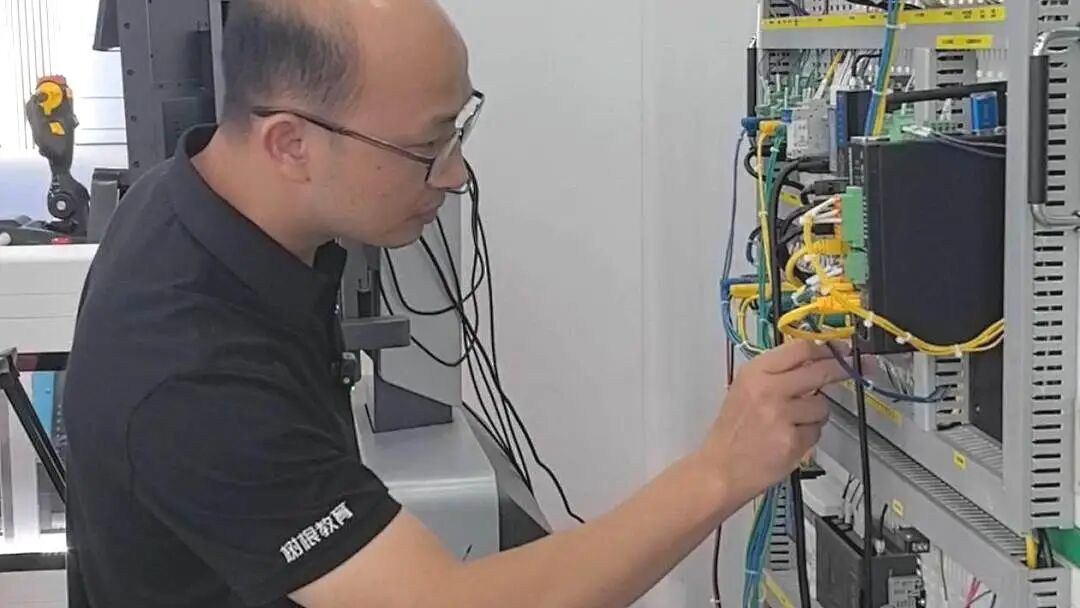
Zheng Fei is preparing for the competition
02
“Guangdong’s Skill Soil is Particularly Nurturing!”
Speaking of his connection with skills, Zheng Fei described his experience as quite dramatic. After graduating from Tianjin Vocational Normal University in 2010, he taught electronics at a vocational school in Ningbo but often felt anxious due to “not understanding the real needs of factories.” In 2013, hearing that Guangdong was vigorously developing smart manufacturing, he took his resume and headed south to seek employment. From a workshop technician to a project engineer, he spent 8 years in Guangdong’s factory workshops, finally grasping the “secrets” of the industrial internet. When RootCloud established its education department in 2021, it was precisely because of his dual experience of “understanding both technology and teaching” that he was chosen.
“Guangdong’s skill soil is particularly nurturing!” Zheng Fei said with a smile. With the support of RootCloud, he adapted case studies from the automotive parts and new energy industries he had served into teaching training projects and independently developed an industrial data collection training system. This system simulates real factory scenarios and has entered classrooms in many vocational schools in Guangdong. Now, he spends half of his time teaching at schools and half participating in industry standard formulation, becoming a “bridge” for cultivating skilled talents.
This competition is also a microcosm of Guangdong’s skill ecosystem. As a leading enterprise in the industrial internet, RootCloud not only builds the “ROOTCLOUD” platform serving 45 countries and regions worldwide but also deeply participates in the “Guangdong Skills Initiative”: co-building majors withmore than 20 vocational schools, and last year’s Guangdong Province Industrial Internet Technology Competition attractedover 500participants, with many award-winning contestants being directly “booked” by enterprises. “Guangdong enterprises are willing to invest, and the government provides support, allowing skilled talents to grow rapidly,” said the head of the education department at RootCloud.
As the “Guangdong Skills Initiative” continues to deepen, more skilled talents like Zheng Fei are emerging. From the fierce competition in the arena to innovative practices on the industrial front line, Guangdong is using skills as a key to unlock high-quality development in the industrial internet. As Zheng Fei said, “In Guangdong, as long as you are willing to delve into skills, there is a stage to realize your value.” This competition is one of the most exciting showcases on that stage.
Teaching Robots How to Work in 3 Days
Artificial Intelligence Engineering Technology Project
In today’s era of rapid technological development, artificial intelligence is no longer a fantasy from science fiction movies but has genuinely integrated into our lives and work. Let’s explore the artificial intelligence engineering technology project and see how contestants from Guangdong teach robots to “work.”
01
Focusing on Industrial Practice
Full-Process Assessment of Core Strength
Li Zhan, representing Guangdong, is undoubtedly one of the most notable contestants in this competition. “Half a day of workshop work + half a day of competition training,” Li Zhan maintains this rhythm every day, continuously honing his skills while switching between production and preparation.
ThisArtificial Intelligence Engineering Technology Project focuses on the research and application of artificial intelligence technology, resembling a high-tech feast that brings together cutting-edge technologies such as multimodal data processing, intelligent model construction, and system integration. It aims to showcase the magical charm of artificial intelligence in typical industrial and digital scenarios.
In this competition, the focus is on assessing contestants’ comprehensive abilities in deep learning model design, natural language and visual processing, multimodal fusion, and system deployment. Contestants are like magicians in the world of artificial intelligence, tasked with completing a series of high-difficulty operations in simulated AI application scenarios, including data preprocessing, model training and tuning, result evaluation and visualization, edge deployment, and debugging.
Within a limited time, contestants must complete the full-process tasks of intelligent systems, covering key aspects such as ethical risk assessment, algorithm module development, model training optimization, fault diagnosis, and performance enhancement. Each step is like a level in a game, testing contestants’ wisdom and skills.
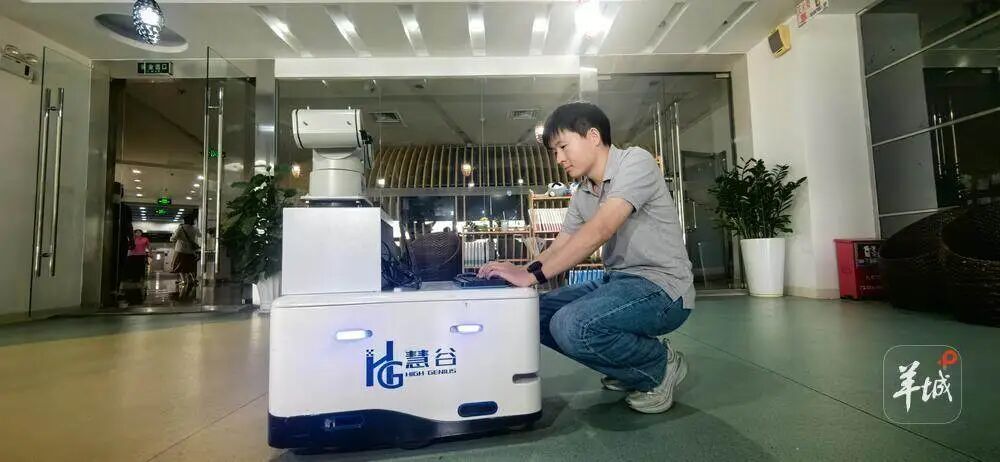
Li Zhan is teaching the robot
02
From Workshop Practice to Competition Contestant
Preparing for Competition with Industry Problems
After graduating from Dalian University of Technology with a degree in automation in 2020, Li Zhan embarked on a journey to pursue his dream of artificial intelligence. During his undergraduate studies, he actively participated in research related to robots and artificial intelligence, thus forming an inseparable bond with this field. After graduation, he started his career in Shenzhen, focusing on the robotics field, accumulating rich industry experience as if he were continuously honing his skills in the world of artificial intelligence.
In July 2023, Li Zhan joined TCL Industrial Research Institute and participated in several core projects. He engaged in the construction of internet system platforms, acting as a wise architect, promoting factory processing cycle optimization and intelligent transformation, making significant contributions to improving operational efficiency and reducing operational burdens for the company.
“What I do in the factory is to make AI truly serve production,” Li Zhan explained. The project he led for optimizing factory processing cycles and intelligent transformation ultimately established a platform that broke down the barrier of “AI technology only belonging to experts,” allowing ordinary frontline employees to participate in AI model training and apply it in production processes, directly increasing operational efficiency by over 15%. This practical experience rooted in the industry has become his “secret weapon” for competition preparation.
Flipping through Li Zhan’s competition preparation notes, one can find that every page is marked with “industry corresponding scenarios.” “I will transform the production pain points I encounter at work into competition focal points.” With this pragmatic approach to preparation, Li Zhan has already won the dual championships in the 2024 Shenzhen Skills Competition and the Nanshan District Skills Competition in the artificial intelligence trainer project.
“This competition in my hometown is both tense and familiar. I hope to transform the practical experience of enterprises into technical achievements through the competition while systematically filling the knowledge gaps in the field of natural language processing to better solve practical problems in factories in the future.” When discussing his competition goals, Li Zhan’s eyes were filled with determination.
As the National Competition approaches, the training rhythm at the preparation site is becoming increasingly intense. Craftsmen like Li Zhan are using industry practice as a foundation to refine AI technologies that are more aligned with reality on the competition stage.
Mr. Zheng Jiawei, senior manager of Shenzhen TCL High-tech Development Co., Ltd., stated: “The winners of this competition are not only those who receive medals but also those who can bring the competition technology back to the workshop, truly driving industrial upgrades.”
Source: Yangcheng Evening News, Guangdong Human Resources and Social Security
Editor: Foshan Human Resources and Social Security

Like

Share

View