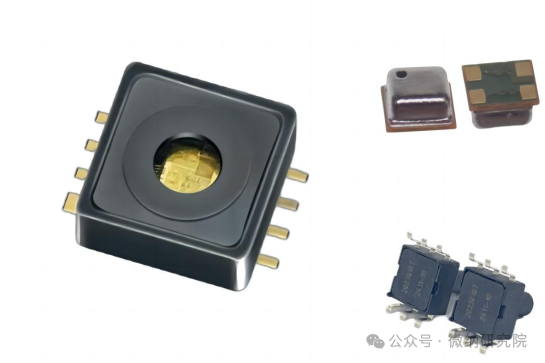
The domestic MEMS pressure sensor market exceeds 8 billion yuan, yet the localization rate is less than 5%. High-end automotive and industrial products are almost monopolized by foreign giants such as Bosch, Infineon, and Honeywell. As a “micro-nano level artifact” that integrates microelectronics and precision mechanics, why has it become a “hard nut to crack” for localization? It’s not that domestic companies do not want to engage, but rather that they face three significant barriers: technology, supply chain, and market validation, each of which is difficult to overcome.
 If you want to stay updated, click above to follow and set as a star!
1. Technical Barriers
The core of MEMS pressure sensors is the high integration of “micro-mechanical structures + electronic circuits” — etching micron-level elastic membranes and cantilevers on single crystal silicon wafers, paired with signal processing circuits, ensuring both the sensitivity of mechanical deformation and the precise conversion of electrical signals. The technical barriers behind this are much higher than those of ordinary chips.
1.1 Core Process Bottlenecks
The pressure-sensitive components of the sensor rely on deep silicon etching technology for production. Automotive-grade sensors require an etching depth-to-width ratio of 100:1, with membrane thickness controlled between 1-5μm, and vertical deviation not exceeding 0.5° — this means the etched “sidewalls” must be as straight as walls; otherwise, it will lead to pressure response deviations.
Foreign giants have long mastered mature deep silicon etching processes, capable of stably controlling membrane stress uniformity; whereas domestic companies can mostly only achieve a depth-to-width ratio of 50:1, with significant membrane stress fluctuations, resulting in sensor accuracy of only ±2% FS, far below the ±1% FS of foreign products, failing to meet automotive and industrial standards.
1.2 Packaging and Calibration
The packaging of MEMS pressure sensors is not just a simple shell; it must solve the dual challenges of “gas tightness + resistance to harsh environments”.
Gas tightness requirements: Once the micro-mechanical structures inside the sensor come into contact with moisture or dust, they will fail. Automotive-grade products require a leak rate of less than 10⁻⁸ atm・cm³/s, while domestic packaging factories have a yield of only about 70%, compared to over 85% for foreign counterparts;
Calibration algorithms: Temperature and vibration can affect sensor accuracy. Foreign giants have self-developed temperature compensation algorithms that maintain accuracy stability within the range of -40~150℃; domestic companies often rely on open-source algorithms, resulting in temperature drift errors 2-3 times higher than foreign products.
More critically, high-end products require “wafer-level calibration” — completing accuracy calibration during the chip manufacturing stage. Domestic companies lack supporting calibration equipment and processes, relying instead on subsequent manual calibration, which is inefficient and costly, making mass production impossible.
2. Supply Chain
The manufacturing of MEMS pressure sensors involves multiple links such as wafer foundry, packaging testing, materials, and equipment. The “dispersed” nature of the domestic supply chain leads to insufficient overall competitiveness.
2.1 Wafer Foundry
MEMS sensor wafer processing requires specialized MEMS processes. The focus of mainstream domestic wafer factories is on logic chips, with low maturity in MEMS processes. High-end products can only rely on dedicated production lines from TSMC and GlobalFoundries — not only are foundry costs high, but there is also the risk of priority allocation of capacity.
2.2 Materials and Equipment
In terms of materials: Doped silicon wafers for pressure-sensitive resistors and ceramic bases for packaging have insufficient stability in domestic materials. For example, deviations in the thermal expansion coefficient of ceramic bases can lead to sensor failure in high-temperature environments;
In terms of equipment: Deep silicon etching machines, wafer-level bonding equipment, and gas tightness testing equipment are mostly sourced from foreign manufacturers like Applied Materials and KLA, with domestic equipment still lagging in precision and stability.
These combined shortcomings lead to production costs for domestic companies being 15-20% higher than those of foreign companies, putting them at a disadvantage in price competition.
3. Market Rules
3.1 Long Certification Cycles and High Capital Consumption
AEC-Q100 certification requires passing over 10 stringent tests, including high temperature, high humidity, vibration, and salt spray, with testing cycles lasting 1-2 years and costs reaching several million yuan. Most domestic SMEs cannot bear such time and financial costs, while foreign giants have already passed certification and occupy the supply chain system of automotive companies.
3.2 Trust Barriers Are Hard to Break
The automotive industry has extremely high reliability requirements for components. A sensor needs to accumulate millions of kilometers of road test data to prove its lifespan exceeds 10 years and its failure rate is below 10⁻⁹. Domestic companies lack long-term road test data accumulation, making automotive companies hesitant to easily replace imported products — a certain domestic car company once attempted to use domestic sensors, but experienced accuracy drift in high-temperature environments, leading to recalls of some models, after which they reverted to Bosch products.
Similarly, in the industrial sector, high-end scenarios such as petrochemicals and aerospace tend to prefer foreign brands with mature case studies, while domestic products can only compete in the mid-to-low-end consumer electronics sector, with gross margins below 15%, far lower than the over 40% of automotive-grade products.
4. Seizing Opportunities in Niche Markets: The Time for Domestic Substitution is Now
Although the challenges are immense, the window for domestic substitution has arrived. Domestic companies are gradually breaking the monopoly of foreign giants through “niche market breakthroughs + supply chain collaboration”:
4.1 Focusing on Niche Scenarios to Avoid Direct Competition
Domestic companies are no longer blindly targeting the high-end automotive and industrial markets but are instead entering niche scenarios such as commercial vehicles, construction machinery, and smart home applications — these scenarios have relatively lower precision requirements, shorter certification cycles, and can quickly accumulate data and cash flow. For example, a certain company focuses on tire pressure sensors for commercial vehicles, optimizing algorithms to reduce the requirements on wafer processes, and has already achieved mass supply with increasing localization rates.
4.2 Supply Chain Collaboration to Fill Gaps
Domestic companies are forming collaborative alliances of “wafer factories + design companies + packaging factories”. For instance, SMIC collaborates with domestic MEMS design companies to optimize MEMS process yields; Changdian Technology and Tongfu Microelectronics are increasing R&D in MEMS packaging technology to improve gas tightness packaging yields. At the same time, policies are also supporting the localization of core equipment and materials, such as deep silicon etching machines and ceramic bases, with breakthroughs already achieved by domestic companies.
4.3 Technical Breakthroughs Focusing on Core Pain Points
Domestic companies are no longer pursuing “large and comprehensive” but are focusing on core technical breakthroughs: for example, improving temperature drift compensation accuracy through AI algorithms in calibration algorithms; developing low-cost gas tight packaging processes to reduce production costs. A certain company has controlled the temperature drift error of its sensors to within ±0.5% through self-developed temperature compensation algorithms, reaching the level of foreign mid-range products.
The localization of MEMS pressure sensors is not a “lightning war” that can be achieved overnight, but a “protracted war” that requires technology, capital, and patience. Its localization rate of less than 5% essentially reflects the long-term accumulation deficit of the domestic micro-nano manufacturing industry, but this also means there is significant room for improvement.