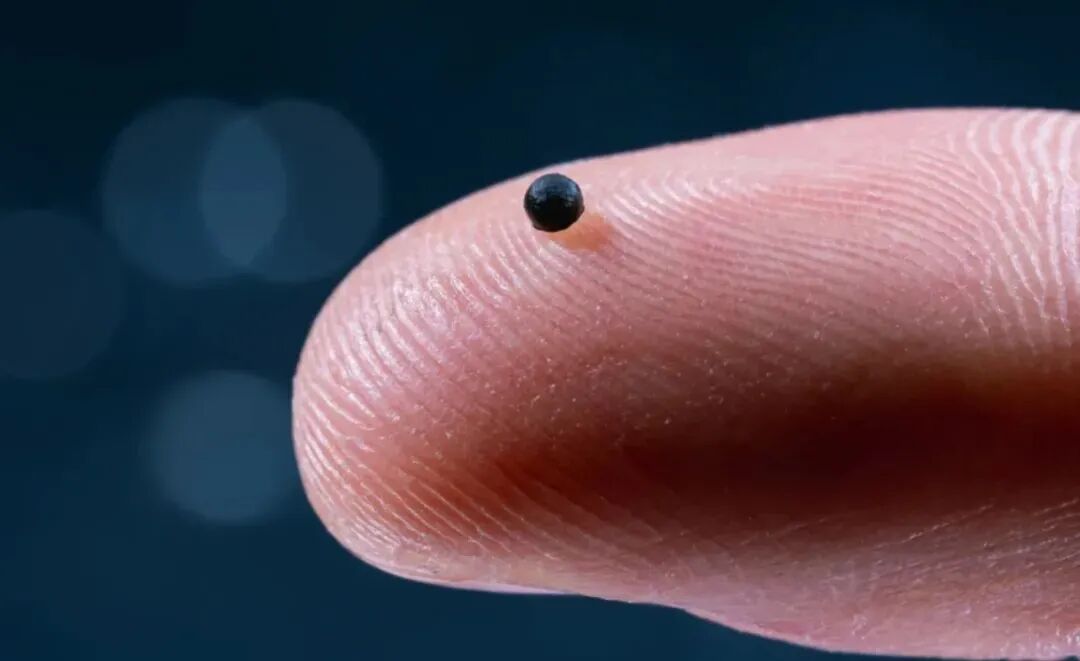
 In 1966, a science fiction film titled Fantastic Voyage was released in the United States. In the film, to save a scientist whose brain blood vessels were damaged and in critical condition, five doctors were miniaturized to a fraction of a millimeter and injected into the body to travel to the brain to repair the blood vessels and save his life. These once fanciful scientific ideas are now becoming a reality.
On November 13, 2025, researchers from the Swiss Federal Institute of Technology Zurich (ETH) published a research paper titled: Clinically ready magnetic microrobots for targeted therapies in the prestigious journal Science.
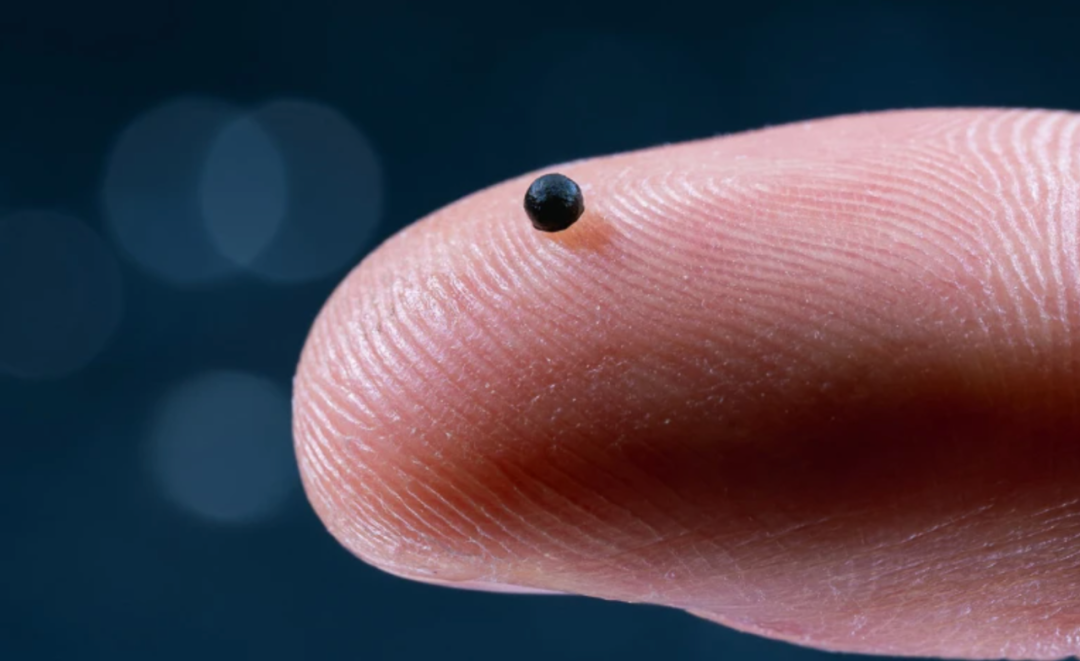
The study developed a clinical-grade magnetic microrobot the size of a grain of sand (less than 2 millimeters in diameter) that can swim within blood vessels under magnetic field guidance, delivering drugs precisely to specific sites, thereby avoiding the toxic side effects of systemic treatments and providing a promising solution for targeted drug delivery.
The research team stated that about one-third of developed drugs fail to be approved for market due to excessive toxic side effects. The microrobot developed in this study can deliver smaller amounts of drugs directly to the treatment site, thereby reducing potential toxic side effects. This technology can be used to treat diseases such as vascular blockages that lead to strokes and brain tumors.
When you swallow a pill, only a small amount of the drug ultimately reaches the target site, while most is distributed throughout the body. This systemic method of administration often leads to off-target effects, limiting therapeutic efficacy and potentially increasing side effects. In fact, about one-third of developed drugs fail to be approved for market due to excessive toxic side effects.
For decades, researchers have been exploring how to use microrobots to deliver therapeutic drugs precisely to the affected areas. This targeted drug delivery method can increase the local drug concentration at the site while minimizing systemic drug exposure, thereby reducing potential toxic side effects.
In this new study, the research team developed a clinically usable magnetic-controlled microrobot targeted drug delivery platform, bringing the concept of microrobots for precise drug delivery into reality.
Over the past two decades, microrobots have shown great potential in targeted drug delivery, but clinical translation has progressed slowly. The problem is that existing research often operates in silos—key technologies such as motion control, drug loading, and real-time imaging are studied separately, lacking integration.
The platform introduced by the team achieved three major breakthroughs:
1. Modular design. The platform seamlessly integrates an electromagnetic navigation system, a custom release catheter, and magnetic microrobots, allowing flexible adaptation to different clinical scenarios. This design enables hospitals to use it without major renovations to existing facilities.
2. Clinical-grade navigation system. The research team employed a dual Navion electromagnetic navigation system, generating a working space of 20×20×20 centimeters that sufficiently covers the human head, with a magnetic field gradient of up to 1T/m, ensuring stable navigation of the microrobots within blood vessels.
3. Safe and biodegradable microrobots. The robots are made from a gelatin matrix containing iron oxide nanoparticles (for magnetic response), tantalum nanoparticles (for X-ray visibility), and therapeutic drugs. All materials have been approved by the US FDA for intravascular applications, ensuring safety.
The entire microrobot is spherical, with a diameter of about 1.69 millimeters, suitable for operation in the brain vessels of pig models, as the size of pig brain vessels is similar to that of human brain vessels.
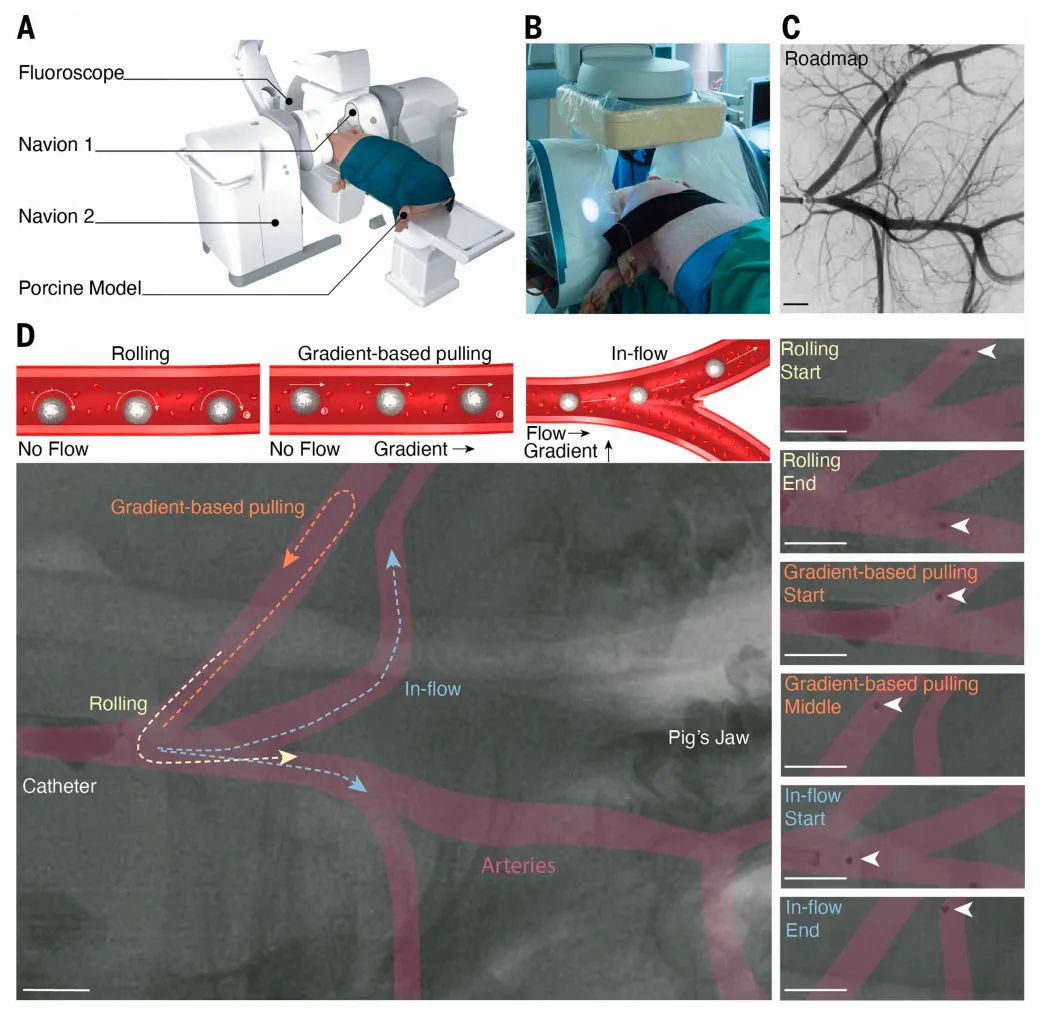
The research team designed three navigation modes to adapt the microrobots to different blood flow environments:
Rolling: Rolling along the vessel wall, suitable for low-flow areas;
Counterflow navigation: Against the blood flow, capable of reversing up to 21.2 cm/s;
Downstream navigation: Utilizing blood flow for transport, guided by the magnetic gradient, with a success rate of 95% at junctions.
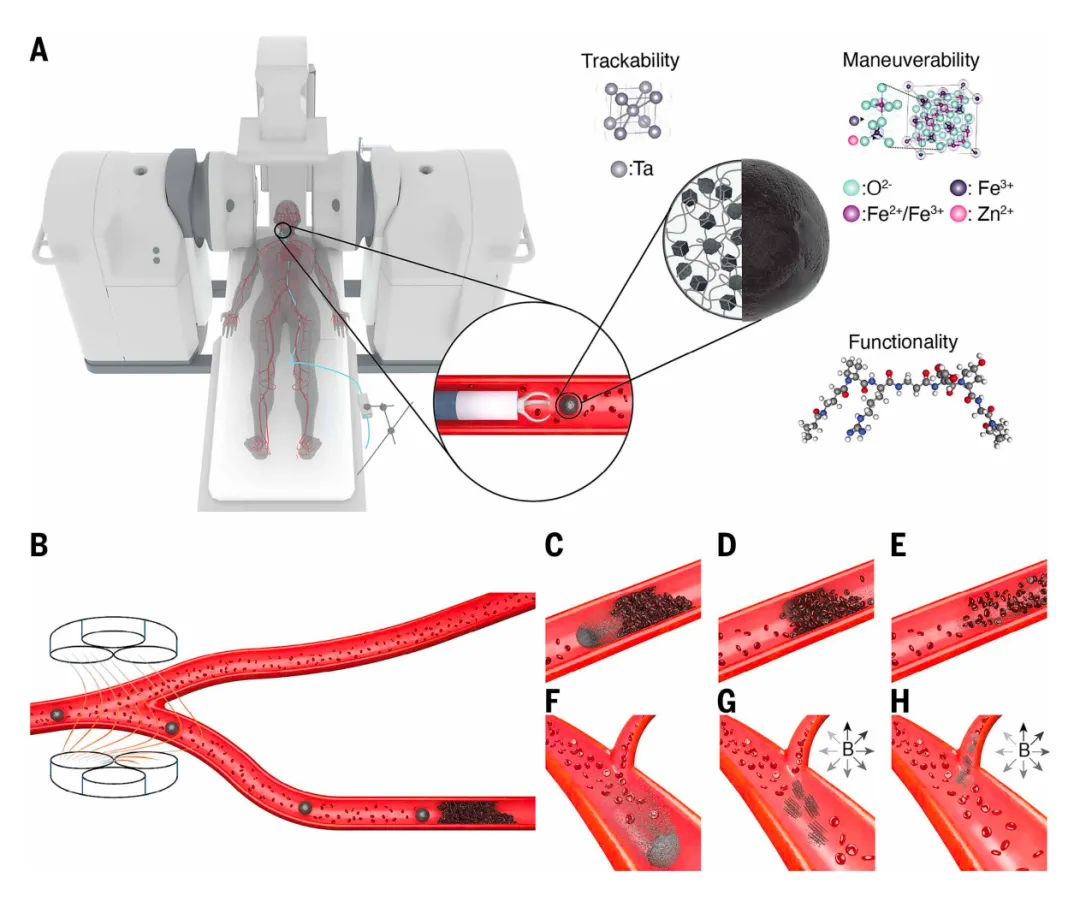
When the microrobots successfully reach the target site, a high-frequency magnetic field of 510 kHz excites the iron oxide particles to generate heat, causing the gelatin matrix to dissolve and release the drug within 40 seconds. This achieves timed and targeted drug delivery while providing a safety mechanism—if the microrobots deviate from the target location, drug release is terminated.
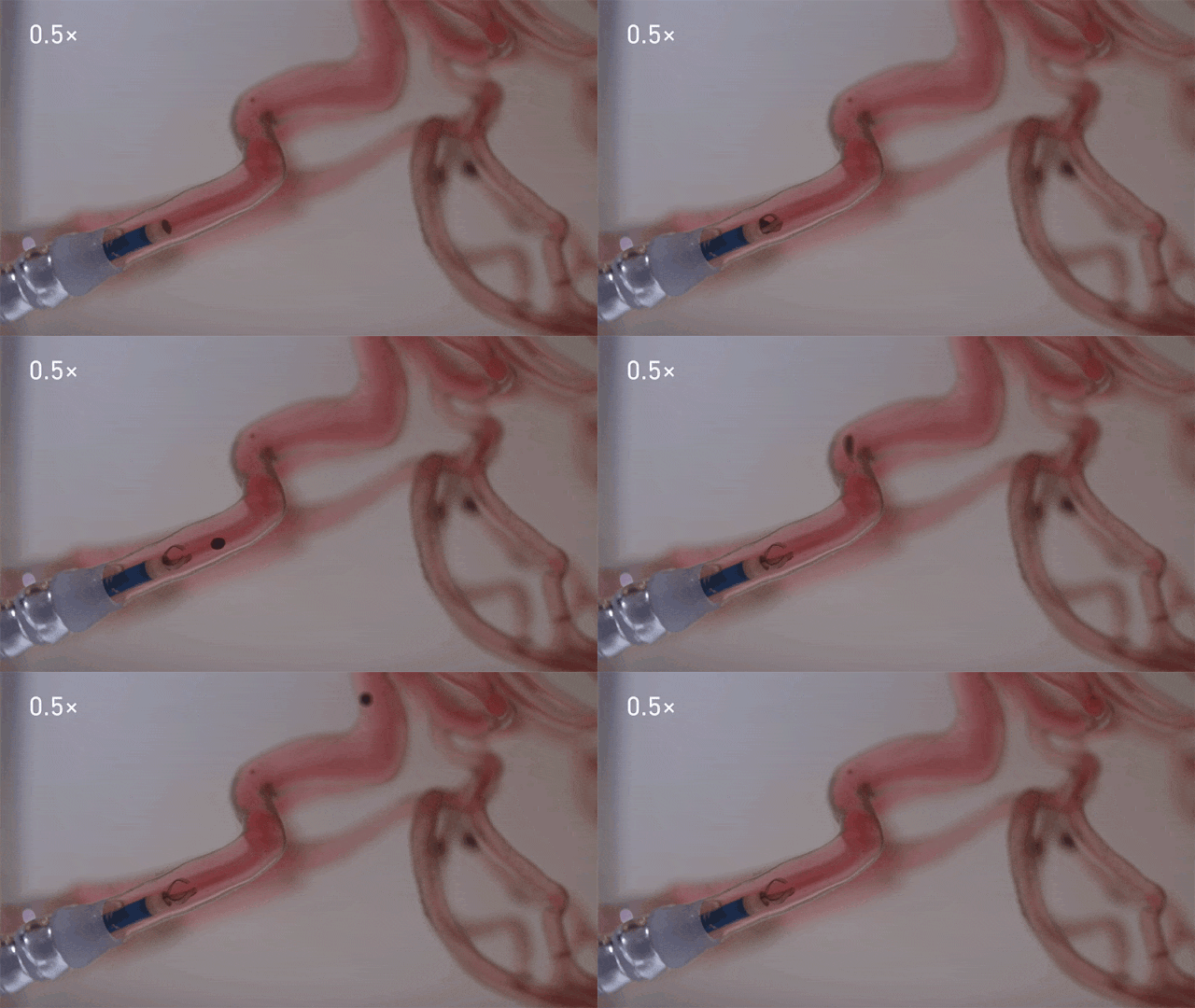
Exciting results were obtained in experiments using a biomimetic vascular model: at an internal carotid flow rate of 37 cm/s (close to the actual blood flow rate in adults), the microrobots were precisely navigated to different branches of the middle cerebral artery. The targeted thrombolysis demonstration further showcased the therapeutic potential: microrobots carrying recombinant tissue plasminogen activator (rtPA) were guided to the thrombus, and through thermal dissolution, the drug was released, resulting in vessel recanalization within 7.5 minutes and nearly complete thrombus dissolution after 19 minutes.
Large animal experiments further validated clinical feasibility: in pig models, the research team successfully guided the microrobots to target vessels such as the facial artery and lingual artery under fluoroscopy using the three navigation modes. In sheep models, the microrobots even successfully navigated to the fourth ventricle, demonstrating potential applications in the central nervous system.
Although clinical applications will take time, this research provides a practical technical pathway for precise targeted drug delivery. The advantages of the platform include: safe materials, modular systems, and compatibility with existing clinical processes. In the future, this technology may be used to treat vascular occlusions, local infections, or tumors. By reducing systemic drug exposure, it is expected to significantly improve efficacy while reducing side effects.
The corresponding author of the paper, Bradley Nelson, stated that finding the right combination of materials to allow these microrobots to be remotely controlled while maintaining a sufficiently small size to navigate through narrow blood vessels seemed obvious, but achieving this significant breakthrough took the team 20 years. The next step will be to consider conducting some form of clinical trials in humans.
Paper link:
https://www.science.org/doi/10.1126/science.adx1708
Source | Biological World
AAAR Reprint
Previous Reviews
China’s Postdoctoral First Author Science Paper: Unveiling New Mechanisms of Lipid Droplet Formation and Fat Storage in Adipocytes

Father of Organoids’ Latest Paper: Overcoming the Greatest Obstacles to Clinical Applications of Organoids, Entering a New Era of Organoid Culture

Nobel Laureate David Baker’s Latest Nature Paper: AI-Designed Antibodies Achieving Atomic-Level Precision

The Asian Institute of Anti-Aging and Translational Medicine (AAAR), headquartered in Hong Kong, is a translational medicine platform initiated by local universities, internationally renowned biomedical scientists, and patriotic elites, focusing on anti-aging and geriatric medicine, addressing aging and aging-related diseases. It aims to eliminate diseases and poverty caused by aging and promote the professional development of industry-academia-research in the field of anti-aging, achieving the strategic goal of healthy aging.