Click the blue text to follow us immediately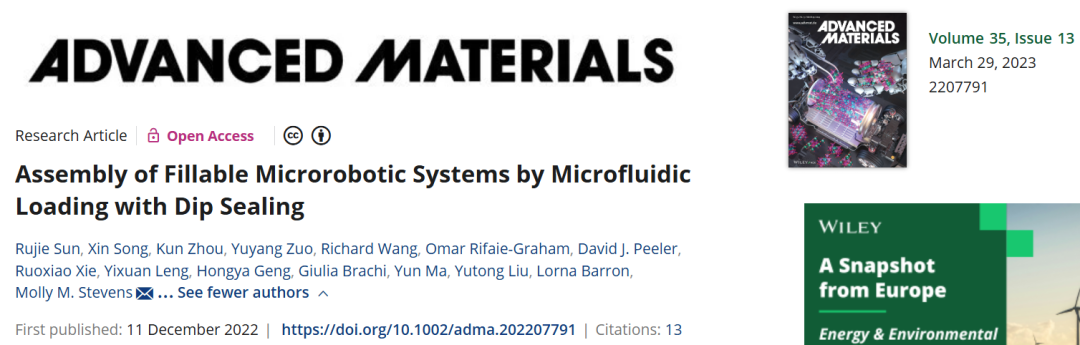
The research was conducted by Rujie Sun and his team from Imperial College London, and the paper was published in the journal “Advanced Materials”. This study introduces a novel manufacturing technique for filling microrobots, known as Microfluidic Loading and Immersion Sealing (MLDS). This innovative approach aims to enhance the loading efficiency and cargo protection capabilities of microrobots, demonstrating significant potential in biomedical applications such as drug delivery and environmental monitoring.
In the medical field, microrobots provide a new method for drug delivery. Compared to traditional drug delivery technologies, microrobots can achieve more precise spatiotemporal control, improving treatment efficiency. However, current loading technologies, including surface coating and direct mixing, often face issues of low loading efficiency and insufficient cargo protection, which may lead to degradation and waste of drugs during transport. Moreover, these methods may cause non-specific contact with healthy tissues before the drugs reach the target tissues, thereby reducing therapeutic efficacy. Therefore, it is urgent to develop microrobot loading and release technologies that can enhance cargo loading efficiency while effectively protecting formulations.
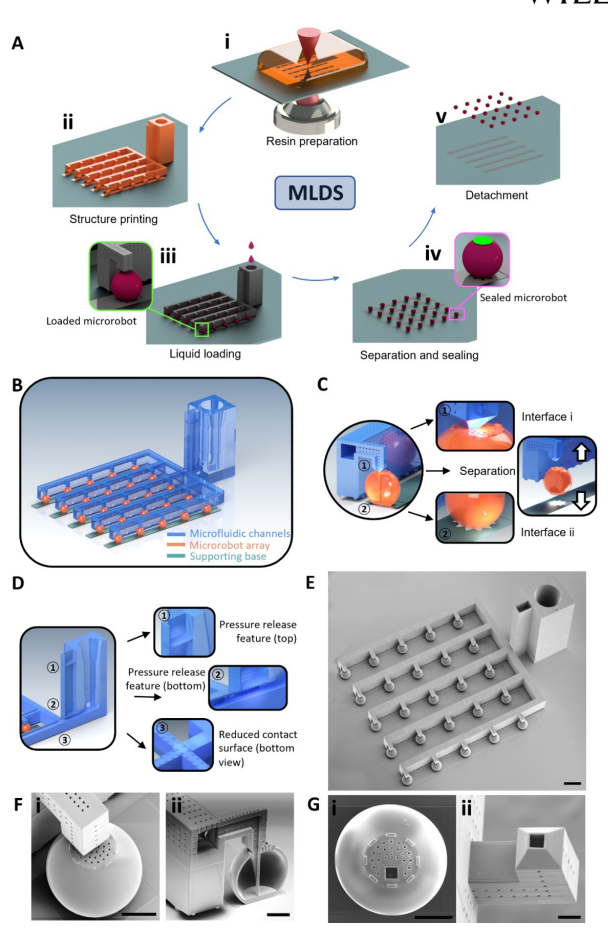
To address this, the research team designed and implemented the MLDS technology, which combines high-resolution 3D printing with microfluidic systems. The newly added microfluidic loading system allows for precise control of cargo, ensuring that different anti-drug agents can be effectively encapsulated. To enhance the protection of the loaded cargo, the researchers also developed an immersion sealing strategy compatible with the current loading system, ensuring encapsulation without affecting the geometric shape of the microrobots. Notably, the study utilized equipment from Nanoscribe, employing two-photon polymerization technology (2PP) for high-precision 3D printing to achieve complex structures of microrobots, ensuring stability during the loading and sealing processes.
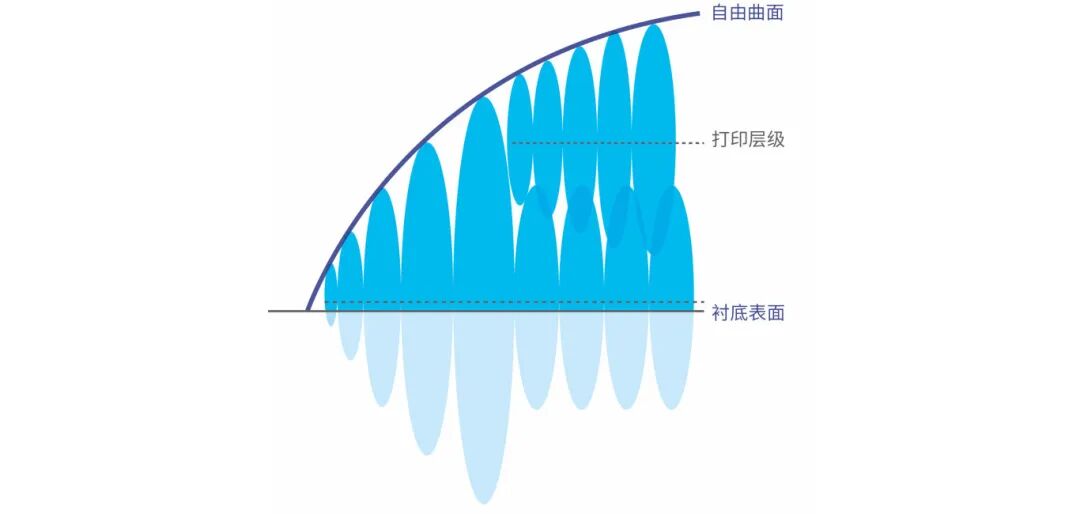
Nanoscribe’s two-photon grayscale lithography technology (2GL®) is a revolutionary breakthrough in the field of micro-nano 3D manufacturing. This technology combines the advantages of grayscale lithography and two-photon polymerization, achieving precise control over microstructures and their surfaces, providing unprecedented design freedom. 2GL® can manufacture ultra-smooth spherical/aspherical microlenses, sharp planar structures, and high aspect ratio freeform micro-optical devices, and even create diffraction/refraction hybrid optical elements. Nanoscribe’s 2GL® technology is protected by Chinese national patent (Patent No.: CN110573291B).
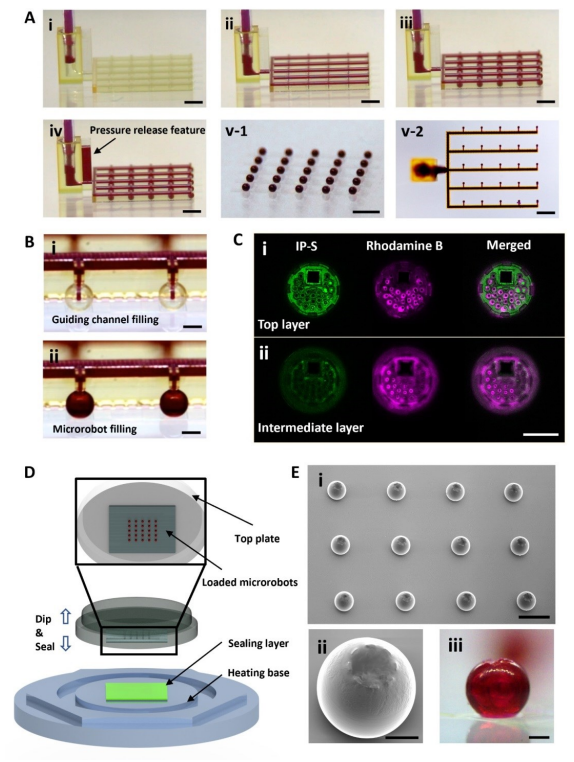
The research team first designed the microfluidic loading system, constructing a complex system composed of multiple steps. Firstly, by optimizing the printing parameters with Nanoscribe equipment, the researchers were able to shorten the printing time while maintaining the structural integrity of the microrobots. In the design of the microfluidic channels, the researchers cleverly utilized apertures of different sizes to develop a pressure release mechanism to reduce the risk of leakage that may occur during the loading process. Subsequently, they used a syringe pump to deliver drugs by precisely controlling the flow rate, ensuring that each microrobot could uniformly and efficiently load cargo, while also allowing for the recovery of unused drugs, minimizing resource waste.
Additionally, the research team innovatively proposed a method called “immersion sealing,” using thermoplastic polymers to encapsulate the loaded microrobots. By bringing the microrobots into contact with molten polymer at an appropriate temperature, they achieved sealed protection of the cargo, preventing leakage or degradation during transport. This sealing material not only has good biocompatibility but also maintains the stability of the cargo under physiological conditions.
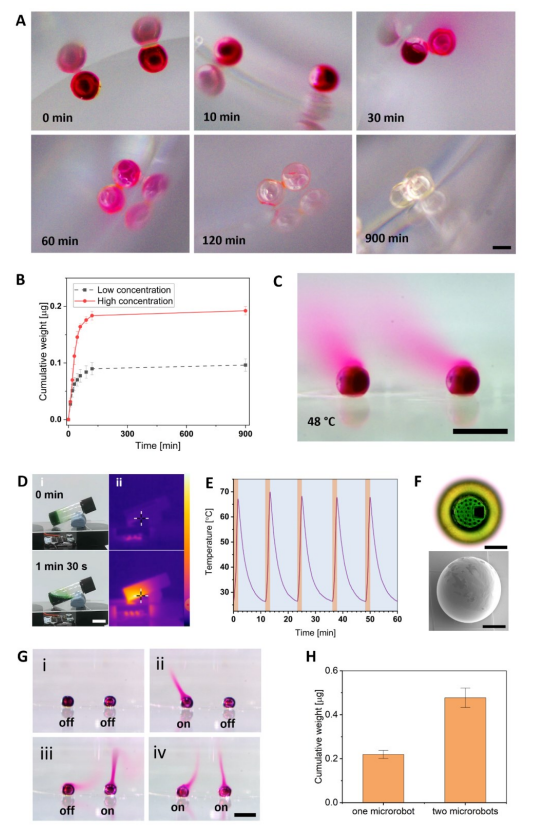
During the experiments, the researchers also explored various external stimuli to achieve precise drug release. Thermal stimulation and near-infrared light stimulation were both proven to be effective release mechanisms. When the microrobots are heated above the drop point of the polymer in vivo, the sealing layer returns to a liquid state, thereby releasing the loaded drugs. Furthermore, they improved the polymer material by incorporating infrared dye (IR-813), allowing the material to rapidly reach the required release conditions under near-infrared irradiation, further enhancing the flexibility and precision of the release.
Through these innovations, the research team demonstrated the prospects of MLDS in various application fields. For example, they constructed a vascular structure simulating a tumor, using a magnetic field to guide the microrobots along a predetermined path in the model, and releasing cargo upon accurately reaching the designated location. This flexible operation not only improves the targeting of drug release but also showcases the potential of MLDS-based microrobots in autonomous movement.
In conclusion, the research team highlighted the diversity and flexibility of MLDS. This method allows for broad exploration in applications such as drug loading, environmental sensing, and even as chemical-powered micromotors. This technology demonstrates how design and process optimization can enhance loading efficiency and protection mechanisms, paving the way for future precision medical applications, with the ultimate goal of achieving more efficient clinical drug therapies and the development of multifunctional micro-devices.
Through this research, the team not only expanded the application potential of microrobots in the biomedical field but also pioneered a new generation of micro-manufacturing technology, laying the foundation for the future creation of more efficient drug delivery and environmental monitoring tools, which is expected to fundamentally change traditional treatment methods.
Related literature and image sources
https://doi.org/10.1002/adma.202207791
 MNTech Micro-Nano NavigationScan the QR code to follow usPrevious Recommendations:
Breakthroughs in Microfluidic Technology: Research on New Methods for Producing Monodisperse Micrometer Bubbles
Preparation of Functional Hydrogel Fibers via Microfluidic Wet Spinning Technology
Click here to “read the full article” to view the original paper