

Buildings are not just cold collections of steel and concrete; they are complex systems that need to operate in coordination, much like the human body. The nervous system, skeletal system, and other systems in the human body operate in an orderly manner under the command of the brain, and similarly, the building’s self-control, power supply, and fire protection systems must work efficiently together.
If any link is disconnected, it can lead to energy waste, decreased comfort, and other issues. Therefore, buildings also need a ‘smart brain’—the Smart Building IoT Cloud Platform, and the solutions provided by Shenzhen Sanbo Electric Co., Ltd. inject such a ‘core of life’ into buildings.
1. Buildings Need a ‘Brain’: Solving the Pain Points of Ordinary Building Operations
The self-control systems of ordinary buildings operate independently, relying on human experience for maintenance, which has many shortcomings. Manual inspections are inefficient when faced with diverse equipment, and the varying skill levels of personnel lead to untimely fault diagnosis; at the same time, independently operating systems cannot optimize collaboratively, which not only increases maintenance costs but also causes significant energy waste. Just like the human body would fall into chaos without the brain’s command, buildings lacking a ‘smart brain’ find it difficult to coordinate their systems, unable to meet the modern demands for efficiency, energy conservation, and safety, urgently requiring an intelligent management solution that can integrate all systems.
2. The Cloud Platform as the ‘Brain’: 8 Major Functions to Make Buildings ‘Come Alive’
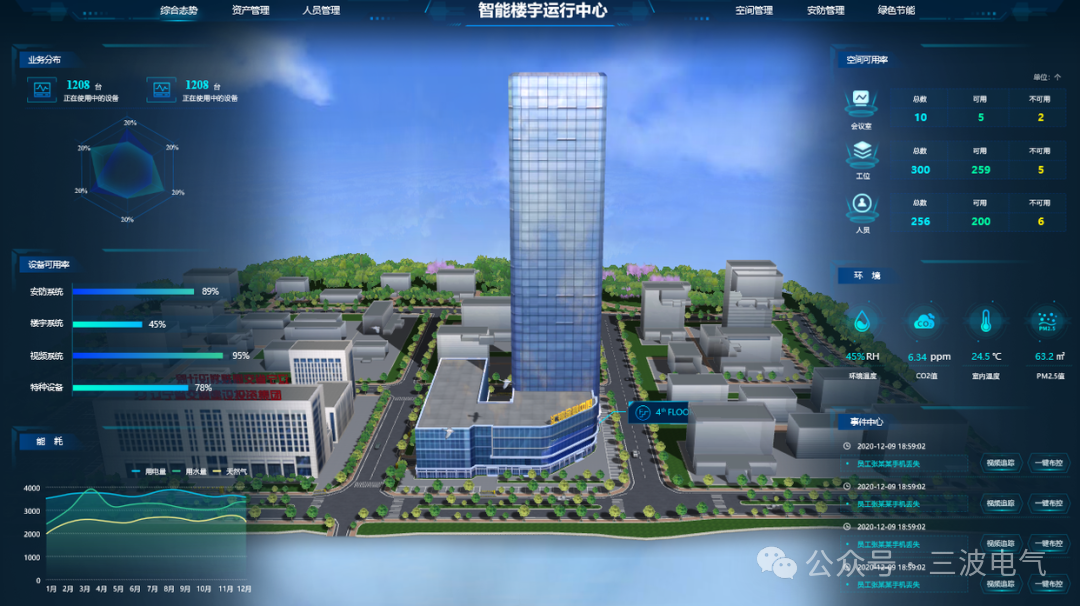
Sanbo Electric’s Smart Building IoT Cloud Platform, relying on IoT sensing technology and digital twin technology, connects all devices like the human brain, achieving 24-hour intelligent operation and maintenance, with its 8 core functions making buildings ‘come alive’.
The first is smart environmental monitoring, which continuously monitors air quality in various areas and links to control air conditioning and purification devices;
The second is smart air conditioning monitoring, which understands air conditioning conditions and accurately sets parameters to ensure comfort and energy efficiency;
The third is smart elevator monitoring, which presents the elevator’s operating status and floor position through building visualization, enhancing safety management efficiency;
The fourth is smart lighting control, which automatically or manually adjusts lighting based on light intensity and working days, reducing energy consumption;
The fifth is a smart water supply and drainage system, which monitors flow, pressure, and equipment status to ensure stable water supply and drainage;
The sixth is smart fire management, which collects temperature, smoke, and other data, providing real-time alerts and displaying evacuation maps;
The seventh is smart parking management, which clearly presents parking space availability and vehicle entry and exit situations, optimizing the parking experience;
The eighth is smart energy consumption monitoring, which statistically analyzes water, electricity, and gas consumption by area, assisting in low-consumption optimization.
These functions achieve coordinated control of key building systems, making management more efficient.
3. Flexible Management: Backend Mode Adapting to Diverse Needs
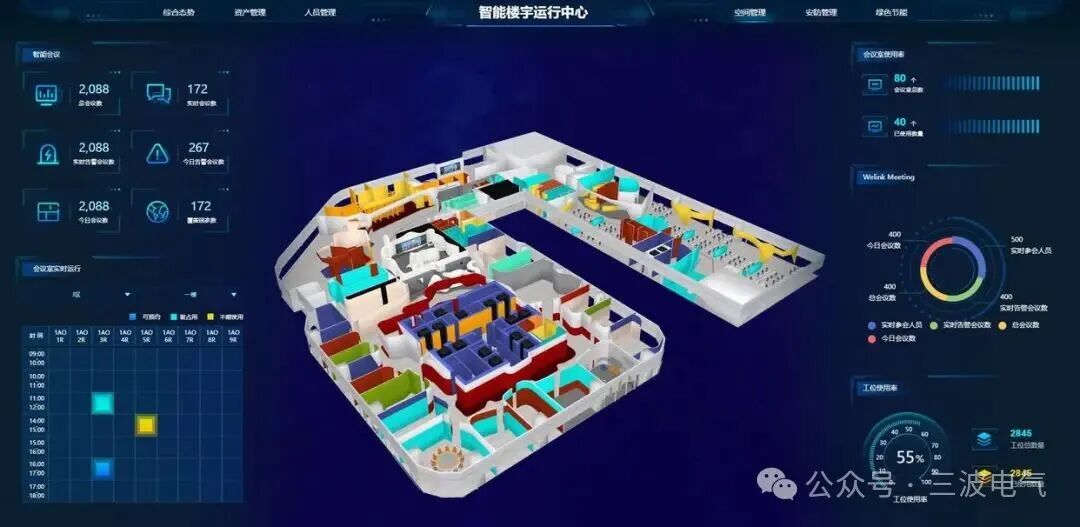
In addition to large-screen visual management, this cloud platform also provides a modular backend management mode to meet personalized user needs. First, the data monitoring module supports filtering building parameters by floor and room, allowing users to view historical data by clicking cards, fully grasping operational dynamics; second, the system configuration module allows customization of floor structures, adding devices, setting alarm conditions, and automatic control logic, flexibly adapting to different building scenarios; third, the data management module allows users to customize statistical parameters and presentation forms, such as curves and reports, providing data support for decision-making; fourth, the task inspection module supports setting inspection rules, issuing tasks, and counting completion status, standardizing maintenance processes. Each menu can be freely adjusted and combined, truly achieving ‘tailored solutions’ that make management more aligned with user needs.
Sanbo Electric’s Smart Building IoT Cloud Platform, acting as a ‘smart brain’, breaks down the management barriers of ordinary buildings, transforming them from ‘passive operation’ to ‘active intelligence’, truly bringing them to life and providing a new solution for modern building management that is efficient, energy-saving, and safe.

Recommended Reading:
Next-Generation SCADA Configuration Software: Opening a New Era of Intelligent Factory Management
SCADA Systems: The ‘Smart Eye’ of Factories for Efficient Operations
SCADA and HMI: The Golden Partners in Industrial Automation
IIoT Empowering Smart Factories: Driving a New Era of Industry 4.0
Industry 4.0: The Future of Manufacturing Productivity and Growth
Embracing Industrial IoT (IIoT): Eight Reasons to Drive Business Transformation and Innovation