Source:Ordinary, Warm, and ShiningEditor: Chen Pingping’s Princess @ A Little Artificial IntelligenceGroup Invitation: 10Professional Direction Discussion Groups
Embodied intelligence, as a cutting-edge direction in the field of artificial intelligence, emphasizes that agents acquire knowledge and enhance capabilities through interaction with the physical environment, achieving a closed-loop intelligence of “perception-decision-action.” This endows humanoid robots with the core abilities to understand the environment, make autonomous decisions, and act flexibly. Humanoid robots, with their highly realistic appearance and human-like movement and interaction methods, serve as ideal carriers for embodied intelligence technology, complementing each other and jointly promoting the development of intelligent robotics.
Currently, the global embodied intelligence and humanoid robot industry is in a rapid development phase, with the market size continuously expanding and application fields constantly broadening, covering various scenarios such as scientific research and education, medical rehabilitation, home services, and industrial manufacturing. With continuous breakthroughs in key technologies such as sensor technology, artificial intelligence algorithms, and materials science, as well as strong policy support for intelligent manufacturing and technological innovation, the industry is showing trends of accelerated technological iteration, increased product intelligence, and diversified application scenarios. In the future, it is expected to achieve deep integration and innovative applications in more fields, becoming an important force driving economic and social development.

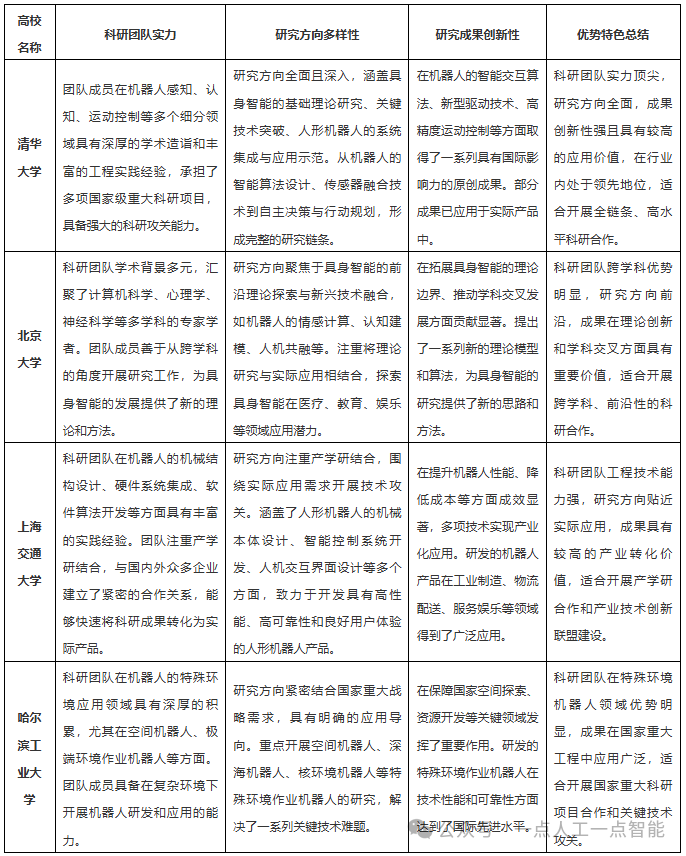
Research Strength of Universities
Tsinghua University Interdisciplinary Information Research Institute, Brain-like Computing Research Center, focuses on multimodal large models and robot decision-making integration, and bionic robot motion control. It released the world’s first end-to-end general robot large model “RobotDreamer,” which supports autonomous planning for complex tasks; developed a bionic dexterous hand that achieves high-precision object grasping.
Peking University Department of Intelligent Science, Institute of Artificial Intelligence, focuses on embodied cognitive models and human-robot collaboration. It proposed a “embodied-symbol” hybrid learning framework to enhance robots’ environmental understanding capabilities. Developed collaborative robots for medical assistance scenarios and led the construction of a national-level large-scale multi-configuration embodied intelligence dataset to promote technological standardization.
Zhejiang University School of Control Science and Engineering, Brain-Machine Fusion Laboratory, focuses on brain-machine interfaces and bionic control of robots, collective intelligence, and multi-robot collaboration. It released the world’s first Transformer-based robot decision large model “Wudao-Robot,” which supports natural language instruction understanding and task planning. The “Jueying” series quadruped robots have dynamic obstacle avoidance capabilities and can perform backflips.
Harbin Institute of Technology National Key Laboratory of Robotics Technology and Systems, focuses on spatial embodied intelligence and special scene interaction. It developed a “small robotic arm” system with flexible grasping and precise operation capabilities, used for maintenance of space station experimental cabins. Developed a nuclear power plant inspection robot that achieves autonomous navigation through laser SLAM and visual fusion, with radiation resistance at an internationally leading level. A bionic amphibious robot, designed with a modular approach, adapts to complex terrains and can be used for disaster rescue.
Table 1 Comprehensive Comparison of University Research Strengths

Main Enterprises and Progress
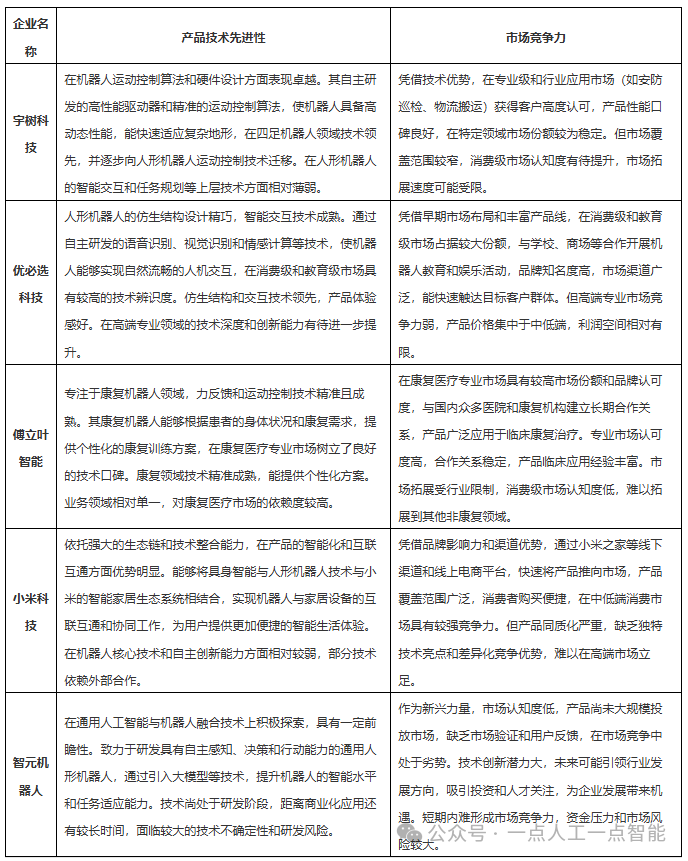
Yushu Technology, as a global leader in quadruped robot technology, is known for its quadruped robots (robot dogs) such as Laikago and Aliengo, which possess high dynamic movement capabilities, enabling rapid running, jumping, and rolling in complex terrains. In recent years, it has actively entered the humanoid robot field, launching the humanoid robot H1, which has relatively flexible limb joints and can perform walking, turning, and jumping actions, continuously achieving breakthroughs in movement speed and stability. Quadruped robots have been widely applied in security inspections, logistics transportation, scientific research, and education, establishing partnerships with numerous enterprises and institutions.
UBTECH Robotics, as a pioneer in humanoid robot commercialization, launched the Walker series humanoid robots, which have undergone multiple iterations and possess relatively mature capabilities in walking, grasping, and interaction. Walker X can walk on complex terrains, perform delicate operations such as serving tea and writing, and can engage in voice communication and emotional interaction with people. For industrial scenarios, it developed the industrial version humanoid robot Walker S, which has been used in training at BYD and participates in tasks such as door lock quality inspection and seat belt testing.
Fourier Intelligence focuses on rehabilitation robots and general humanoid robots. In the rehabilitation robot field, it has launched a series of upper and lower limb rehabilitation robot products, such as the upper limb rehabilitation robot Fourier M2 and the lower limb rehabilitation robot ExoMotus M4, widely used in hospital rehabilitation departments to assist patients in functional rehabilitation training. In the humanoid robot field, it launched the general humanoid robot GR-1, equipped with self-developed high-performance electric drive joints, capable of high-precision motion control, completing tasks such as walking, obstacle avoidance, and grasping. Rehabilitation robot products have been applied in many hospitals in China and are gradually expanding into overseas markets.
Xiaomi Technology, leveraging its technological accumulation in artificial intelligence, the Internet of Things, and intelligent manufacturing, will release its first full-size humanoid bionic robot CyberOne (Iron Big) in 2024, which has high-precision environmental perception capabilities, able to perceive surrounding environmental information in real-time, recognize human expressions, gestures, and postures, and respond accordingly. In terms of movement capabilities, CyberOne can achieve bipedal posture balance, with strong limbs capable of performing various complex actions such as walking, turning, and grasping. Currently, CyberOne is mainly in the technology development and demonstration stage.
ZhiYuan Robotics is a high-tech enterprise focused on the field of embodied intelligence. Founded by the Huawei Genius Youth Team, its core product, the Expedition series humanoid robots, features a highly bionic torso configuration and humanoid movement performance, capable of quickly adapting to various complex terrains and environments. The “Expedition A1” excels in interaction capabilities, equipped with an advanced voice interaction system and visual recognition system, enabling natural and smooth human-machine dialogue and accurately recognizing objects and scenes.
Table 2 Comprehensive Comparison of Enterprise Development Status

Conclusion and Recommendations
The domestic field of embodied intelligence and humanoid robots shows a collaborative development trend of “universities breaking through underlying technologies and enterprises accelerating scene implementation.” Tsinghua University and Peking University are at the international forefront in core technology areas such as multimodal large models and embodied cognitive architectures, while Zhejiang University and Harbin Institute of Technology have formed barriers in hardware technologies such as precision drive and bionic perception. On the enterprise side, UBTECH Robotics and ZhiYuan Robotics focus on achieving large-scale applications in industrial scenarios, while Yushu Technology and Xiaomi Technology rapidly penetrate the market through consumer-grade products, and Fourier Intelligence deeply cultivates the medical rehabilitation field to build differentiated advantages.
Based on the company’s digital business foundation and artificial intelligence technology accumulation, it is recommended to:
1. Strengthen technical collaboration with top universities, focusing on key technologies such as multimodal data fusion and lightweight edge models, to build a full-chain technology reserve of “perception-decision-execution.”
2. Relying on existing algorithm capabilities, prioritize the development of embodied intelligence solutions aimed at high-value scenarios such as intelligent manufacturing and smart logistics, creating industry benchmark cases through a “cloud-edge-end” collaborative architecture.
3. Explore ecological cooperation with leading robotics companies, embedding the company’s digital platform, artificial intelligence platform, and other capabilities into their product systems, while simultaneously laying out value-added businesses such as robot operation and maintenance and data services.
4. Establish a cross-departmental innovation fund to support artificial intelligence teams and industry experts in joint research and development, focusing on pain points such as dynamic environment adaptation and natural human-machine interaction, to form differentiated technological competitiveness.
—— Recommended Highlights ——1. Long-term Task Planning Based on Multimodal Diffusion Strategies2. Autonomous Driving Decision-Making Methods Based on Large Language Model Collaborative Reinforcement Learning3. Hierarchical Attention Spatiotemporal Feature Fusion Algorithm for 3D Human Pose and Shape Estimation4. Research Progress on 3D Defect Detection Technology5. Multi-action Collaborative Grasping Strategies for Robotic Arms in Complex Scenarios Click “Read the Original” to unlock more information