Are you confused about the keywords <span><span>auto</span></span>, <span><span>static</span></span>, and <span><span>extern</span></span> in C language? Today, we will use the most vivid locker analogy to help you thoroughly understand their differences!
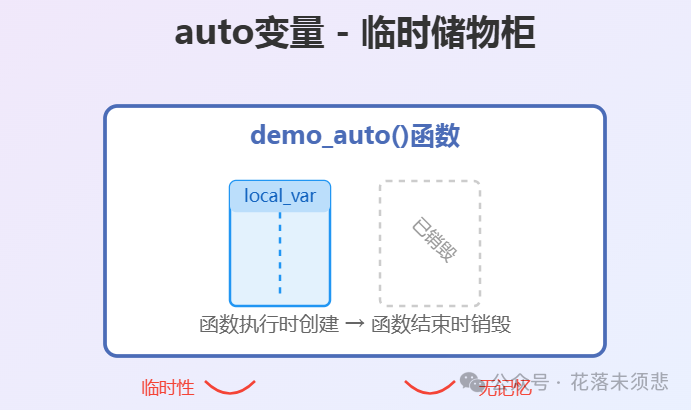
🔑 1. auto – Temporary Locker (Default Type) The most common local variable, no need to explicitly write the <span><span>auto</span></span> keyword
Simple Explanation: Just like a private temporary locker for functions, created as needed and discarded when done.
Characteristics:
-
Short lifespan: Allocated when the function is called, immediately reclaimed after execution
-
Always new: Each function call gets a brand new independent locker
-
High privacy: Only accessible within the function that defines it
Code Example:
#include <stdio.h>
void demo_auto() {
    int local_var = 0; // Default is auto
    local_var++;
    printf("Auto local_var value: %d\n", local_var);
}
int main() {
    demo_auto(); // Output: Auto local_var value: 1
    demo_auto(); // Output: Auto local_var value: 1 (always new)
    return 0;
}
🔒 2. static – Locked Private Permanent Locker
A. Static Local Variable (Used Inside Functions)
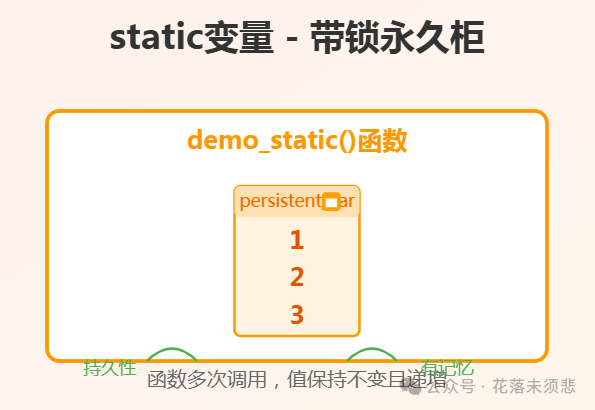
Simple Explanation: A locked private permanent locker inside a function. The contents remain unchanged after the function exits.
Characteristics:
-
Long lifespan: Allocated at the start of the program, reclaimed only when the entire program ends
-
Retains memory: Values are not lost after the function call ends
-
Initialized once: Initialization occurs only during the first execution
Code Example:
#include <stdio.h>
void demo_static_local() {
    static int persistent_var = 0; // This initialization statement executes only once!
    persistent_var++;
    printf("Static value: %d\n", persistent_var);
}
int main() {
    demo_static_local(); // Output: Static value: 1
    demo_static_local(); // Output: Static value: 2 (remembers the last value)
    demo_static_local(); // Output: Static value: 3
    return 0;
}
B. Static Global Variable/Function (Outside All Functions)
Simple Explanation: Originally like a bulletin board in the central hall, after adding <span><span>static</span></span>, it is equivalent to moving it into a locked room, accessible only to people within the same file.
Characteristics: Access is restricted (hidden): Can only be accessed by code within the same source file
Purpose: Encapsulation and modularization, improving code security and maintainability
Code Example:
// file1.c
#include <stdio.h>
static int private_global = 42; // Static global variable, valid only in file1.c
static void private_function() { // Static function, also valid only in file1.c
    printf("This is a private function in file1.c\n");
}
📢 3. extern – Declaring “Where the Bulletin Board Is”
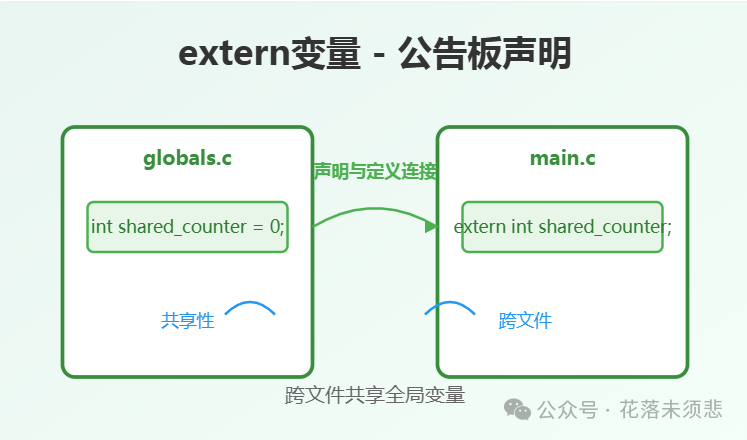
Simple Explanation: Used to declare global variables or functions that have already been defined elsewhere. It announces: “Attention everyone! The items on that bulletin board exist! They have been placed in another room!”
Characteristics:
-
It is a declaration, not a definition: Does not create new variables or allocate storage space
-
For cross-file access: Allows multiple source files to share the same global variable or function
Code Example:
// main.c
#include <stdio.h>
extern int shared_counter; // Declare global variable
extern void increment_counter(); // Declare function
int main() {
    printf("Counter value: %d\n", shared_counter);
    increment_counter();
    printf("Counter after increment: %d\n", shared_counter);
    return 0;
}
📊 Summary Comparison Table
| Storage Type | Simple Analogy | Lifespan | Scope | Main Purpose |
|---|---|---|---|---|
| auto (default) | Temporary private locker | During function execution | Inside the defining function | Create ordinary local variables |
| static (local) | Locked private permanent locker | Throughout program execution | Inside the defining function | Keep local variable state |
| static (global) | Bulletin board in a private room | Throughout program execution | Within this file | Hide global variables/functions |
| extern | Informing “Where the bulletin board is!” | Decided at the definition point | In the area after declaration | Access global variables across files |
Mastering the characteristics and usage of these storage types can make our C programs more efficient and modular! Have you learned it?
Feel free to leave comments to share your learning insights!
#C Language #Programming Skills #Programmer #Software Development #Embedded
——————————————————————————————
Writing is not easy, if you find it useful, please give a 【Follow】 and 【Recommend】. Your likes are my motivation to keep writing, thank you!