 First, let’s look at the conclusion:
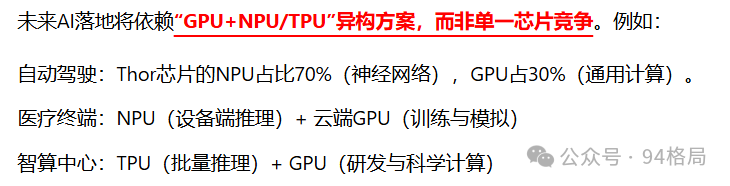 Core conclusion: The hardware architecture will evolve towards a “cloud-based GPU as the main component + edge NPU as support” hybrid model, where GPUs are the main force in the cloud, and NPUs have core advantages in terminal devices. For example, Google’s TPU has been used for batch inference in search/translation, but model development still relies on GPUs; Tencent’s Hunyuan model training uses GPUs (such as A100), while high-frequency user requests may be diverted to TPU clusters.
1. Short term (1-3 years): In the short term, HuaweiNPU will continue to dominate the domestic AI acceleration chip market due to its technological advantages and a complete ecosystem; Domestic GPUs will achieve breakthroughs in gaming and edge computing and rapidly increase market share; Domestic TPUs will find applications in large model training and other specific scenarios, but their market share will be relatively small.
2. Medium term (3-5 years): In the medium term, HuaweiNPU will maintain its technological and market leadership, but its market share may be challenged by domestic GPUs and TPUs; Domestic GPUs will form advantages in versatility and cost-effectiveness and gain applications in more fields; Domestic TPUs will develop characteristics in specialized computing fields and gain more market share in large model training and high-performance computing.
3. Long term (10 years or more): In the long term, the three types of chips will form a differentiated competitive landscape: HuaweiNPU will maintain an important position in the AI acceleration chip market, especially in key industries such as government, finance, and telecommunications; Domestic GPUs will achieve breakthroughs in versatility and global market expansion, becoming an important player in the global GPU market; Domestic TPUs will form unique advantages in specialized AI computing fields, dominating in large model training and high-performance computing.
Strategic choice recommendations:
1. Short term (1-3 years): It is recommended to prioritize choosing HuaweiNPU, as it has significant advantages in technological advancement, market share, and ecosystem maturity, especially in AI application scenarios in key industries such as government, finance, and telecommunications.
2. Medium term (3-5 years): It is recommended to prioritize choosing domestic GPUs, as they have advantages in versatility, market growth potential, and supply chain security, especially in fields such as gaming, edge computing, and small to medium-sized enterprise AI applications.
3. Long term (10 years or more): It is recommended to choose based on specific application scenarios: for AI training and inference in general scenarios, choose domestic GPUs; for high-performance AI computing and specific industry applications, choose HuaweiNPU; for specialized scenarios such as large model training and high-performance computing, choose domestic TPUs.
4. Comprehensive consideration: If you need to choose the option with the most long-term development potential among the three types of chips, it is recommended to choose domestic GPUs, as they have the strongest versatility, the broadest application scenarios, and the greatest potential for technological iteration, and as the ecosystem improves and the market scale expands, their long-term competitiveness will continue to strengthen.
For different application scenarios:
1. AI training and inference centers:
Short term: Prioritize choosing Huawei AscendNPU, such as Ascend 910B/C, to meet the computing power requirements for large-scale AI model training and inference.
Medium term: Consider introducing domestic GPUs as a supplement, such as Moore Threads full-featured GPUs, to improve resource utilization and reduce costs.
Long term: Based on model characteristics and computing power requirements, build a heterogeneous computing platform that includes GPUs,NPU and TPU, to achieve optimal performance and cost-effectiveness.
2. Gaming and consumer electronics:
Short term: The 7G100 series from Lishuan Technology is the first choice, as its performance is already close to the international mid-to-high-end level, capable of meeting the demands of gaming and consumer electronics.
Medium term: As more domestic GPU manufacturers’ products enter the market, options with better performance and price advantages can be selected.
Long term: Domestic GPUs will become one of the mainstream choices in the gaming and consumer electronics market, and it is recommended to pay attention to manufacturers with leading technology.
3. Scientific computing and research:
Short term: Moore Threads’ full-featured GPUs are a good choice, as they support FP64 double precision computing, capable of meeting the demands of scientific computing.
Medium term: Domestic TPUs will gradually show advantages in high-performance computing, and it is worth considering introducing domestic TPUs as a supplement.
Long term: Build a heterogeneous computing platform based on domestic GPUs and TPUs, to meet the needs of different types of scientific computing.
4. Industry intelligent transformation:
Short term: Huawei AscendNPU has mature solutions in industries such as energy, finance, and transportation, making it the first choice.
Medium term: Different chips can be selected based on industry characteristics, such as the gaming industry choosing domestic GPUs, and industries with more AI applications choosing HuaweiNPU or domestic TPUs.
Long term: Based on the needs of industry digital transformation, build a diversified computing power infrastructure that includes GPUs,NPU and TPU.
5. Edge computing and the Internet of Things:
Short term: Domestic GPUs have advantages in versatility and cost-effectiveness in edge computing, making them a good choice.
Medium term: With technological advancements, domestic TPUs will also show advantages in specific scenarios of edge computing.
Long term: Choose the most suitable chip type based on specific application scenarios in edge computing, or build a heterogeneous computing platform.
 Appendix:
1.The current state of China’s computing power chip industry
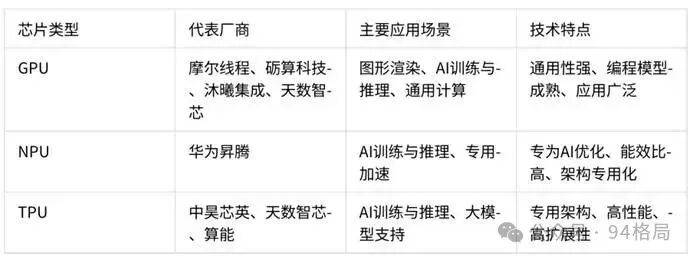
Has formed a diversified computing power chip industry pattern represented by Huawei Ascend as NPU, general GPUs represented by Moore Threads, and TPUs represented by Zhonghao Xinying.
1. Domestic GPUs
Lishuan Technology officially released its self-developed GPU chip series “7G100” in July 2025, which is China’s first true self-developed GPU using a 6nm process, adopting a fully self-developed TrueGPU architecture, with the instruction set and computing core completely designed independently.
This chip provides a peak computing power of up to 24TFLOPS in FP32 floating-point operations, supporting various data precisions such as FP32, FP16, INT8, etc.
In terms of gaming performance, the 7G100 series GPUs equipped in the Lisuan eXtreme series graphics cards performed excellently in the game “Black Myth: Wukong”, with an average FPS exceeding 70 (resolution: 1080p, quality: high). In benchmark tests, its FireStrike score reached about 26800, comparable to the level of RTX 4060. This indicates that domestic GPUs have already possessed the strength to compete with international first-tier GPU manufacturers in the high-end consumer market.
Moore Threads is the first domestic company to support full computing precision with full-featured GPUs, achieving significant breakthroughs in computing power: it was the first to support FP8 precision computing, efficiently meeting the native computing needs of large models such as DeepSeek V3/R1; at the same time, it is equipped with FP64 double precision computing power, which can support traditional high-performance computing scenarios such as scientific computing and accelerate AI for Science (AI4S) and other emerging fields.
Tianshu Zhixin launched the Tianhai 100, an AI training acceleration card based on a self-developed general architecture, with a peak computing power of 147TFLOPS (FP16/BF16), supporting various data precisions and flexibly adapting to various algorithms. Its 1.2TB/s inter-card interconnect bandwidth shows absolute advantages in distributed training tasks.
2.HuaweiNPU
Ascend 910B is a high-performance AI processor based on Huawei’s self-developed Da Vinci architecture, designed for data centers, suitable for deep learning, machine learning, and large-scale data processing scenarios. It adopts a 7nm process, providing a peak computing power of up to 376 TFLOPS in FP16 floating-point operations, comparable to NVIDIA’sA100, while maintaining a low power consumption of 350W, demonstrating excellent energy efficiency.
Huawei Ascend 910B supports large-capacity HBM high-speed memory, with a bandwidth of up to 400GB/s, and is compatible with various AI frameworks, including Huawei’s self-developed MindSpore. Through cooperation with Baidu in the field of autonomous driving, algorithm performance has improved by more than 2 times, and power consumption has been reduced by 80%.
It is worth noting that Huawei is accelerating the iteration of the Ascend series chips. Reports indicate that Huawei plans to launch the Ascend 910C chip in 2025, which will integrate two Ascend 910B chips, providing up to 800 TFLOP/s of computing power in FP16 mode, with memory bandwidth reaching 3.2 TB/s, with performance close to NVIDIA’s H100 GPU.
3. Domestic TPU
Zhonghao Xinying is the only domestic company that has mastered the core technology of TPU architecture AI chip and achieved mass production of chips. Its self-developed high-performance TPU artificial intelligence chip “Shan Zhi” has multiple technological advantages. This chip, developed by Zhonghao Xinying over nearly 5 years, is China’s first mass-produced high-performance TPU architecture AI dedicated large chip, with fully self-developed IP cores, instruction sets, and computing platforms. The “Shan Zhi” TPU chip outperforms well-known overseas GPU chips by nearly 1.5 times in AI computing scenarios, with energy consumption reduced by 30%. This chip supports efficient interconnect between 1024 chips, supporting the computation and inference of large models with over 100 billion parameters.
Zhonghao Xinying’s “Tai Ze” large-scale AI computing cluster system is built based on the self-developed high-performance TPU chip “Shan Zhi” and achieves efficient interconnect between 1024 chips, supporting the computation and inference of large models with over 100 billion parameters. This system not only has a strong underlying computing power reserve but also can respond to multiple user demands in real-time through a refined computing power scheduling mechanism, dynamically adjusting the allocated workload computing power and storage resources.
Hengwei Technology and United Computing Power released the industry’s first domestic TPU orthogonal architecture super node – AS9000 series orthogonal architecture 128AI super node. This product deeply integrates domestic CPUs and computing power TPU chips at the hardware level, adopting a mixed cooling solution of air and liquid to ensure continuous high-performance output.
2.Comparison
Based on the market performance of the three types of chips, the following evaluations can be made:
1. Current market share: HuaweiNPU occupies a dominant position in the domestic AI acceleration chip market due to its first-mover advantage and Huawei’s strong ecosystem, especially in key industries such as government, finance, and telecommunications; the domestic GPU market is rapidly growing, with products from manufacturers such as Lishuan Technology and Moore Threads starting to enter the market; the domestic TPU market share is small, but it is gradually gaining recognition in specific fields such as large model training.
2.Growth trend: The domestic GPU market is expected to maintain rapid growth, especially with the mass production and market expansion of products from manufacturers such as Lishuan Technology; Huawei’s NPU may face supply chain challenges, which could limit growth; although the domestic TPU market is small, it is expected to achieve rapid growth driven by demand in large models and high-performance computing.
3. Application breadth: Domestic GPUs have the widest range of application scenarios, covering gaming, AI training, scientific computing, and industry applications; HuaweiNPU is mainly concentrated in AI training, autonomous driving, and cloud computing; the domestic TPU is mainly applied in specific scenarios such as large model training, smart cities, and high-performance computing.
4. International market: Huawei AscendNPU is limited in international market expansion due to US sanctions; domestic GPU manufacturers such as Lishuan Technology are beginning to gain international attention; the domestic TPU international market has not yet been widely developed.
5. Price competitiveness: Domestic GPUs are gradually improving in price competitiveness due to advanced processes and strong versatility; Huawei’s NPU may have higher prices due to supply chain issues; domestic TPUs have good cost-effectiveness in specific scenarios, with unit computing power costs reduced by nearly half.
In summary, in terms of market share, Huawei NPU currently holds a leading position; domestic GPUs are growing the fastest, with the widest range of application scenarios; domestic TPUs, although starting later, show unique advantages in specific fields.
3. Development potential assessment over different time dimensions
(1) Short-term development potential (1-3 years)
Domestic GPUs:
1. Technological development: Lishuan Technology’s 7G100 series GPUs have already achieved mass production, and the next generation of products is expected to be launched within the next 1-3 years, with performance expected to further improve; Moore Threads’ full-featured GPUs will make progress in FP8 precision computing and AI framework adaptation; domestic GPUs may further improve in process technology, narrowing the gap with international advanced levels.
2.Market expansion: Domestic GPUs will achieve breakthroughs in the gaming market, with products from manufacturers such as Lishuan Technology filling the gap in the domestic high-end GPU market; in the field of AI training and inference, domestic GPUs will gain market share in edge computing, small to medium-sized enterprise AI applications, etc., due to their versatility and cost-effectiveness; it is expected that by 2027, domestic GPUs will reach about 20% of the domestic AI acceleration chip market share.
3. Ecological construction: Domestic GPU manufacturers will strengthen software ecosystem construction, improve API compatibility and the ease of use of development tools; strengthen adaptation with mainstream AI frameworks to lower the barriers for developers; establish a more complete developer community and technical support system.
HuaweiNPU:
1. Technological development: Huawei will continue to optimize the performance and energy efficiency of AscendNPU, and it is expected to launch a new generation of products in 2026, adopting more advanced process technology to further enhance computing power and energy efficiency; solving yield issues will be a key focus for Huawei AscendNPU in the short term.
2. Market expansion: Huawei AscendNPU will continue to dominate the domestic AI server market, especially in key industries such as government, finance, and telecommunications; due to supply chain constraints, Huawei may focus more on improving product quality and yield rather than blindly pursuing shipment growth; it is expected that by 2027, Huawei AscendNPU will maintain a market share of over 50% in the domestic AI acceleration chip market.
3. Ecological construction: Huawei will continue to improve the MindSpore framework and Ascend computing ecosystem, strengthen cooperation with industry partners, and launch more industry solutions; in the open-source ecosystem, Huawei will increase investment to attract more developers to participate in the MindSpore community.
Domestic TPU:
1. Technological development: Zhonghao Xinying and other manufacturers will accelerate the iteration and upgrade of TPU chips, enhancing computing power performance and energy efficiency; improve cluster interconnect technology to enhance the stability and efficiency of large-scale clusters; within 2-3 years, domestic TPUs are expected to surpass GPUs and NPUs in performance in specific fields.
2. Market expansion: Domestic TPUs will gain more applications in large model training and inference, especially in scenarios such as intelligent computing centers and research institutions; in specific application scenarios in smart cities, finance, etc., domestic TPUs will gain market recognition due to their high performance and high energy efficiency advantages; it is expected that by 2027, domestic TPUs will reach about 10% of the domestic AI acceleration chip market share.
3. Ecological construction: Domestic TPU manufacturers will strengthen software ecosystem construction, improving the maturity and ease of use of development tools; strengthen integration with mainstream AI frameworks to lower the barriers for developers; establish a more complete technical support system and industry solution library.
(2) Medium-term development potential (3-5 years)
Domestic GPUs:
1. Technological development: Domestic GPUs are expected to achieve breakthroughs in process technology, with some manufacturers expected to achieve mass production of 5nm or more advanced processes by 2030; in architectural design, domestic GPUs will become more mature, with performance expected to approach international leading levels; in functionality, domestic GPUs will further enhance AI computing capabilities, becoming a fusion platform for general computing and AI acceleration.
2. Market expansion: Domestic GPUs will rapidly grow under the dual drive of the gaming market and the AI market; in the gaming market, domestic GPUs will compete directly with international manufacturers, with market share expected to reach 30% or more; in the AI market, domestic GPUs will occupy important positions in edge computing, small to medium-sized enterprise AI applications, and scientific research; domestic GPU manufacturers will also actively expand into international markets, especially in Southeast Asia and the Middle East.
3.Ecological construction: The software ecosystem of domestic GPUs will mature, with significant improvements in API compatibility and the ease of use of development tools; integration with mainstream AI frameworks will become closer, supporting more AI application scenarios; the developer community will become more active, forming a good atmosphere for technical exchange and innovation.
HuaweiNPU:
1. Technological development: Huawei will solve supply chain issues within 3-5 years, achieving stable mass production of AscendNPU; the new generation of AscendNPU will adopt more advanced process technology, further enhancing performance and energy efficiency; Huawei will also strengthen investment in chip architecture innovation to maintain technological leadership.
2. Market expansion: Huawei AscendNPU will continue to dominate the domestic AI acceleration chip market, but its market share may be challenged by domestic GPUs and TPUs; Huawei will strengthen its layout in the international market, especially in Southeast Asia, the Middle East, and Africa; it is expected that by 2030, Huawei AscendNPU will maintain a market share of around 40% in the domestic AI acceleration chip market.
3. Ecological construction: Huawei will continue to improve the MindSpore framework and Ascend computing ecosystem, strengthen cooperation with global developers; launch more industry solutions covering more industries and application scenarios; in the open-source ecosystem, Huawei will increase investment to enhance the international influence of MindSpore.
Domestic TPU:
1. Technological development: Domestic TPUs will achieve breakthroughs in architecture innovation and energy efficiency, with performance expected to further improve; support larger-scale cluster expansion to meet the training needs of ultra-large-scale AI models; in specialized computing fields, domestic TPUs will form significant technological advantages.
2. Market expansion: Domestic TPUs will dominate in large model training, high-performance computing, and scientific research; in specific application scenarios in finance, healthcare, and education, domestic TPUs will become the preferred AI acceleration chip; domestic TPU manufacturers will also actively expand into international markets, especially in scientific and enterprise-level applications requiring high-performance computing.
3. Ecological construction: The software ecosystem of domestic TPUs will reach international advanced levels, with significant improvements in the ease of use and completeness of development tools; integration with mainstream AI frameworks will become closer, supporting more AI application scenarios; a more complete industry solution library and technical support system will be established.
(3) Long-term development potential (10 years or more)
Domestic GPUs:
1. Technological development: Domestic GPUs will reach international leading levels in technology, keeping pace with international manufacturers in process technology, architectural design, and performance indicators; GPUs will become a fusion platform for general computing and AI acceleration, supporting more application scenarios; in cutting-edge fields such as quantum computing, GPUs will also play an important role.
2. Market expansion: Domestic GPUs will occupy an important position in the global GPU market, with market share expected to reach over 20%; in gaming, AI, and scientific computing, a complete industrial chain and ecosystem will be formed; domestic GPU manufacturers will become important players in the global GPU market, competing comprehensively with international manufacturers.
3.Ecological construction: The software ecosystem of domestic GPUs will reach international advanced levels, with API compatibility, ease of use of development tools, and completeness of functions comparable to international leading levels; a global developer community will be formed, attracting global talents to participate in technological innovation; a complete intellectual property protection system and technical standards system will be established.
HuaweiNPU:
1. Technological development: Huawei will maintain its technological leadership in the AI chip field, continuously promoting chip architecture innovation and process upgrades; AscendNPU will achieve a fully autonomous and controllable industrial chain, unaffected by external environments; Huawei will also layout in cutting-edge technology fields such as photonic computing and integrated storage and computing, exploring the next generation of AI chip technology.
2. Market expansion: Huawei AscendNPU will occupy an important position in the global AI acceleration chip market, especially in key industries such as government, finance, and telecommunications; Huawei will enhance the international competitiveness of AscendNPU through technological innovation and ecosystem construction; it is expected that by 2035, Huawei AscendNPU will reach about 30% of the global AI acceleration chip market share.
3. Ecological construction: Huawei will build a globally leading AI computing ecosystem, with the MindSpore framework becoming one of the mainstream AI development frameworks globally; a global developer community will be formed, attracting global talents to participate in technological innovation; a complete technical standards and industrial ecosystem will be established to promote the development of the global AI industry.