Recently, Professor Thomas Kodadek’s team at the University of Florida published a research paper titled “Exploiting Avidity Effects for the Discovery of Low-Affinity Protein-Binding Fragments” in the Journal of Medicinal Chemistry. This groundbreaking fragment drug screening technology innovatively utilizes avidity effects, successfully developing a new platform for efficient and low-cost fragment screening.
Research Background
Fragment-based drug discovery (FBDD) has become an important method in modern drug development, leading to the launch of several new drugs. However, due to the typically weak affinity of fragments for target proteins (KD usually in the high micromolar to low millimolar range), traditional detection methods requiring washing steps are difficult to apply. Existing fragment screening mainly relies on expensive techniques such as nuclear magnetic resonance (NMR), surface plasmon resonance (SPR), and X-ray crystallography, which have high experimental condition requirements. These limitations hinder the application of FBDD in broader laboratory environments. Therefore, developing an economical, versatile fragment discovery platform that does not require complex equipment is of great significance.
Research Content
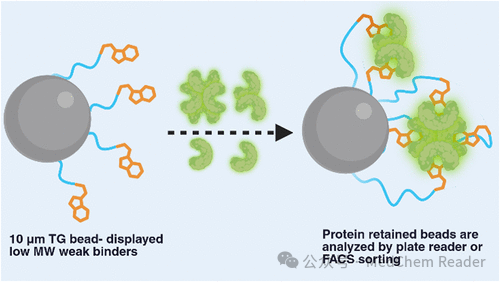
To break through this bottleneck, Kodadek’s team proposed utilizing the multivalent binding effect between polymeric proteins and resin-fixed small molecule fragments to stabilize weak interaction complexes. The researchers fixed low molecular weight fragments on the surface of TentaGel microspheres through solid-phase synthesis and used fluorescently labeled polymeric target proteins for detection. Due to the avidity effect, even low-intensity binding at the fragment level can be stably captured after washing and detection, enabling simple “pull-down” screening.
Proof of Concept
The team first used a tetrameric streptavidin (Streptavidin, SA) as a model target and synthesized and validated fragment compounds containing pyridine-thiazole groups. SPR measurements showed that the fragment molecule had a KD of 706 μM, which is consistent with the binding strength of typical fragment molecules. After fixing it on TentaGel microspheres, it was able to stably capture fluorescently labeled SA, while negative control compounds or blank microspheres showed no binding signal. Further experiments indicated that this binding was highly sensitive to protein concentration and could be competitively blocked by excess biotin, proving that the binding occurred at the biotin binding site of SA. Notably, the fragment molecule–SA complex on the resin remained stable for over 24 hours after thorough washing.
Statistical analysis showed that the Z′ factor of this method was 0.66, meeting the standards for high-throughput screening and demonstrating potential for large-scale application. Mechanistic studies further confirmed that this stability relies on the avidity effect: the tetrameric SA can stably bind fragments, while monomeric SA cannot achieve effective binding, and ligand density significantly affects binding strength.
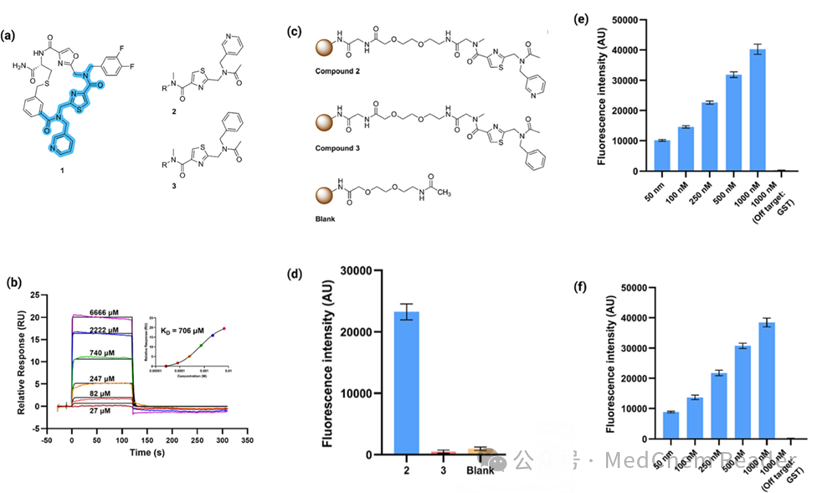
Figure 1. Identification of weak streptavidin binders. (a) SA binding to macrocyclic compound 1 and its derived weak binders 2 and 3 structures; (b) Schematic of compound 2 binding to immobilized SA via SPR; (c) Structures of bead-linked compounds and blank controls; (d) Fluorescence intensity after incubating bead-linked compounds with SA-647 (500 nM) in PBST at room temperature for 1 hour; (e) Fluorescence intensity of bead-linked compound 2 with different concentrations of Alexafluor 647 labeled SA (SA-A647) in PBST at room temperature for 1 hour, with the last group being off-target control glutathione S-transferase (GST); (f) Same as (e), but beads were left in a protein-free buffer for 24 hours after thorough washing, demonstrating the high kinetic stability of the complex on the resin. Note: The bar graphs in (d-f) represent the average of three repeated experiments, each using 250,000 beads.
Conclusion and Outlook
This study is the first to introduce avidity effects into fragment screening experiments, establishing a simple, low-cost, and instrument-free “pull-down” detection platform. This method not only captures low-affinity fragments but also supports typical fragment growth strategies, providing a new tool for the promotion and application of FBDD. In the future, this platform is expected to be widely used for fragment discovery against different protein targets, accelerating the early stages of drug development.
The avidity effect is an important concept in molecular biology and drug discovery, referring to the phenomenon where multiple weak interactions produce strong and stable binding through synergy.
Original link: https://doi.org/10.1021/acs.jmedchem.5c01742
Disclaimer: The content of this article is based on publicly published academic papers and is for reference and communication purposes only. Copyright belongs to the original authors and publishing groups. Reasonable reproduction is welcome, please indicate the source 【MedChem Reader】. For detailed and comprehensive information, please refer to the original text. For submissions, collaborations, and communications, please contact us through the backend.
Previous Recommendations
→【Nat Commun】Farewell to “Species Differences”: Scientists Design Nearly Perfect Human P2X7 Inhibitor, What Did It Do Right?
→ 【JMC】East China Normal University/Shanghai Jiao Tong University Team Discovers New Pyrrole-Pyridine Aurora A Inhibitor, Effectively Inhibiting Gastric Cancer Organoid Growth
→ 【JMC】Targeting VDAC1-Hexokinase II Complex with Self-Assembling Amphiphilic Peptides Induces Apoptosis in Cervical Cancer Cells【Follow us to explore the frontiers of science together】👍 Your every 【like】 and 【share】 is the motivation for us to continue creating quality content!