Table of Contents:1. Classification of Wastewater from Printed Circuit Boards2. Determination of Wastewater Volume3. Treatment Process of Wastewater1. Classification of Wastewater from Printed Circuit BoardsWastewater from printed circuit boards can be classified based on its characteristics into cyanide-containing wastewater, nickel-containing wastewater, high-concentration organic wastewater, low-concentration organic wastewater, complex copper wastewater, copper-ammonia wastewater, copper-containing wastewater, and grinding wastewater.Wastewater containing precious metals such as gold and silver should be recovered online and is generally not included in wastewater treatment projects. (“Zero discharge”)2. Determination of Wastewater Volume👉1. With Reference DataThe wastewater generation of existing enterprises can be determined through actual measurements. For new enterprises, the wastewater generation can be estimated by comparing with similar enterprises in terms of product variety, production process, production scale, work system, and management level. It can also be determined based on material balance and water balance. (The determination of wastewater quality follows the same principle.)👉2. Without Reference DataIf there is no reference data, the following methods can be used for estimation: 👇👇1) Tap Water Usage Method:Design water volume = Total water usage in the workshop (production line) × (85%~95%);where the total water usage in the workshop (production line) includes process water (for each process, unit), wastewater washing water, floor washing water, etc.2) Pollution Coefficient Method:a) Single-sided board: (0.14~0.30) t/m2;b) Double-sided board: (0.42~1.32) t/m2;c) Multi-layer board: (0.42+0.29n) t/m2~(1.3+0.49n) t/m2;d) High-Density Interconnect (HDI) board: (0.52+0.49n) t/m2~(1.3+0.79n) t/m2;where n is the number of additional layers.3. Treatment Process of WastewaterWastewater from printed circuit boards should be collected and pre-treated separately before being integrated into comprehensive wastewater, which should be treated to meet standards before discharge or reuse.The process flow diagram for wastewater treatment engineering is illustrated below: 👇👇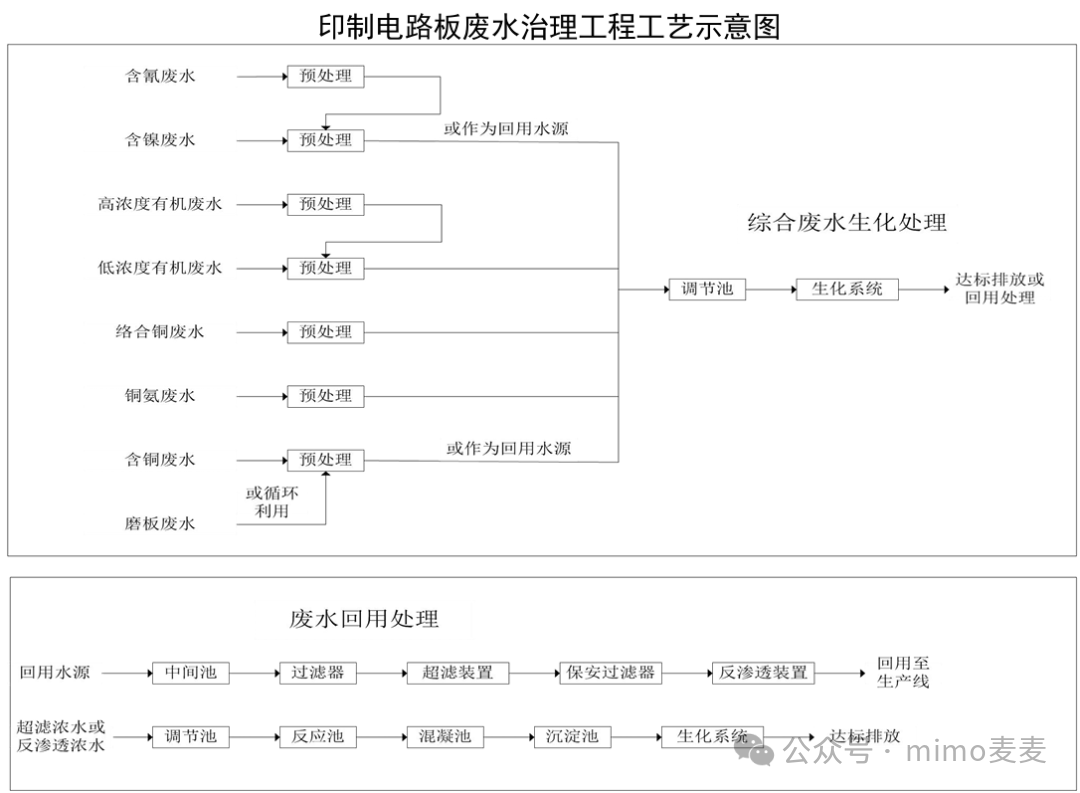 👉1. Pre-treatment1) Cyanide-containing WastewaterCyanide-containing wastewater pre-treatment can use alkaline chlorination or hydrogen peroxide oxidation methods.a) Alkaline Chlorination pre-treatment process flow diagram is as follows: 👇👇
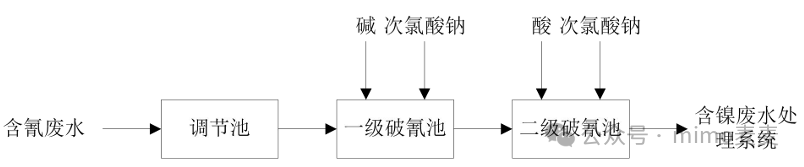 b) Hydrogen Peroxide Oxidation methodpre-treatment process flow diagram is as follows: 👇👇
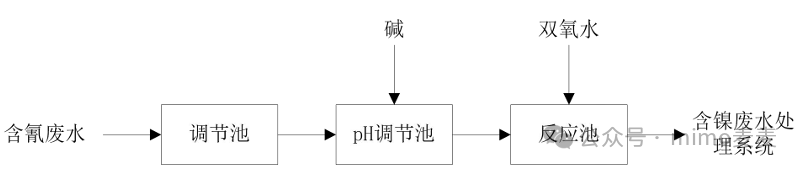 2) Nickel-containing WastewaterNickel-containing wastewater can use chemical precipitation, ion exchange, or reverse osmosis methods.a) Chemical PrecipitationIf nickel-containing wastewater is mixed with other metal pollutants and organic pollutants, chemical precipitation should be used, the process flow is as follows:👇👇
 b) Ion ExchangeIf the nickel-containing wastewater has a relatively simple composition of pollutants, mainly in ionic form, or if nickel recovery is required, ion exchange can be used, the process flow is as follows: 👇👇
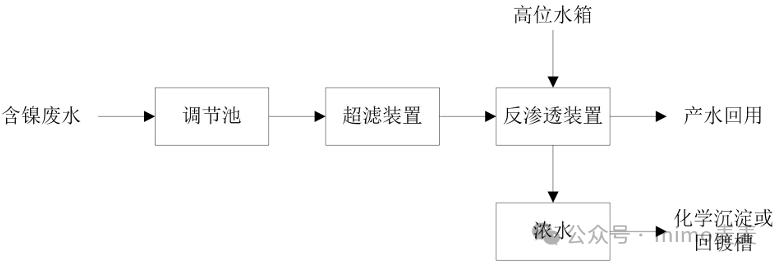
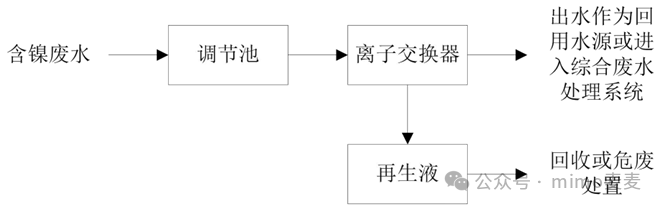 c) Reverse OsmosisIf nickel-containing wastewater requires online recovery in the workshop, reverse osmosis can be used, the process flow is as follows:👇👇
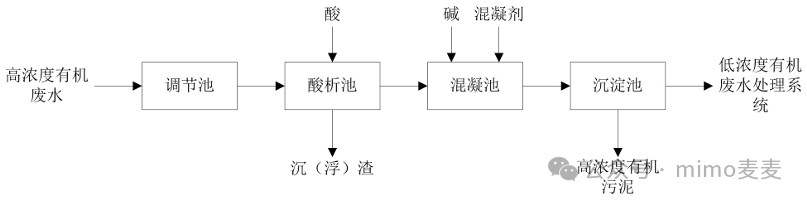
 3) High-concentration Organic WastewaterHigh-concentration organic wastewater can precipitate solids under acidic conditions, and then solid-liquid separation can remove most organic matter and some heavy metals, the process flow is as follows:👇👇
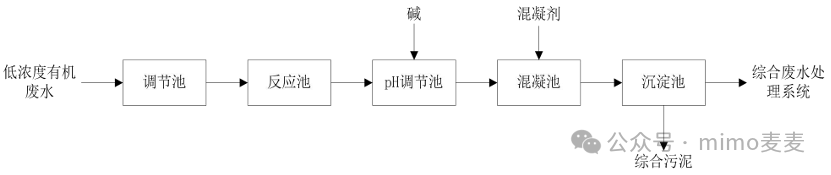
 4) Low-concentration Organic WastewaterLow-concentration organic wastewater pre-treatment can use chemical oxidation or iron-carbon micro-electrolysis to remove organic matter, and chemical precipitation to remove heavy metals, the process flow is as follows:👇👇
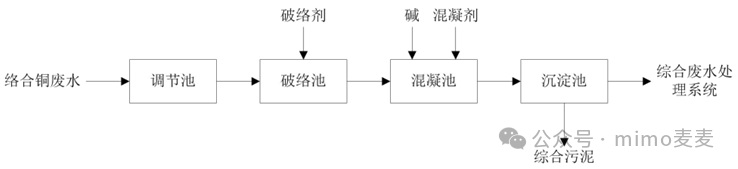
 5) Complex Copper WastewaterComplex copper wastewater pre-treatment should use chemical precipitation, the process flow is as follows:👇👇
 6) Copper-Ammonia WastewaterCopper-ammonia wastewater pre-treatment can use breakpoint chlorination, selective ion exchange, or ammonium magnesium phosphate deammonification methods.a) Breakpoint ChlorinationWhen the wastewater volume and ammonia nitrogen concentration do not vary significantly over time, breakpoint chlorination can be used, the process flow is as follows:👇👇
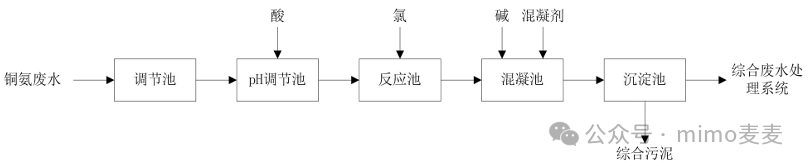 b) Selective Ion ExchangeIf the wastewater contains multiple metal ions or organic substances, the ammonium magnesium phosphate deammonification method should be used, the process flow is as follows:👇👇
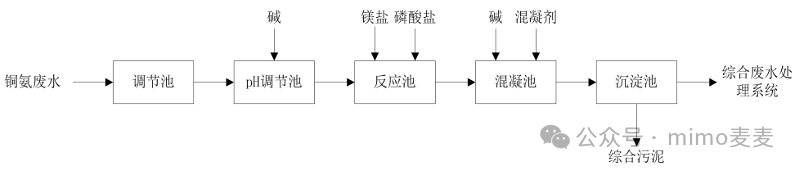 7) Copper-containing WastewaterThe pre-treatment process flow for copper-containing wastewater is as follows: 👇👇
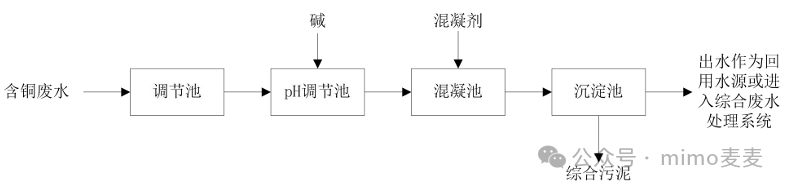 👉2. Comprehensive Wastewater TreatmentThe pH value of the comprehensive wastewater after pre-treatment should be controlled between 7~9, and biochemical treatment processes should be used.The biochemical treatment processes for comprehensive wastewater include anaerobic, anoxic, and aerobic units,👉3. Reuse Water Treatment1) The reuse water treatment process should use a combination of filtration + dual membrane (ultrafiltration membrane and reverse osmosis membrane); wastewater with a single component and low conductivity can use ion exchange processes. The process flow is as follows: 👇👇
 2) Ultrafiltration Concentrate can enter the low-concentration organic wastewater treatment system for processing or can be collected and treated separately. The process flow is as follows: 👇👇
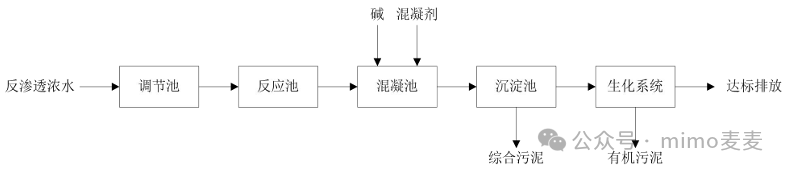
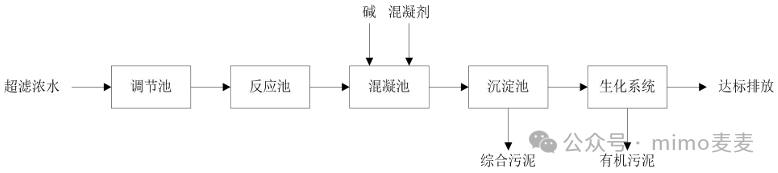 3) Reverse Osmosis Concentrate can enter the pre-treatment system or be treated separately. When entering the pre-treatment system, it should ensure that salt accumulation does not occur. The process flow for separate treatment of reverse osmosis concentrate is as follows: 👇👇
 Reference Document: “Technical Specifications for Wastewater Treatment Engineering of Printed Circuit Boards (HJ2058-2018)
Sharing of valuable content on GHG, ESG, RPA, environmental protection, etc. If you like it,  just scan the code to follow us~