
|
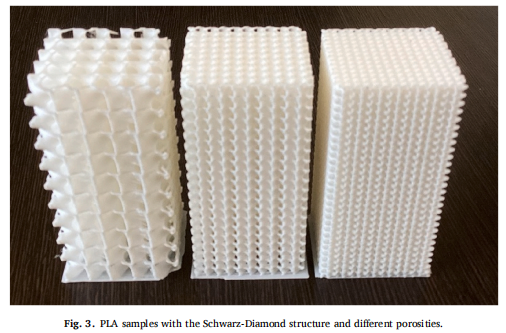
3D printing technology can accurately create unique shapes that are difficult to achieve with traditional processes. As a star material in the 3D printing field, polylactic acid (PLA) filament has great potential in manufacturing composite materials and lightweight structures. This study systematically analyzes the fracture characteristics and damping performance of biodegradable PLA samples with bio-inspired structures under ballistic loading tests at different densities. The samples were prepared using 3D printing technology combined with fused deposition modeling (FDM) processes, and a dedicated computer program was developed for the Schwartz-Diamond minimal surface topology structure. The research found that the energy absorbed by PLA samples with Schwartz-Diamond surface structures under ballistic loading is closely related to their density and impact velocity. Using scanning electron microscopy, we revealed the internal structure of 3D printed PLA honeycomb samples with Schwartz-Diamond three-period minimal surface structures, as well as the fracture mechanisms of samples with different densities—showing that as density increases, the fracture mode transitions from ductile to quasi-brittle. This research provides important theoretical support for understanding the manufacturing principles of 3D printed plastic honeycomb products. |


|
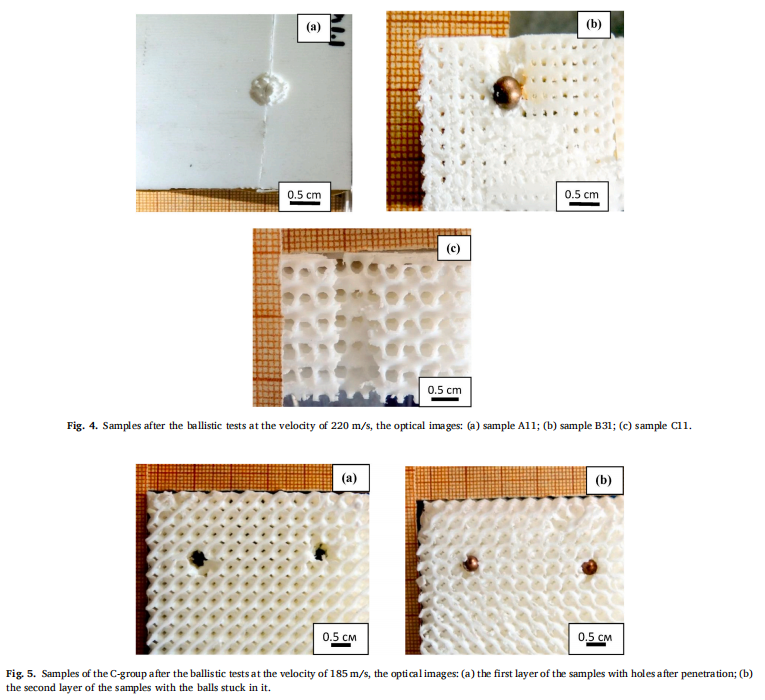
The ballistic test results show that the fracture mechanism of 3D printed PLA honeycomb materials is significantly different from that of dense PLA samples. Through literature data analysis, we revealed the causes of the differences in energy absorption values of the same material under dynamic loading. Based on the experimental and computational results of this paper, the following conclusions can be drawn: 1. For the first time, ballistic tests were conducted on PLA samples with three-period minimal surface structures, showing that the specific impact energy in ballistic tests is influenced by material density and loading speed, while the volumetric impact energy is not affected by these factors. 2. For the first time, scanning electron microscopy observations of TPMS structure PLA samples after ballistic impact were presented, revealing a trend of fracture mechanism transition from ductile to quasi-brittle with changes in material density, where samples with a density of 930 kg/m3 exhibited distinct quasi-brittle fracture characteristics. |