Welcome to the True Deep Dive community (click) ← Don’t miss any snippets.
If GPUs are like “off-the-rack suits,” then ASICs are like “bespoke tuxedos.” The former can meet the needs of most occasions, but the latter fits perfectly—just like ASICs are tailored computing circuits for specific AI models.
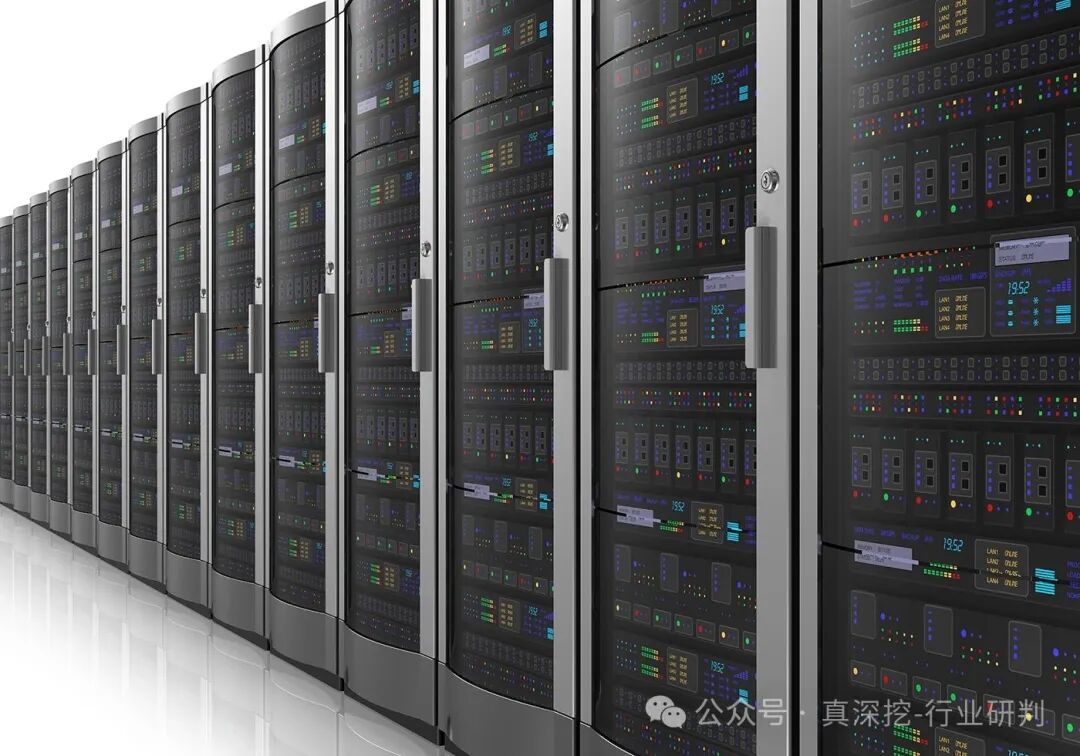
When Google launched its first TPU in 2016, people realized the terrifying potential of ASICs: during the match between AlphaGo and Lee Sedol, the TPU’s Go inference speed was 15 times that of a GPU, while its power consumption was only one-third. The latest seventh-generation TPU released this year is even more impressive, achieving 4614 TFLOPS in FP8 computing power, rivaling Nvidia’s B200, but reducing costs by 60%.
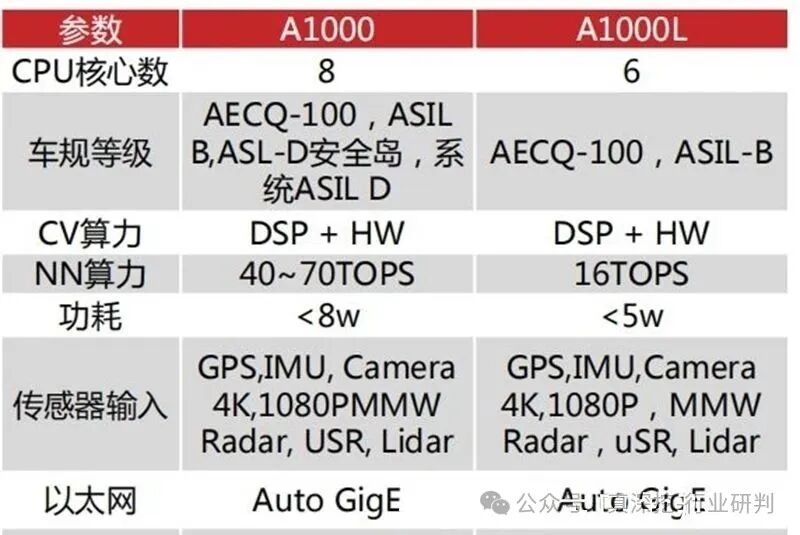
“When AI shifts from training to inference, ASICs become money printers.” explained Morgan Stanley analyst Frank, noting that by 2026, inference demand will account for over 60% of AI computing power, and ASICs are 5-10 times more efficient than GPUs for specific tasks. Just as a delivery person wouldn’t use a fire truck for deliveries, AI inference no longer requires a “universal” GPU.
The “ASIC Arms Race” Among Global Giants
In this computing power revolution, Broadcom and Marvell hold 70% of the market share. Broadcom has exclusive orders from Google, Meta, and Microsoft, and its 3.5D packaging technology can increase chip signal density by seven times; Marvell has secured 2nm chip orders from Amazon and Microsoft, planning to go into mass production by 2026.
Tech giants are also developing their own “high-end” models: Google’s TPU has now reached its seventh generation, optimized for large model inference; Meta’s MTIA chip can improve Instagram’s recommendation algorithm response speed by 40%; even Apple is quietly collaborating with Broadcom to develop an AI chip specifically for the iPhone.
Nvidia certainly won’t sit idly by. The NVLink Fusion technology launched in May this year allows ASIC chips to connect to its GPU ecosystem. This competition has led to a 20-fold increase in ASIC performance over three years, while prices have dropped by 60%.
Dissecting the Four Core Components of ASIC Customization
The explosion of ASICs has also driven the prosperity of the entire industry chain:
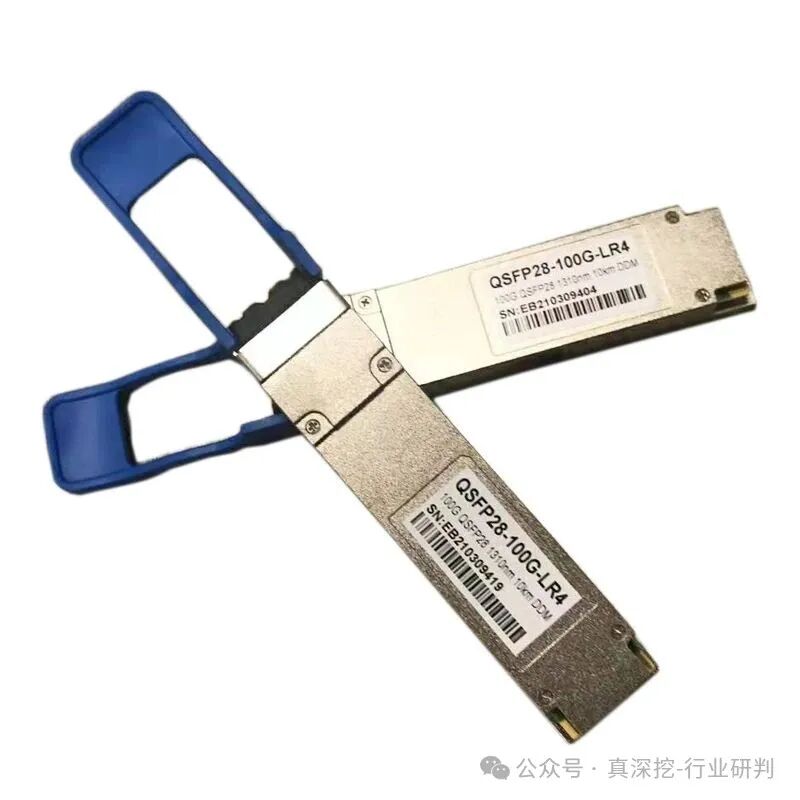
Optical Modules
As the number of ASIC chips increases from 2 million to 7 million, data transmission becomes a bottleneck. The 800G optical modules produced by New Fiber and Zhongji Xuchuang can transmit data at a speed of 100GB per second, equivalent to transferring 25 movies in one second. When the 1.6T optical modules go into mass production next year, the speed will double.
Switches
In Meta’s data centers, each ASIC requires a switch to coordinate. Huawei and H3C’s 102.4T switch can simultaneously direct 1 million vehicles to pass in an orderly manner, while Shengke Communication’s switch chip has become the fourth largest globally.
High-Speed Copper Cables
The silver cables in the cabinets are not ordinary wires. Zhaolong Interconnect’s 56Gbps copper cables can transmit 400GB of data within 1 meter, 10 times faster than traditional cables, while reducing costs by 30%. In Amazon’s data centers, the usage of these copper cables has increased fivefold in three years.
PCBs
To maximize ASIC performance, Huidian Co. has increased the number of PCB layers from 16 to 28, equivalent to expanding a highway from a two-lane to a twelve-lane road. This “skeleton” costs more per square meter than gold but can enhance chip computing power by 40%.
The “Comeback Path” of Chinese ASICs
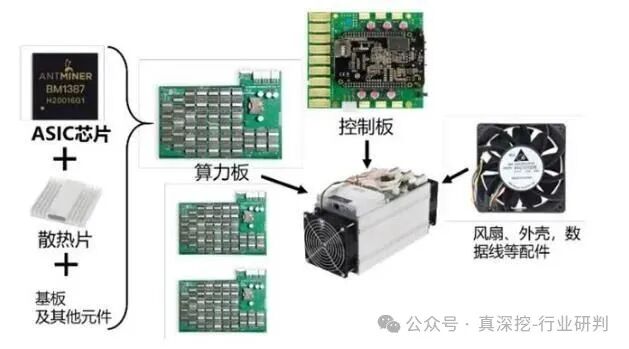
In the Zhangjiang Laboratory in Shanghai, Huawei’s Ascend 910C chip is undergoing final testing. Through the “four-core bridging” technology, this chip achieves 300 PFlops of computing power in a 384-card cluster, with memory bandwidth surpassing Nvidia’s H100. Cambricon’s Siyuan 370 adopts Chiplet technology, combining multiple small chips into a large chip like building with Legos, reducing costs by 40%.
Strong policy support is also in place. Shanghai’s latest plan requires that by 2027, domestic computing power in intelligent computing centers must exceed 70%, which means a market space of 122.8 billion yuan. SMIC’s 14nm production line has a capacity utilization rate of 94%, providing a “manufacturing workshop” for domestic ASICs; Chipone’s IP core licensing revenue has surged by 52%.
Quick Fact: Why are ASICs so efficient?
Regular chips are like Swiss Army knives, multifunctional but not precise; ASICs are like surgical knives, optimized for specific tasks. For example, an ASIC used for facial recognition dedicates 70% of its transistors to processing image data, while a GPU can only allocate 30% of its resources for this task.
Key Enterprises in the Industry Chain
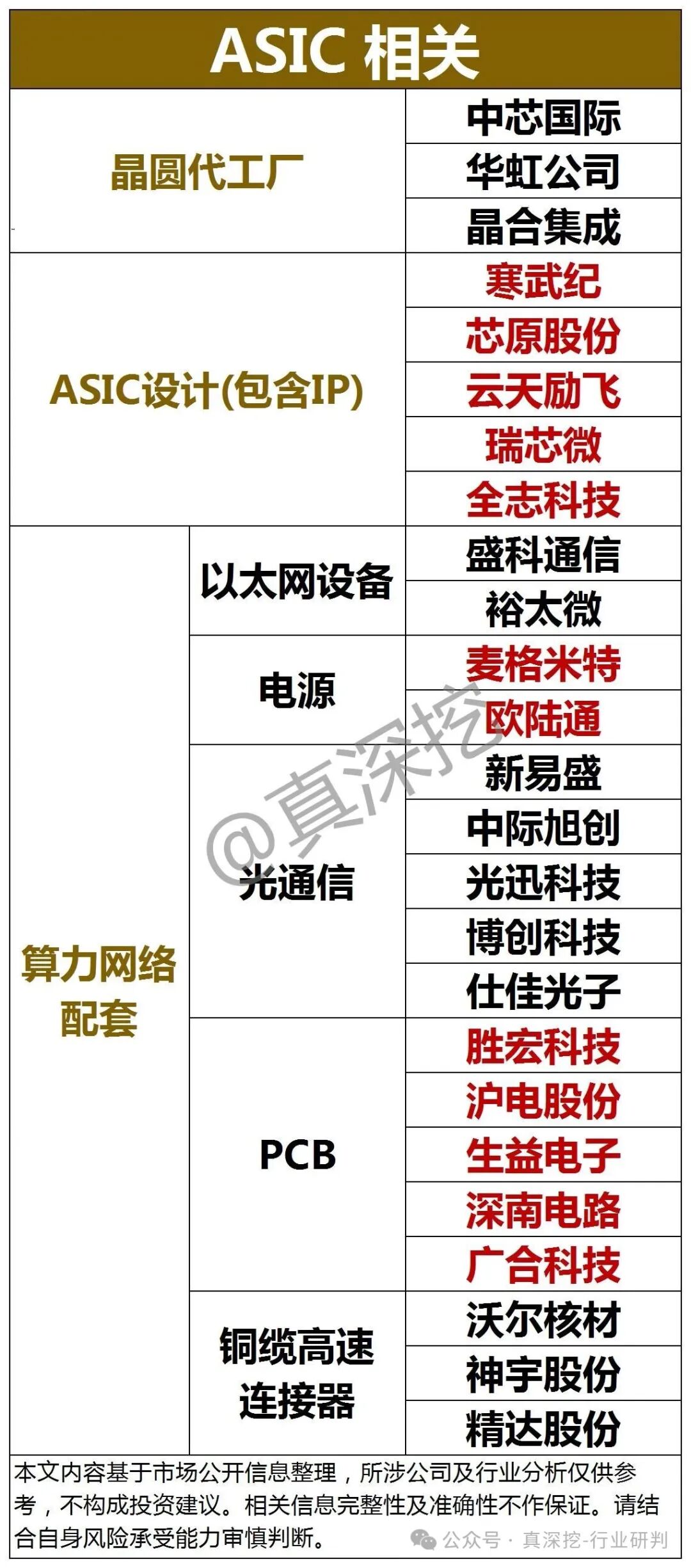
Wafer Foundry: SMIC, Huahong
Chip Design: Cambricon, Chipone, Rockchip
Optical Communication: New Fiber, Zhongji Xuchuang
Connectors: Shenyu Co., Woorl Nuclear Material
PCB/Substrate: Shenghong Technology, Huidian Co.
Save for future reference, stay ahead
Check out the pinned information on the public account homepage. Join the True Deep Dive community to not miss any snippets.
👇👇👇
Welcome to the True Deep Dive community
Previous Concept Selections
Stablecoins/RWA, Tesla FSD, comprehensive sorting of cargo drones (save for future reference, stay ahead)
Nvidia-related, chip design EDA, consumer branch hair loss prevention, comprehensive sorting of leading companies in autonomous vehicles (save for future reference, stay ahead)
Cross-border payment crypto assets, autonomous taxis, autonomous sanitation vehicles, concepts related to the Dragon Boat Festival, comprehensive sorting of smart manicures (save for future reference, stay ahead)
New consumer beverages, unmanned logistics, autonomous taxis (carrot fast run), Doubao ISP vision (save for future reference, stay ahead)
Focusing on research in popular industries and companies. Disclaimer: The content of this account does not constitute any investment advice, guidance, or commitment, and is for academic discussion only. The market has risks, and investment decisions should be based on rational independent thinking.