Arm has launched the new Lumex Computing Subsystem (CSS) platform, designed to bring faster on-device artificial intelligence (AI) to smartphones, personal computers, and smaller devices. This platform combines CPUs that support SME2, a new series of Mali GPUs, and support for major AI frameworks.
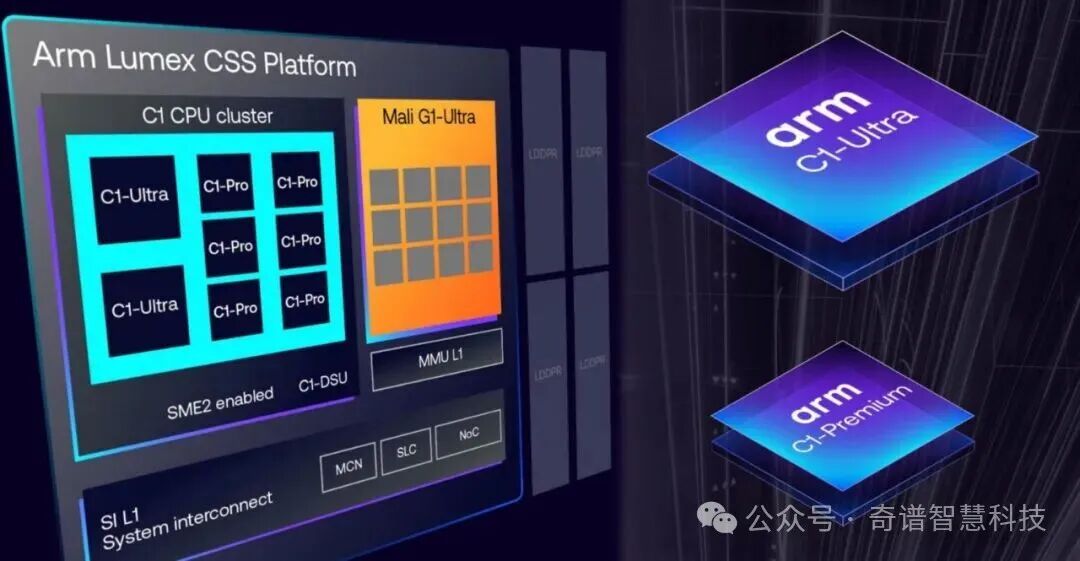
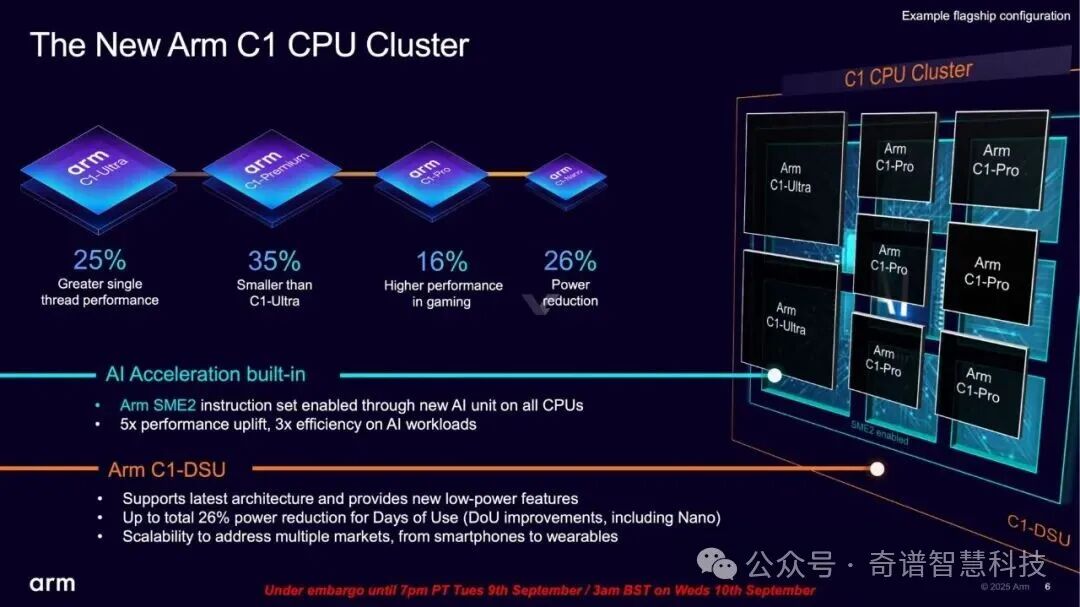
As part of the new Arm Lumex Computing Subsystem (CSS) platform, the Arm C1 CPU cluster is the first cluster built on the Armv9.3 architecture, integrating the matrix extension SME2. This upgrade achieves up to a 5x increase in AI performance, a 4.7x reduction in voice latency, and a 2.8x faster audio generation speed compared to the previous generation. In practical demonstrations, SME2 improved text-to-speech speed by 2.4x and reduced response time for large language models in collaboration with Alipay and vivo by 40%.
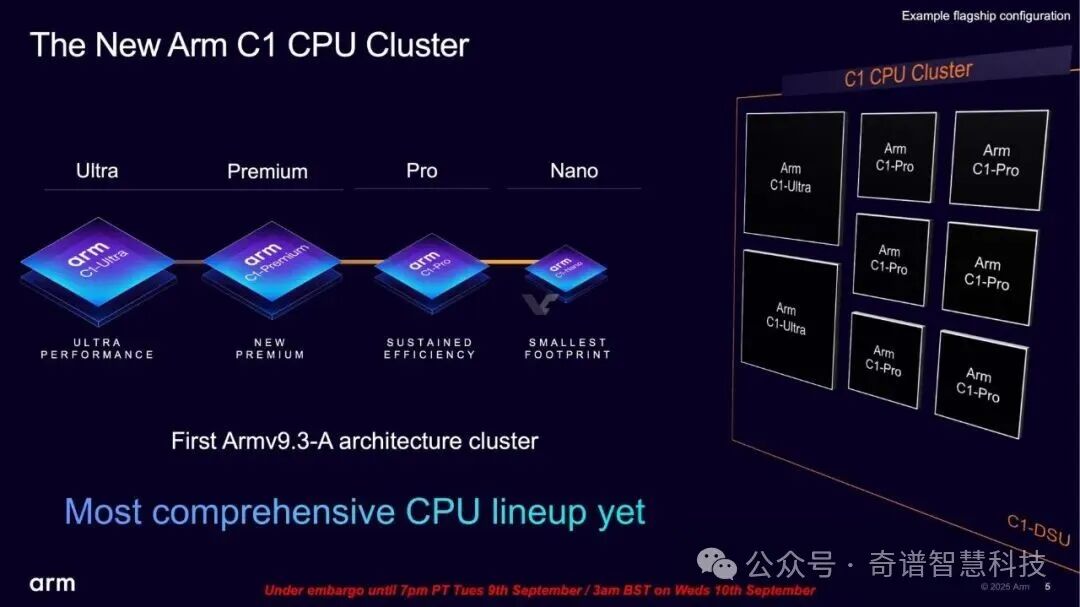
The C1 CPU family includes:
-
C1-Ultra: 25% faster single-thread performance than Cortex-X925, continuing a stable IPC improvement over the past 6 years.
-
C1-Premium: 35% smaller area than Ultra, aimed at mid-range devices.
-
C1-Pro: 16% higher sustained performance, suitable for gaming and video playback.
-
C1-Nano: 26% more energy-efficient than Cortex-A520, aimed at wearable devices.
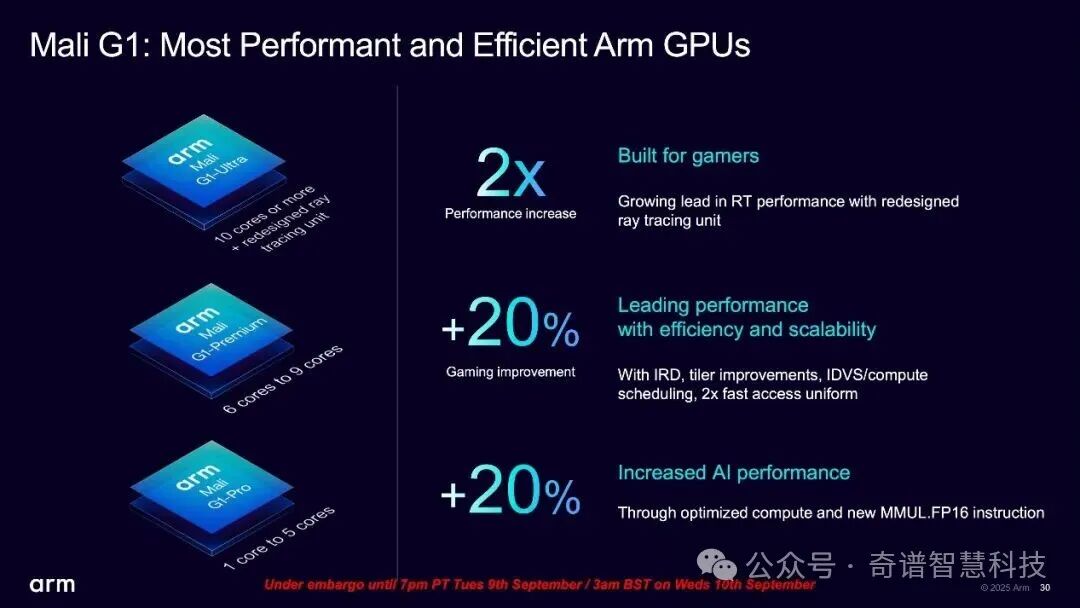
In terms of graphics processing, the new Mali G1-Ultra GPU doubles ray tracing performance through RTU v2 and achieves a 20% improvement in both gaming and AI inference. Arm states that this GPU will enhance the visual effects and responsiveness of games such as Fortnite, Genshin Impact, Arena of Valor, and Honkai: Star Rail. The smaller G1-Premium and G1-Pro variants focus on efficiency for mid-range devices.
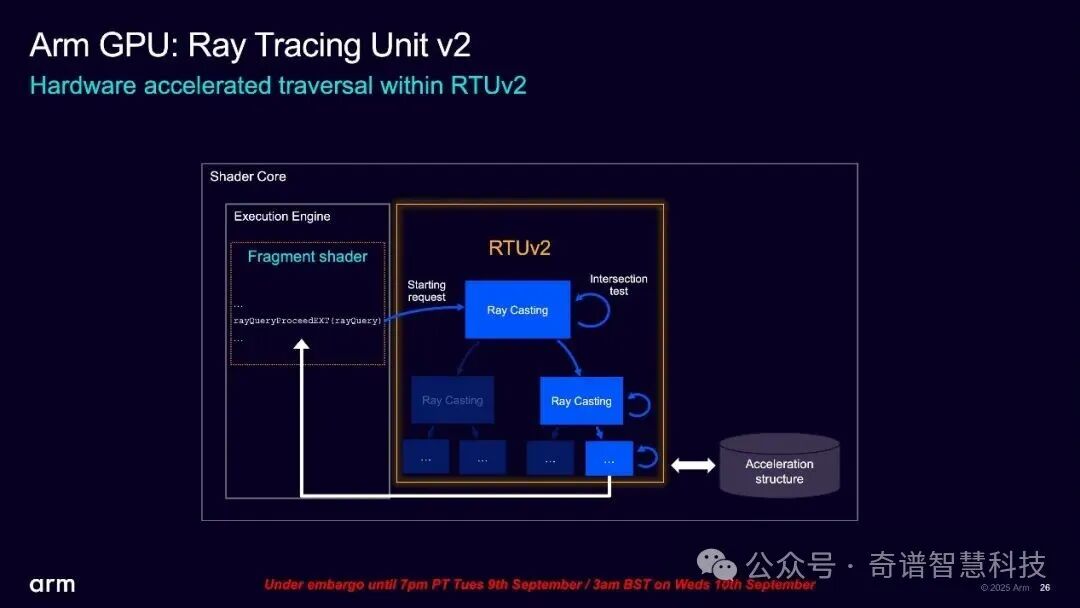
Arm’s new RTUv2 introduces hardware-accelerated traversal within the ray tracing unit, replacing the compute shader method used in RTUv1, and shifts from a packed ray model to a single ray model for better handling of incoherent rays, providing greater flexibility. While the packed method improves efficiency by combining multiple rays, it struggles with divergence after multiple reflections, whereas the single ray model used in the Mali G1-Ultra is better suited for achieving realistic lighting and reflection effects.
Arm claims that ray tracing performance can be improved by up to 2x in micro-benchmarks, although actual performance gains will vary in real applications, with a 40% improvement in its Lumilings demonstration, 17% in Genshin Impact, 11% in Fortnite, 25% in Arena of Valor, and 26% in the Mori demonstration.
Arm expects that by 2030, SME and SME2 will provide over 10 billion TOPS of computing power across more than 3 billion devices. The Lumex platform integrates CPU, GPU, and system IP, enabling faster assistant responses, real-time translation, enhanced photography effects, and mobile gaming experiences closer to desktop quality. Currently, partners such as Samsung, Tencent, Alibaba, vivo, and Alipay have adopted the Lumex platform.