The “Interim Regulations on the Management of Unmanned Aerial Vehicle Flight” (State Order No. 761, hereinafter referred to as the “Regulations”) issued by the State Council and the Central Military Commission will officially take effect on January 1, 2024. The “Regulations” clarify the responsibilities of departments for public safety management of civil unmanned aerial vehicles, regulatory services, and the behavioral norms that must be followed during flight activities.
So how should drones be flown legally?
Question
What types of unmanned aerial vehicles are considered legal?
Answer: The “Regulations” classify civil unmanned aerial vehicles (commonly known as “drones”) into micro, light, small, medium, and large unmanned aerial vehicles based on performance indicators such as empty weight, maximum cruising speed, and maximum flight altitude.
In daily use, it is essential to confirm the category of your drone, as different categories correspond to varying management requirements regarding flight airspace, pilot license qualifications, mandatory insurance, and the civil behavior capabilities of the operator.
Question
Where can drones be legally flown?
Answer: According to the “Regulations,” airspace above 120 meters, restricted airspace, controlled airspace, military low-altitude flight airspace, and the airspace above the following areas should be designated as controlled airspace:
(1) Airports and surrounding areas;
(2) Areas within a certain range on the side of the national border line, actual control line, and boundary line;
(3) Military prohibited zones, military management areas, and surrounding areas of sensitive units;
(4) Protection areas for important military industrial facilities, nuclear facility control areas, and areas for the production and storage of flammable and explosive materials;
(5) Public infrastructure such as power plants, substations, gas stations, water supply plants, public transportation hubs, major water conservancy facilities, ports, highways, and electrified railway lines, as well as surrounding areas and drinking water source protection zones;
(6) Facilities that require special electromagnetic environment protection, such as observatories, satellite control (navigation) stations, aviation radio navigation stations, and radar stations, and surrounding areas;
(7) Important revolutionary memorials, significant immovable cultural relics, and surrounding areas;
(8) Other areas specified by the national air traffic management authority.
The airspace outside the controlled airspace is suitable for micro, light, and small unmanned aerial vehicles.
The specific range of controlled airspace is determined by air traffic management agencies at all levels according to the regulations of the national air traffic management authority and published by the municipal governments at the district level and above. No unmanned aerial vehicle flight activities may be conducted in controlled airspace without the approval of air traffic management agencies.
Question
How should flight activity applications be submitted?
Answer: Except as otherwise provided in Article 31 of the “Regulations,” organizations or individuals organizing unmanned aerial vehicle flight activities must submit a flight activity application to the air traffic management agency one day before the planned flight. The air traffic management agency must make a decision to approve or disapprove the application one day before the flight. Organizations or individuals that have obtained approval for flight activities must report the expected takeoff time and preparation status to the air traffic management agency one hour before the planned takeoff, and may only take off after confirmation by the air traffic management agency.
Micro drones can fly in suitable airspace below 50 meters in controlled airspace, while light and small drones can fly in suitable airspace below 120 meters without needing to submit a flight activity application.
Question
How to obtain a drone operator license?
Answer: Personnel operating small, medium, and large civil unmanned aerial vehicles must meet certain entry requirements (Article 16 of the “Regulations”) and apply to the civil aviation authority of the State Council for the corresponding unmanned aerial vehicle operator license. Personnel engaged in routine agricultural unmanned aerial vehicle operations do not need to obtain an operator license but must receive training and assessment from the producer of the agricultural unmanned aerial vehicle system according to the regulations set by the civil aviation and agricultural authorities of the State Council, and obtain an operating certificate upon passing.
Question
How to ensure the safe flight of drones?
Answer: Currently, the application of drones is becoming more widespread. They are small, fly at low altitudes, and have high flight frequencies, making them prone to risk accidents.
The police remind: The use of drones must strictly comply with national, local, and aviation department regulations, flying within suitable airspace. Owners need to complete two steps: real-name registration and submission of identification information; in controlled airspace, owners need to complete six steps: real-name registration, submission of identification information, liability insurance, obtaining an operator license, flight activity application, and takeoff confirmation. These steps can be completed on the “National Unmanned Aerial Vehicle Integrated Regulatory Service Platform (Civil Unmanned Aerial Vehicle Comprehensive Management Platform).”
When taking off, strictly adhere to airspace requirements and fly within legal airspace. When capturing aerial images, familiarize yourself with the surrounding conditions of the flight airspace, closely monitor signal conditions, ensure stable signal connection to avoid collisions and loss of control due to obstacles, and minimize flight risks. It is also crucial to strictly comply with the prohibited flight regulations specified in the “Regulations,” such as not being under the influence of alcohol, narcotics, or other drugs during flight, to maximize safety.
Question
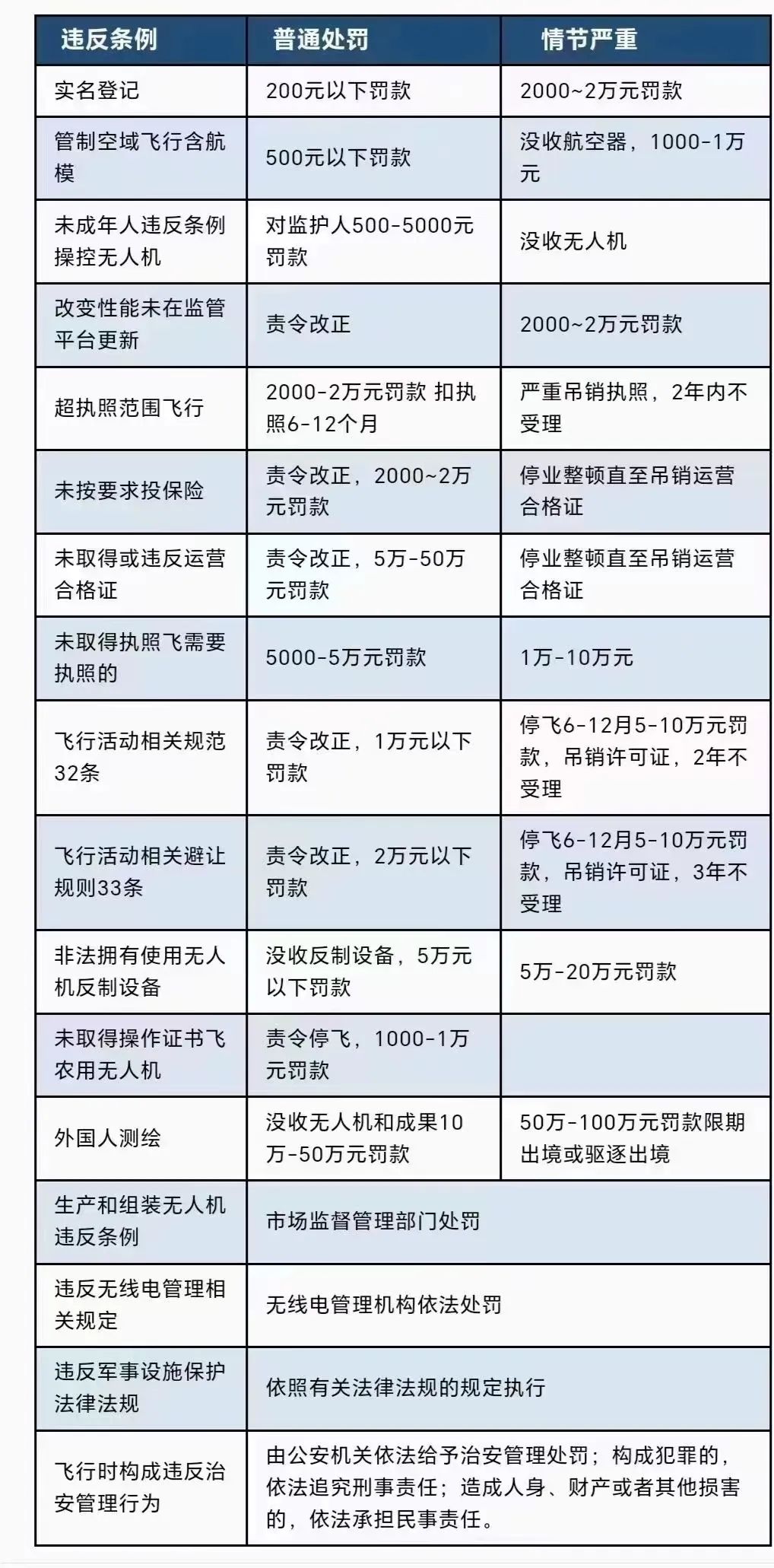
What penalties will be imposed for illegal drone flights?
Answer:
Global Hawk Drone Flight Base
Global Hawk Drone Co., Ltd. is a professional drone pilot training institution approved by the China Civil Aviation Administration and certified by the China Civil Aviation Pilots Association. The academy has a teaching area of 60,000 square meters and is authorized by the China Civil Aviation Administration as a “Civil Drone Pilot License Examination Center” and a “Drone Vocational Skills Improvement Training Base” authorized by the Ministry of Industry and Information Technology. It offers drone license training courses, hardware engineering, aerial photography/mapping/agricultural protection/inspection industry application courses, and students can “live, study, and train all in one place.” As a high-skilled talent training base in Shenzhen, Global Hawk has trained over ten thousand various drone skilled personnel for society. Studying at Global Hawk not only allows for multiple certifications from one exam but also offers high-paying job recommendations upon completion, all aimed at cultivating high-quality technical talents in the drone field.
Disclaimer: Some materials above are sourced from the internet. If there is any infringement, please contact us for removal.