Following NVIDIA’s announcement at the end of August regarding the Rubin architecture chip set to enter mass production next year, NVIDIA discussed the progress of Rubin at the Goldman Sachs Technology Conference on September 8.
NVIDIA’s Chief Financial Officer, Colette Kress, stated that the Rubin chip is already preparing for market entry,and the Rubin architecture will feature six types of chips, all of which have been taped out. She mentioned that in the second quarter of fiscal year 2026, NVIDIA’s data center revenue includes various components, including the Blackwell architecture’s GB200, B200, and the Blackwell Ultra architecture’s GB300. The GB200 and GB300 are still being shipped in the third quarter.
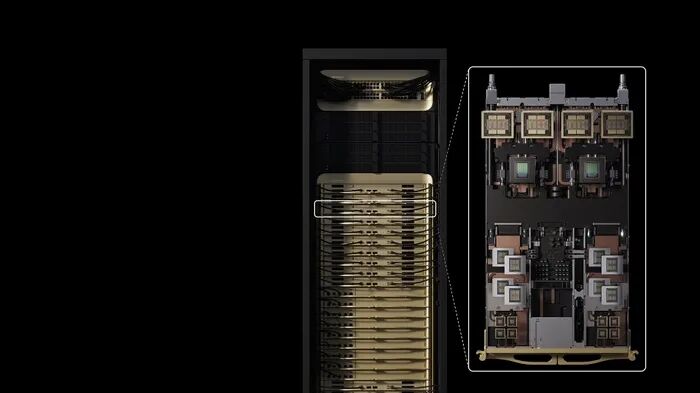
Currently, NVIDIA has begun discussions with data center operators regarding the power infrastructure required for the deployment of Rubin. Colette Kress stated:“We have received feedback and expect that the deployment of the Vera Rubin chip globally will bring about ‘gigawatt-level’ power demand. Even though the chip has not yet been officially released, we are already seeing gigawatt-level demand in the planning stages.”
This indicates thatthe power consumption of the next-generation AI chips will significantly increase, posing greater power and cooling challenges for data centers. This also highlights NVIDIA’s emphasis on energy efficiency when building AI infrastructure.
1. NVIDIA Rubin: Next-Generation AI Chip Platform
Rubin is NVIDIA’s next-generation AI chip platform, which includes GPUs codenamed “Rubin” and CPUs codenamed “Vera,” forming the Vera Rubin super AI chip, replacing NVIDIA’s current Grace Hopper chip architecture.
NVIDIA plans to launch the Vera Rubin NVL144 rack in the second half of 2026, integrating 36 Vera CPUs, 144 Rubin GPUs, and 144 Rubin CPX910 co-processors.
The Rubin CPX co-processor is a next-generation GPU designed specifically for large-scale contextual processing. This technology enables AI to handle software coding tasks and generate text and video content at unprecedented speed and efficiency.
According to Forbes,the Rubin system is “designed entirely for data centers and artificial intelligence”.
2. NVIDIA: Over $3 Trillion in Data Center Capital Expenditures in the Next 5 Years
Previously, Colette Kress mentioned during a conference call following NVIDIA’s earnings report at the end of August thatcapital expenditures related to data center infrastructure will reach $3 trillion to $4 trillion over the next five years.
At the Goldman Sachs Technology Conference, she explained, “We are talking about a new computing platform for the next few decades, and we need to start transitioning from a standard computing platform that has existed for 20 to 30 years.”Factors such as capital expenditures from leading cloud service providers, AI data factory construction, and sovereign AI demand have led NVIDIA to foresee a capital expenditure outlook exceeding $3 trillion.
Colette Kress also addressed questions regarding the lifespan and replacement cycle of chips deployed in 2023, stating that NVIDIA has not yet seen significant replacement demand, as the previous generation Hopper architecture chips are still performing well. Many of NVIDIA’s customers have depreciation periods of 4 to 6 years, and many will continue to retain these chips in their data centers due to their high performance.
In the second quarter of fiscal year 2026, NVIDIA’s GAAP gross margin was 72.4%, and NVIDIA expects a GAAP gross margin of 73.3% for the third quarter. Regarding how to improve gross margins during product transitions, Colette Kress stated that the Blackwell Ultra version is running smoothly, allowing NVIDIA to continue focusing on cycle time, time to market, and lower costs, and NVIDIA can also improve gross margins through its product mix.
On how to ensure the supply chain keeps pace with NVIDIA’s iteration speed, Colette Kress responded that some supply chain vendors have spent a lot of time over the past 30 years understanding NVIDIA and improving overall supply, while some vendors need to build different production lines and consider production flexibility. Partnerships are one of the key factors in NVIDIA’s success, and she does not believe many other companies can establish such supply chains.
Some materials sourced from: the internet
Integration: Optoelectronic Link, if the integrated content involves copyright issues, please contact us, and we will take appropriate measures promptly.
Recommended Reading
· Revolutionary Advances in Hollow Core Fiber! Changfei Fiber and Hengtong Optoelectronics Benefit
· Alibaba Cloud’s First Investment! Self-variable Robot Secures 1 Billion Funding
· Registered Capital of 20.7 Billion Yuan! Yangtze Memory Technologies and Others Establish Changchun Phase III Integrated Circuit Company
· The First AI Computing Open Architecture Released in Chongqing
· The US Government Splurges $8.7 Billion to Rescue Chips, Can Intel Make a Comeback?