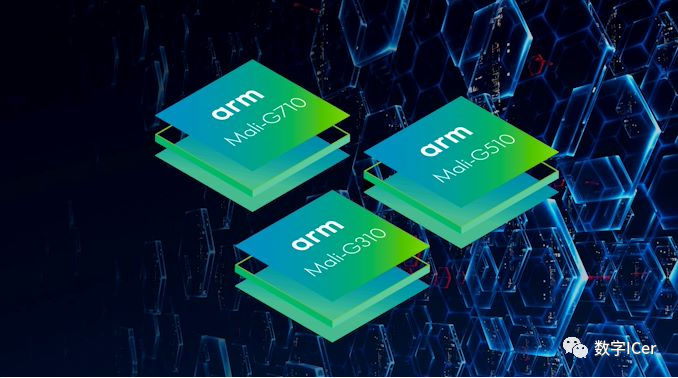
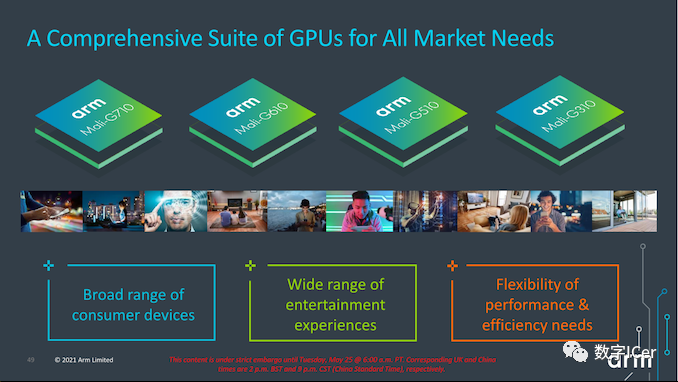
ARM has launched four new mobile GPU IPs with a new naming convention: Mali-G710, Mali-G610, Mali-G510, and Mali-G310. This is the third generation of ARM’s Valhall GPU architecture, covering high, mid, and low-end markets for the first time.
The G710, G510, and G310 target the flagship, mainstream, and entry-level markets, respectively, replacing the existing G78, G57, and G31.
The G610 inherits all the features of the Mali-G710 but is priced lower, with fewer cores compared to the G710.
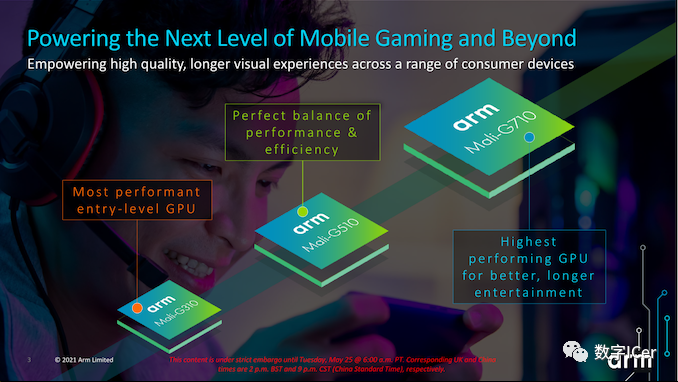
G710
The G710 offers a 20% increase in overall performance, a 35% improvement in machine learning performance, a 50% boost in texture performance, and a 20% enhancement in energy efficiency, making it suitable for high-end flagship smartphones;
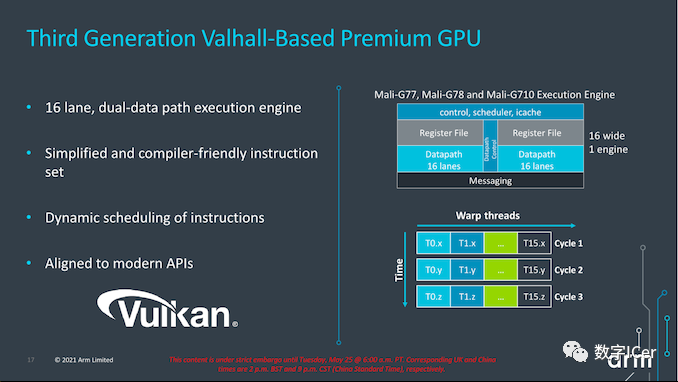
As a continuation of the Valhall GPU architecture, the execution engine design of the G710 is very similar to that of the G77 and G78, with changes primarily in details.
- The wavefront/warp size has increased from 8 to 16, and each execution engine has two data paths, resulting in 32 FMA per core.
- The ISA instruction set has also seen significant improvements to better meet the needs of modern APIs like Vulkan.
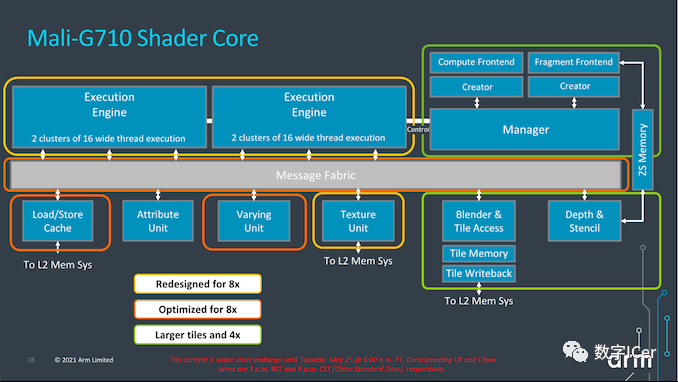
- The G710 has added a second execution engine, effectively doubling the computational performance of each shader core in the Valhall architecture;
In the image above, the “8x” and “4x” metrics refer to the throughput per core per cycle; it can be seen that the throughput per core per clock cycle has increased by 4x and 8x.
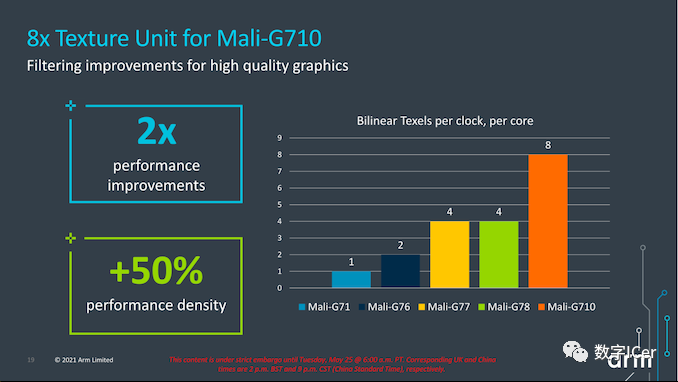
- The new G710 includes an entirely new texture unit, capable of processing up to 8 bilinear texels per clock cycle, with an optimized design that significantly improves area efficiency, resulting in a 50% increase in texture unit performance density compared to the previous generation.
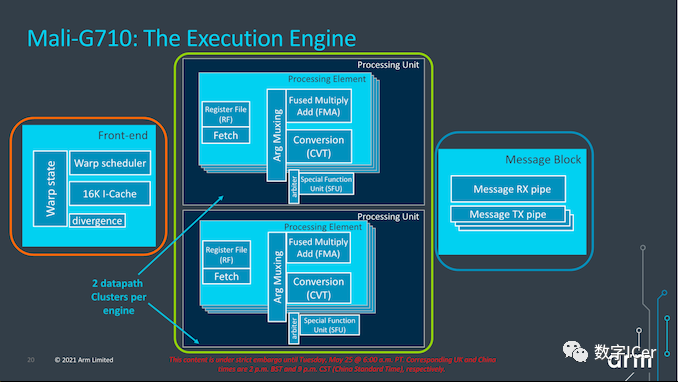
- In the execution engine, two processing units or processing element clusters continue to be used; in this regard, we do not see much difference between generations, but if we delve deeper into the actual processing units, we will find changes in the blocks:
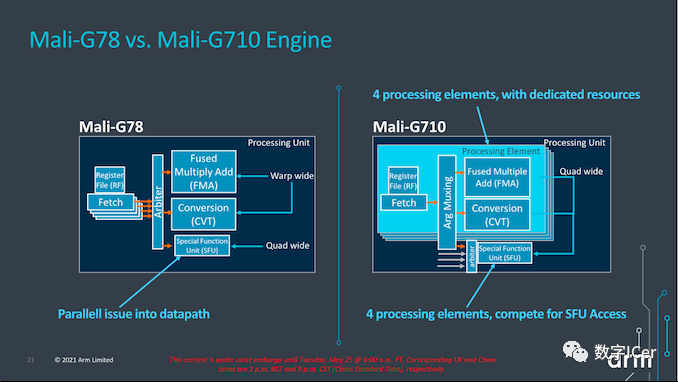
We see a transition from a single instance of 16-wide (warp width) processing elements and execution units to four instances of 4-wide execution units. The throughput between designs remains unchanged, but the new microarchitecture provides more dedicated resources for processing elements and allows for better structures to improve efficiency.
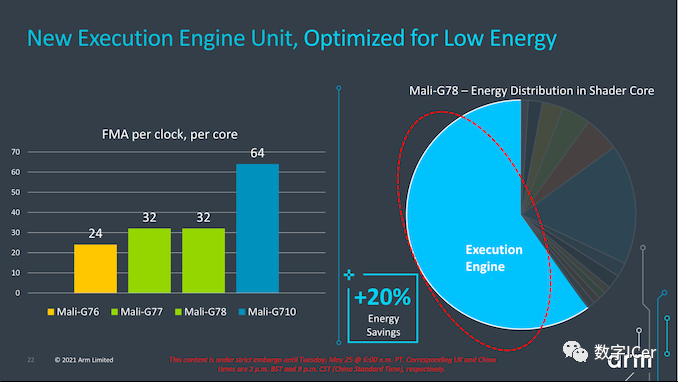
Overall, the new execution engine design doubles the FMA per core per clock frequency and also helps reduce the energy distribution within the shader cores from the execution engine by 20%.
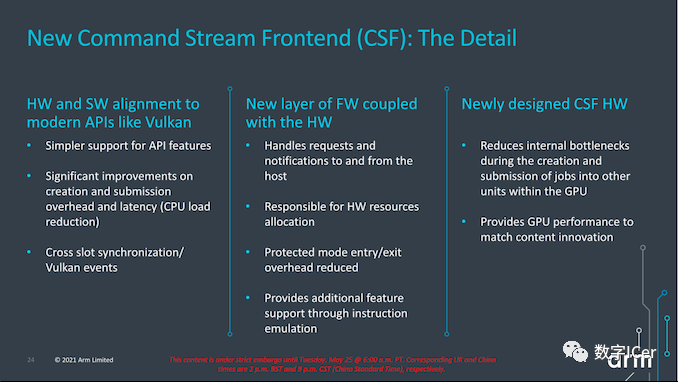
Additionally, the traditional Job Manager has been transformed into the new Command Stream Frontend (CSF), responsible for scheduling and processing draw calls. The CSF introduces a new CPU of an undisclosed nature and introduces a firmware layer for the first time, working closely with hardware to handle host demands. (A draw call is a command from the CPU to the GPU, where each API call to the GPU for rendering constitutes a draw call).
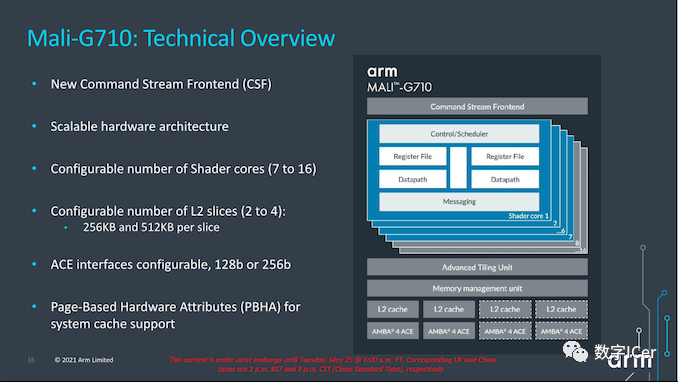
The G710 can be configured with 8-16 different core counts, while the G610 supports up to 6 cores. Additionally, the secondary cache can be configured with 2 or 4 blocks, each block being 256KB or 512KB, resulting in a minimum of 512KB and a maximum of 2MB overall.
G510
In the mid-low range, the new Mali-G510 and Mali-G310 are improvements over the previous G57 and G31 in the market.
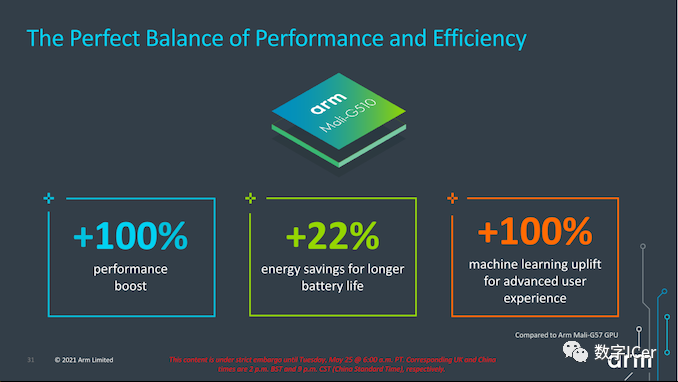
The G510 offers a 100% increase in overall performance, a 100% boost in machine learning performance, and a 22% improvement in energy efficiency, leading to longer battery life. It is suitable for mid-range smartphones, high-end smart TVs, and set-top boxes;
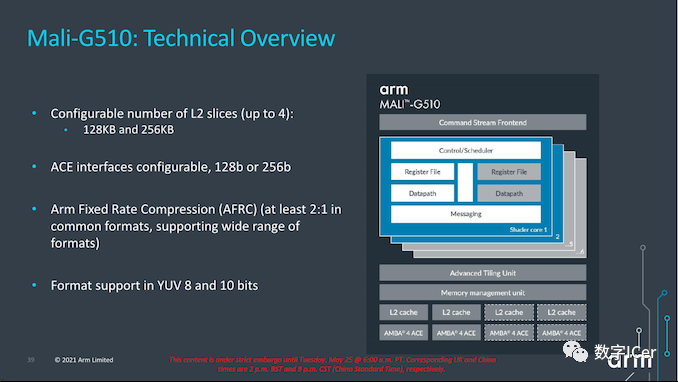
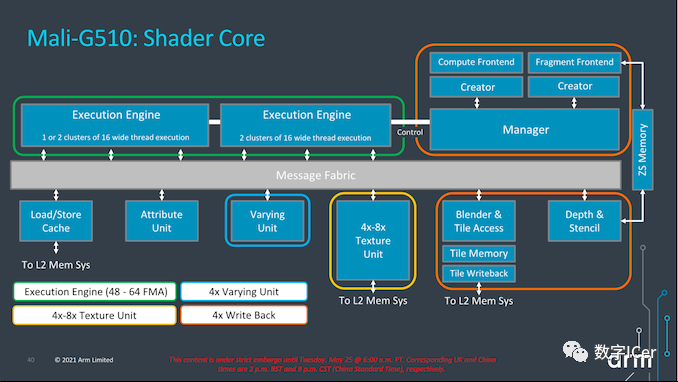
The G510 supports configurations of 2-6 cores, and the configuration of each execution unit can also be customized. The shader core can optionally have 4 or 8 texels processed per cycle, significantly enhancing the texture unit.
With the optional L2 cache, the Mali-G510 can have many configuration options, achieving diverse performance.
In terms of execution engines, it still has 2, but can also be configured to use only 1, reducing the FMA per clock cycle from 64 to 48 (the FMA execution capability can be selected between 48-64 per cycle);
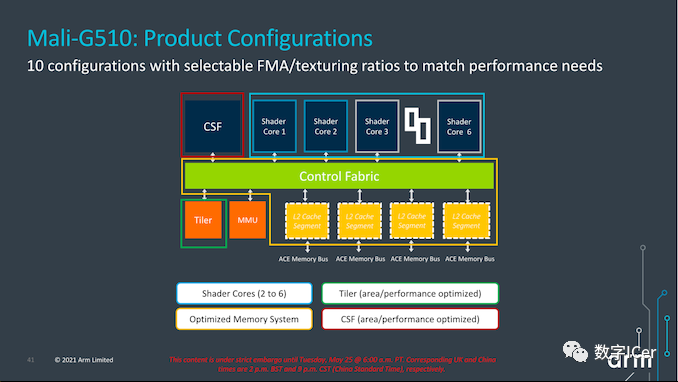
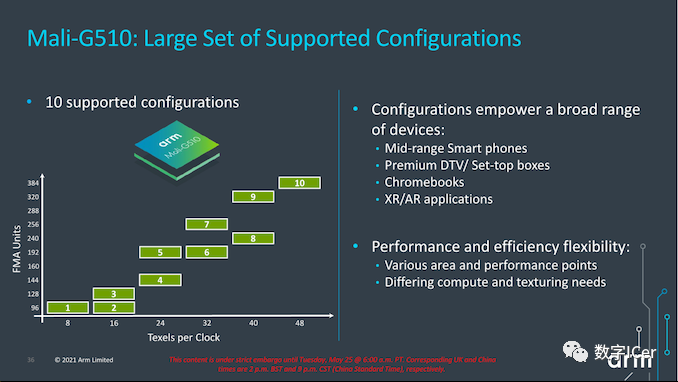
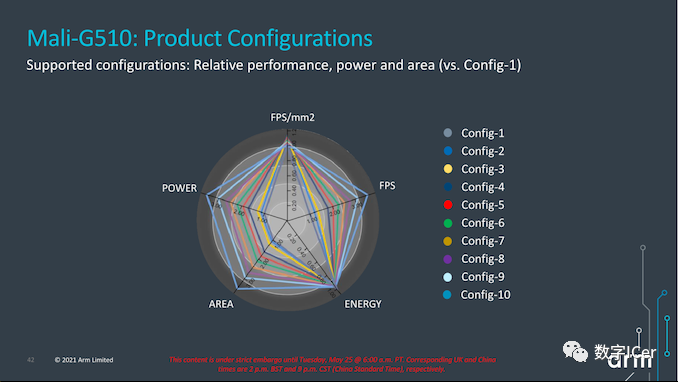
ARM lists 10 possible different specifications for the G510, with varying computational capabilities and fill rates, suitable for different application needs.
G310
The G310 offers the highest performance at the lowest area cost. Although it is positioned as the lowest, it has the most changes, claiming a texture performance increase of up to 6 times, a Vulkan performance boost of 4.5 times, and a 2-fold increase in Android UI content performance; it is suitable for entry-level smartphones, AR devices, and wearables.
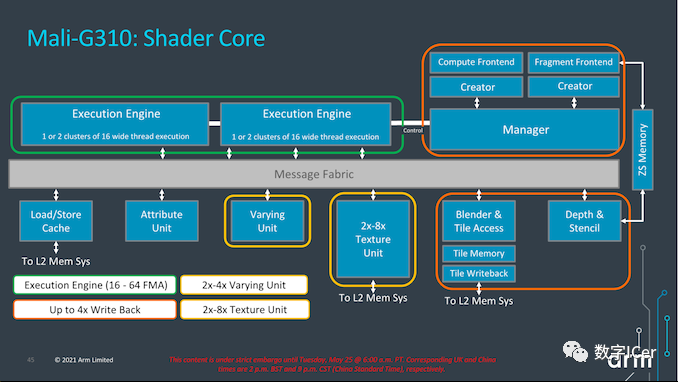
Compared to the previous generation’s smallest Mali IP product, the G31, this GPU represents a significant performance leap, transitioning from the Bifrost architecture to the new Valhall design.
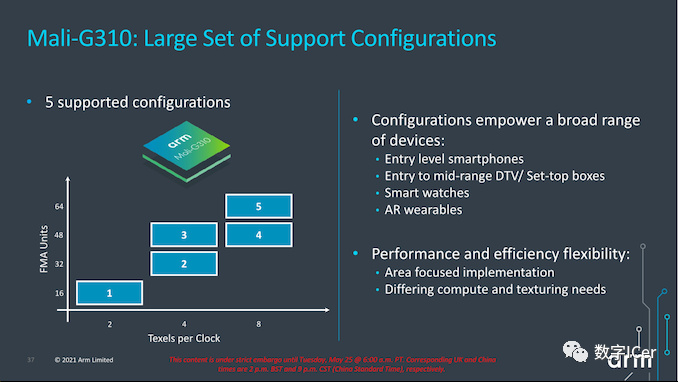
It features a new execution engine design, supporting flexible scaling configurations, allowing clusters to be reduced to just one per EE, and also allowing for a minimum configuration with only one EE, permitting each core to have 16, 32, 48, or 64 FMA, with the texture unit having a minimum of 2 per clock cycle.
However, the G310 only supports a single core design, so configurations are achieved by changing the different execution units within that core.
Conclusion
From Mali-G710 to G610, there is a reduction in core count; from G610 to G510, there are reductions in core count as well as shader core size, texture unit size, etc.; G310 represents a further reduction in core count and additional reductions in shader core size and other unit sizes for a low-end version.