In the mobile technology sector, every release from Arm signifies the performance trajectory of smartphones, tablets, and even laptops for the next year or two. Today, on September 10th, Arm dropped a bombshell by officially launching its new Compute SubSystem (CSS) platform—Lumex CSS Platform. Earlier this year in May, Arm announced the rebranding of its mobile product platform to “Lumex”, and the Lumex CSS Platform is the first product under this brand.
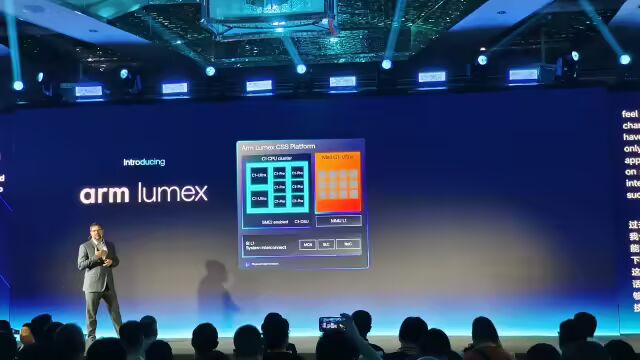
Lumex integrates Arm’s highest-performing CPUs (equipped with the second-generation Scalable Matrix Extension SME2), GPUs, and system IP, helping ecosystem partners to bring AI devices to market faster and provide rich experiences ranging from desktop-level mobile gaming to real-time translation, smart assistants, and personalized applications.
Arm is enabling SME2 across all CPU platforms, and by 2030, SME and SME2 will deliver over 10 billion TOPS of additional computing power to more than 3 billion devices, achieving an exponential leap in AI capabilities at the device level.Partners can freely choose how to integrate Lumex into their SoCs—either by adopting a cutting-edge physical implementation platform delivered by Arm, tailored to their needs, thus gaining advantages in time-to-market and performance; or by configuring the platform RTL according to their target market and completing the core implementation themselves.
The currently released Lumex platform includes:
-
A new generation of Armv9.3 CPU clusters supporting SME2, including C1-Ultra and C1-Pro, providing robust power for flagship devices.
-
The new C1-Premium, designed for the upper mid-range market, featuring top-notch area efficiency.
-
The new Mali G1-Ultra GPU, equipped with next-generation ray tracing technology, enabling advanced graphics and gaming experiences while enhancing AI performance.
-
Arm’s most flexible and lowest power DynamIQ Shared Unit (DSU): C1-DSU.
-
Optimized physical implementation for the 3nm process node.
-
Deep integration with the entire software stack, providing seamless AI acceleration for developers through the KleidiAI library.
SME2-Supported CPUs Accelerate Ubiquitous AI
The Arm C1 CPU cluster supporting SME2 brings significant performance improvements for various AI tasks:
-
AI performance improvements of up to 5 times
-
Voice workload latency reduced by 4.7 times
-
Audio generation speed increased by 2.8 times
This leap in CPU AI computing power enables real-time AI inference on devices, providing users with a smoother and faster experience in audio generation, computer vision, and contextual assistance.
The advantages of SME2 are not just in speed; it also unlocks AI capabilities that traditional CPUs cannot match. For example, neural camera noise reduction can now process 1080p video at over 120fps on a single core, or 4K video at 30fps. This allows smartphone users to capture clearer and purer images even in the dimmest scenes, enabling smoother interactions and richer experiences on everyday devices.
Unlike cloud AI, which is limited by latency, cost, and privacy issues, Lumex brings intelligence directly to the device, making it faster, safer, and always available. SME2 is favored by industry-leading ecosystem partners such as Alibaba, Alipay, Samsung LSI, Tencent, and vivo.
Architectural Freedom for Every Product Tier
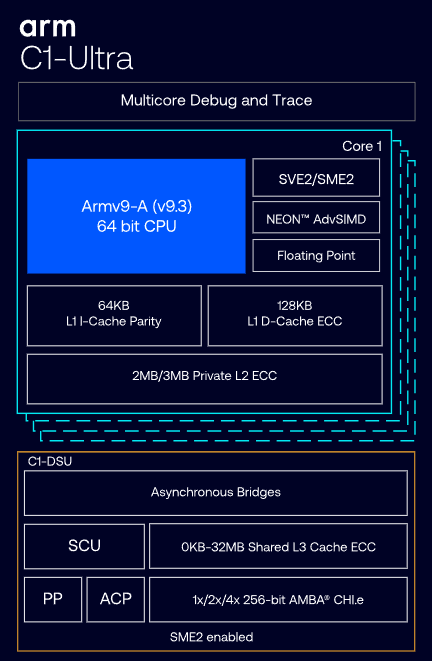
Lumex provides partners with the freedom to balance peak performance, sustained energy efficiency, and chip area, covering high-end smartphones, PCs, and emerging AI-first device forms:
| CPU | Main Advantages | Performance and Efficiency Improvements | Ideal Use Cases |
|---|---|---|---|
| C1-Ultra | Flagship peak performance | 25% improvement in single-thread performance Double-digit IPC growth year-on-year | Large model inference, computational photography, content creation, generative AI |
| C1-Premium | Combines the performance of C1-Ultra with higher area efficiency | Chip area reduced by 35% compared to C1-Ultra | Upper mid-range mobile market, voice assistants, multitasking |
| C1-Pro | Excellent sustained performance and energy efficiency | 16% improvement in sustained performance | Video playback, streaming inference |
| C1-Nano | Ultimate energy efficiency | 26% improvement in energy efficiency, smaller chip area | Wearable devices, miniaturized devices |
Desktop-Level Gaming and Faster AI Inference on Mali GPUs
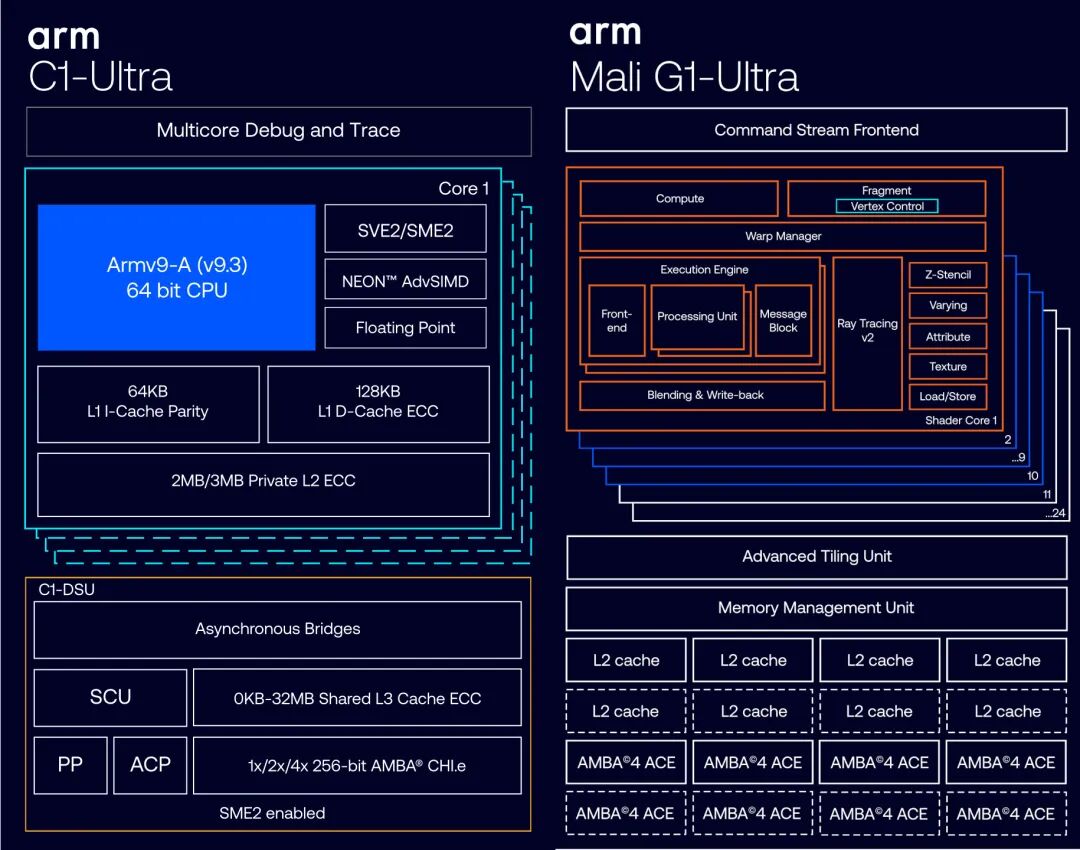
To date, Arm GPUs have shipped over 12 billion units, and Arm has always been at the core of mobile gaming experiences. The new Arm Mali G1-Ultra GPU continues to push the boundaries of mobile gaming, providing high-fidelity, console-level graphics. This is thanks to the new second-generation ray tracing unit (RTUv2), which supports advanced lighting, shadow, and reflection effects, doubling ray tracing performance compared to previous generations. For AI workloads, the G1-Ultra can boost inference performance by up to 20%, enhancing the responsiveness of real-time applications.
Compared to the previous generation, the Mali G1-Ultra has seen a 20% performance improvement in graphics benchmarks and has achieved comprehensive performance enhancements in mainstream games such as “Escape from Tarkov”, “Fortnite”, “Genshin Impact”, and “Honkai: Star Rail”. The G1-Premium and G1-Pro GPUs provide excellent performance and efficiency for resource-constrained devices.
Creating Developer-Friendly AI for Mobile Devices
For developers, seamless AI experiences can be achieved on the Lumex platform. By integrating KleidiAI with mainstream frameworks (including PyTorch ExecuTorch, Google LiteRT, Alibaba MNN, and Microsoft ONNX Runtime), applications can automatically benefit from SME2 acceleration without code modifications.
For developers building cross-platform applications, Lumex brings new portability:
-
Google applications like Gmail, YouTube, and Google Photos are already prepared for SME2, ensuring seamless integration when Lumex-based devices hit the market.
-
Cross-platform portability means that optimizations built for Android can seamlessly scale to Windows on Arm and other platforms.
-
Partners like Alipay have showcased large language models efficiently running on SME2 devices.
Technology leaders—including Apple, Samsung, and MediaTek—are integrating AI acceleration features to enable faster and more efficient device-side AI. Apple is driving Apple Intelligence with this; Samsung and MediaTek are using Google Gemini to improve the responsiveness and efficiency of real-time AI applications (such as translation, summarization, and personal assistants).
Why the Name Change?
Since 2005, Arm’s Cortex architecture has become deeply ingrained, appearing in everything from smartphones to embedded devices. (Note: For the origin of the Cortex architecture name, refer to the previous article by Lao Wu: Why is there no ARM12 after ARM11?) However, the only constant in the tech industry is change. In high-performance computing, Arm has announced the gradual phasing out of the long-standing “Cortex” brand in favor of a new application platform-based naming system, aimed at providing developers and consumers with a clearer and more intuitive product roadmap.
Business Model Transformation
Artificial Intelligence (AI) is undergoing a fundamental transformation. In the past, people were accustomed to offloading complex AI computations to distant cloud servers; now, there is a desire for instant, private, and always-on intelligent experiences. From real-time voice translation to personalized content recommendations to desktop-level mobile gaming, all of this requires AI to run locally on devices.

To meet this challenge, Arm has launched its most advanced Compute SubSystem platform to date—Arm Lumex. This is not just a simple hardware upgrade; it is the foundation for AI experiences designed for the next generation of smartphones, PCs, and various consumer electronics.
In other words, to adapt to the AI era,ARM’s business model has undergone a fundamental transformation: from selling standalone processor “IP cores” to providing pre-integrated and optimized “Compute SubSystems (CSS)” and simplifying an increasingly complex product line.
-
Old Model (Cortex Era): Arm’s main business was licensing individual CPU core IPs, such as Cortex-A78 or Cortex-X2, to chip design companies (like Qualcomm, MediaTek, Apple, Rockchip, etc.). Chip companies had to integrate, verify, and optimize these CPU cores with GPUs, memory controllers, and other system IPs, which was very time-consuming and labor-intensive.
-
New Model (Lumex Era): Arm is increasingly providing “Compute Subsystem (CSS)” platforms, which are no longer standalone CPU cores but rather apre-integrated, pre-validated “solution package”. It has integrated the latest CPUs (like C1-Ultra), GPUs (like Mali G1-Ultra), DSUs (Dynamic Shared Units), and other critical system IPs, and has been deeply optimized.
Significance of the Name Change: Continuing to use the “Cortex” brand, which is strongly associated with “CPU cores”, can no longer accurately convey the new value that Arm provides as a “platform-level solution”. The new naming (such as Arm C1 series CPUs as part of the Lumex platform) aims to emphasize this holistic approach, signaling to the market: “What we offer you is not just a CPU IP license, but a complete computing platform that enhances performance and accelerates your product’s time to market.”
Simplifying Naming to Eliminate Confusion
Advantages of the New Naming: The new naming system is clearer and more descriptive. For example, regarding CPUs:
-
C1-Ultra: Clearly indicates flagship (Ultra) peak performance.
-
C1-Premium: Positioned for upper mid-range (Premium).
-
C1-Pro: Emphasizes sustained professional (Pro) performance.
-
C1-Nano: Highlights ultimate energy efficiency (Nano) and small size.
This naming approach allows partners and consumers to more intuitively understand the market positioning and core advantages of each product.
Embracing the AI Era and Reshaping Brand Image
Technology is constantly evolving, and brands need to keep pace.
“AI-ready” signal, the Lumex platform is “born for the AI era”. By enabling a new brand name, Arm sends a strong signal to the entire industry: this is not just a routine iterative upgrade, but a completely new architecture and platform designed to meet the demands of edge AI computing.
Goodbye to the past, looking to the future, abandoning a distinguished old brand is a difficult but decisive decision, indicating Arm’s focus on the future development direction of heterogeneous computing, system-level performance, and AI acceleration. This is a complete brand “refresh” aimed at aligning Arm’s image with cutting-edge technology trends.
Reference Source
https://newsroom.arm.com/news/announcing-lumex-css-platform-ai-era