Key Insights
3D printing technology has made a critical leap in the aerospace sector from “design validation” to “mass production,” becoming a core process for cost reduction and efficiency enhancement in commercial aerospace. Rocket engines are currently the most valuable and rapidly penetrating application scenario, with the 3D printing delivery value of a single rocket reaching tens of millions of yuan. The industry chain has formed a close ecosystem led by PLT and HuaShu GaoKe, deeply binding leading commercial aerospace companies such as Landspace and Star River Power.
1. Analysis of High-Value Component Applications: Where is the Most Valuable?
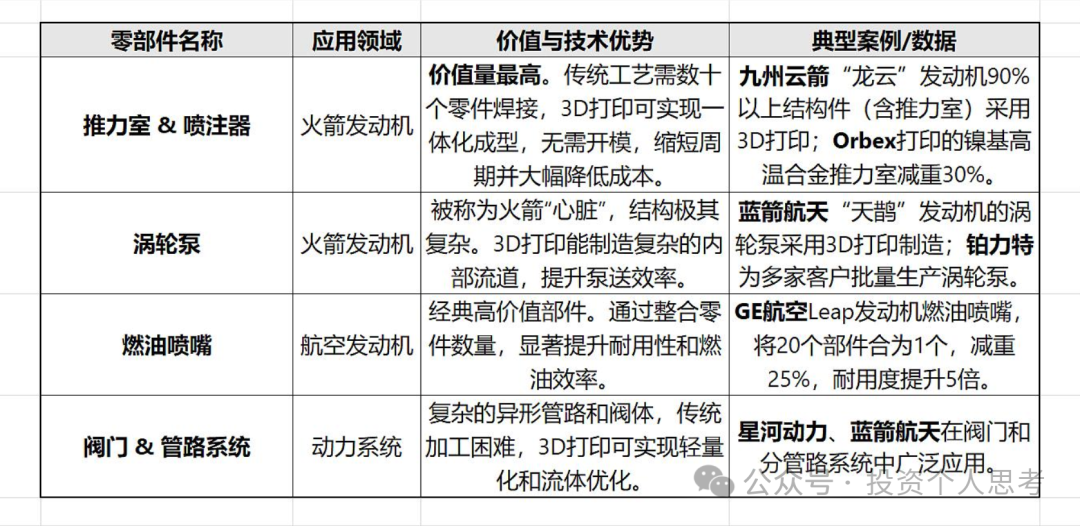
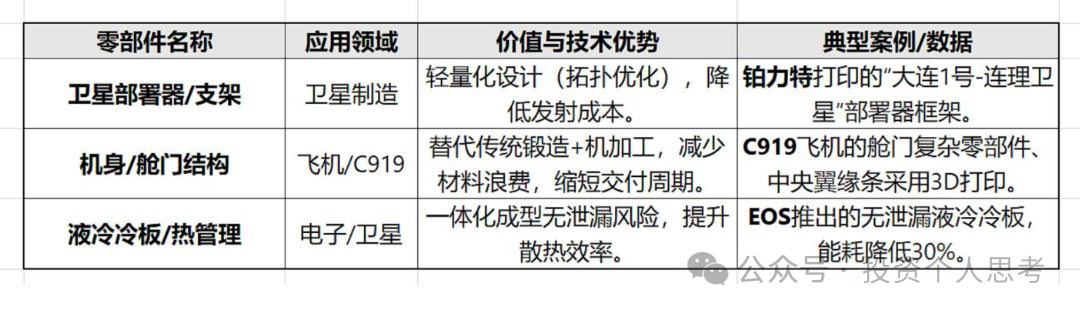
In the aerospace field, the high-value applications of 3D printing are mainly concentrated in power systems (rocket/aircraft engines) and complex structural components. Among them, rocket engines, due to their complex structure and high-temperature, high-pressure requirements, represent the single most valuable scenario for 3D printing.
1. Core High-Value Components: Power Systems (Highest Value Proportion)
In the engine manufacturing of mainstream commercial rocket manufacturers, the proportion of 3D printed components is gradually increasing from 20% to a final 80%.
2. Key Structural Components: Spacecraft and Aircraft
2. Overview of Major Participating Manufacturers
The aerospace 3D printing industry chain is mainly composed of upstream equipment/material suppliers (technology providers) and downstream application providers (OEMs/commercial aerospace companies).
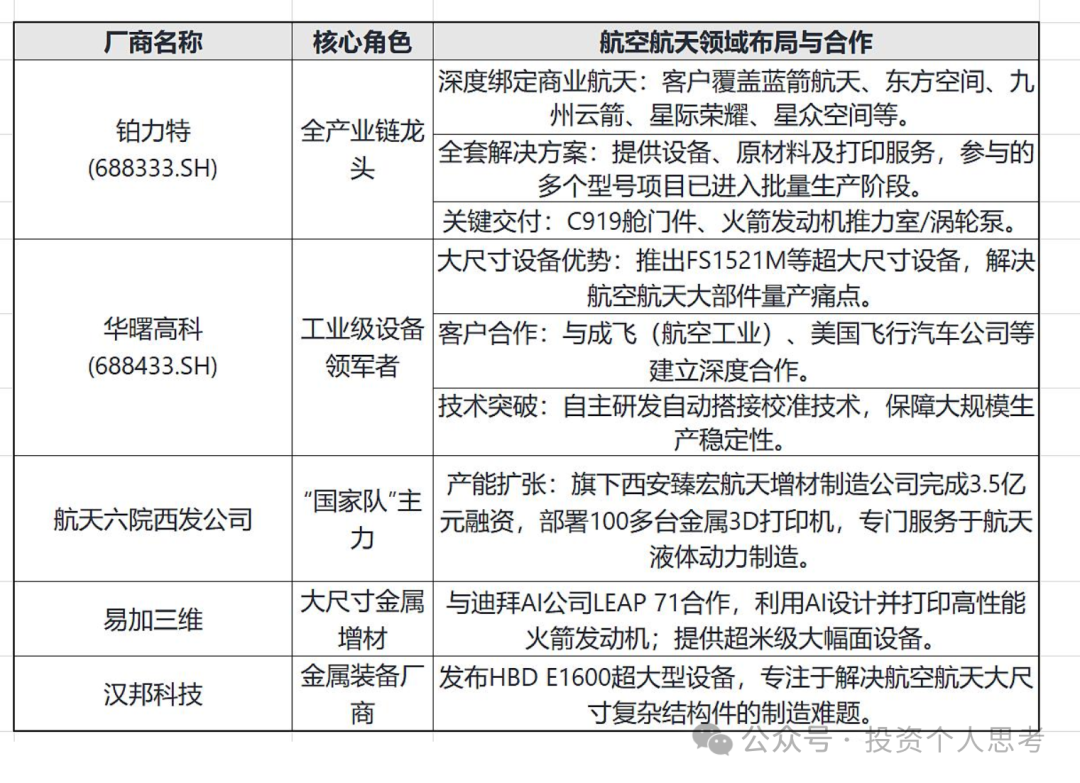
1. Core Equipment and Service Providers (Public Companies and Leaders)
These companies are the “shovel sellers,” benefiting directly by providing equipment, materials, and printing services.
2. Downstream Application Side: Commercial Aerospace and OEMs
These companies are the direct users of technology, some of which have also built their own additive manufacturing capabilities.
- Landspace
- Application Depth: The Zhuque-3 rocket and Tianque engine (thrust chamber, turbine pump) extensively use 3D printing.
- Data: Over 70% of the Tianque-12 engine’s components are 3D printed, reducing the number of parts by 30%.
- Model: A closed-loop capability from design to printing has been established.
- Jiuzhou Cloud Arrow
- Collaboration: Deep collaboration with PLT, over 90% of the structural components of the “Longyun” liquid oxygen-methane engine are manufactured using 3D printing.
- Star River Power
- Layout: Building a precision component and 3D printing additive manufacturing base in the Daxing Airport area to ensure rocket engine production capacity.
- SpaceX (Overseas)
- Benchmark: The Raptor engine extensively uses metal additive manufacturing to achieve extreme lightweight and performance enhancement.
- AVIC & AVIC Xi’an Aircraft
- Application: AVIC’s 3D printed engines were showcased in Dubai; AVIC Xi’an Aircraft is increasing investment in additive manufacturing to meet the demand for composite structural components.
3. Industry Development Trends and Business Logic
- From “Prototype” to “Mass Production”: 3D printing is no longer used solely for model making in the R&D phase but is directly used for producing final flight components. Several aerospace projects involving companies like PLT have officially entered the mass production phase.
- Equipment Large-Scale and Multi-Laser: To meet the integrated manufacturing needs of large components such as rocket tanks and engine nozzles, super-meter-level (>1 meter) forming sizes and multi-laser (8 lasers or more) equipment have become the competitive high ground in the industry.
- Significant Value Increase: With the increase in commercial aerospace launch frequency (265 global launches in 2024), the value of 3D printed components in a single rocket reaches tens of millions, corresponding to a long-term market space of hundreds of billions.
Conclusion
In the aerospace field, rocket engines are the “crown jewel” of 3D printing technology, being the most valuable and mature application. PLT and HuaShu GaoKe, as core domestic suppliers, have become indispensable key links in the commercial aerospace industry chain by providing large-scale metal printing equipment and a full set of process services.