Traditional 3D printing has limitations in process solidification, relying on preset CAD models and passively executing instructions for over 40 years. It cannot respond to internal features of printing materials and environmental changes. Although it has applications in various fields, it struggles to meet the demands for high precision and functionality. Especially in biomanufacturing, traditional 3D printing cannot accurately control the arrangement of components like cells to replicate the functional characteristics of tissues in vivo, such as the requirement for blood vessels to supply energy to cells. Additionally, opaque features in volumetric printing can easily produce shadow artifacts that affect print quality. These bottlenecks have driven the development of the GRACE technology.
GRACE, which stands for “Generative, Adaptive, Context-Aware 3D Printing,” is a generative adaptive context-aware 3D printing technology that integrates multiple technologies to enable 3D printers with the capability of “perception-decision-manufacturing,” automatically generating complex geometric structures that adapt to the features of printing materials from cells to macroscopic structures. This research was published in Nature on September 3, 2025.

Article Title:
Adaptive and Context-Aware Volumetric Printing
First Completion Unit:
Utrecht University Medical Center, Netherlands
Research Team:
Professor Riccardo Levato’s Team
Article Link:
https://doi.org/10.1038/s41586-025-09436-7

Research Highlights
-
Proposed the GRACE technology framework
The team developed the Generative Adaptive Context-Aware 3D Printing (GRACE) technology, integrating 3D imaging (light-sheet microscopy), computer vision (DBSCAN clustering algorithm), and parametric modeling. Based on volumetric 3D printing, it enables the rapid automatic generation of complex geometric structures that adapt to multi-scale features of printing materials without extensive manual intervention, breaking through the limitations of traditional 3D printing that relies on preset CAD models and cannot respond to environmental and material characteristics.
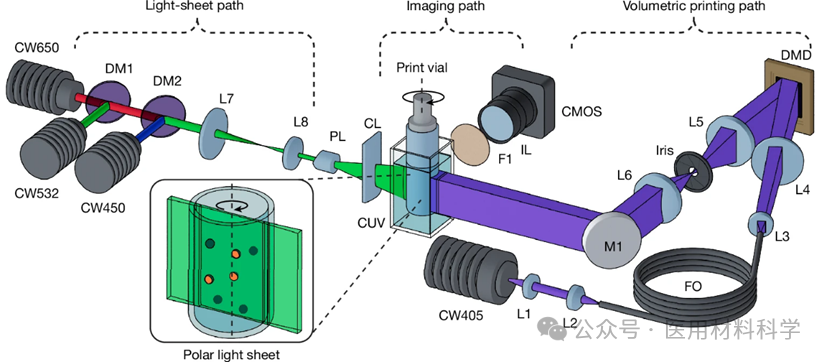 Diagram of the GRACE Printing Experimental Device
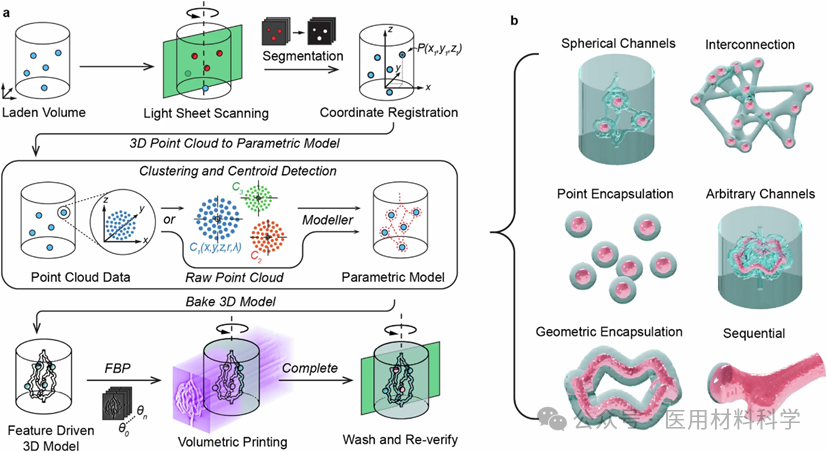
GRACE Workflow Diagram
-
Achieving Context-Driven Parametric Printing
The research team used fluorescent-stained alginate microspheres (simulating organoids, radius 0.15-0.90mm) to generate a vascular-like channel network around the microspheres in 10% w/v GelMA resin, with a diameter of 450±20μm and a microsphere offset of 300μm. It allows for differentiated printing based on microsphere size or fluorescence spectrum, and can complete interconnecting structures between microspheres and encapsulate individual features, with the entire process from scanning, modeling to printing taking about 4 minutes for each spectral channel.
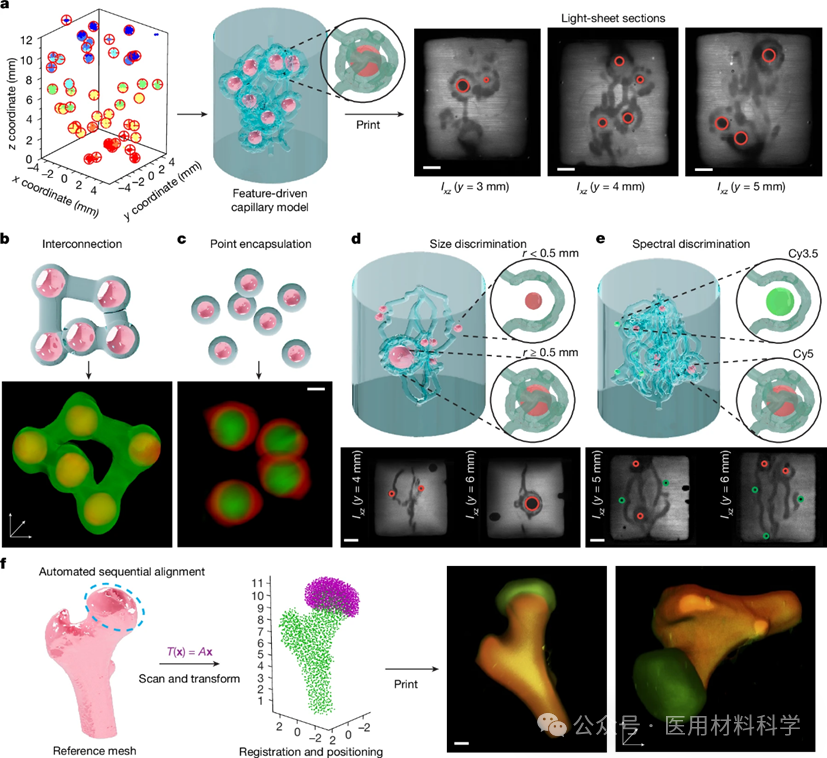 GRACE allows for the printing of adaptive and feature-driven parts with complex geometries
-
Addressing Shadow Artifacts in Volumetric Printing
GRACE enables the capture of surface information from opaque obstructions through light-sheet profiling and combines it with the OSMO (Object Space Model Optimization) algorithm to optimize tomographic reconstruction and correct shadow artifacts. After correction, the Jaccard similarity index improved from 0.70±0.01 to 0.945±0.007, the Bhattacharyya coefficient decreased from 0.39±0.01 to 0.15±0.01, and the root mean square error of the printed surface reduced from 0.50±0.09μm to 0.18±0.05μm. The sphericity improved from 0.830±0.060 to 0.965±0.006, resulting in more uniform crosslinking and better detail retention.
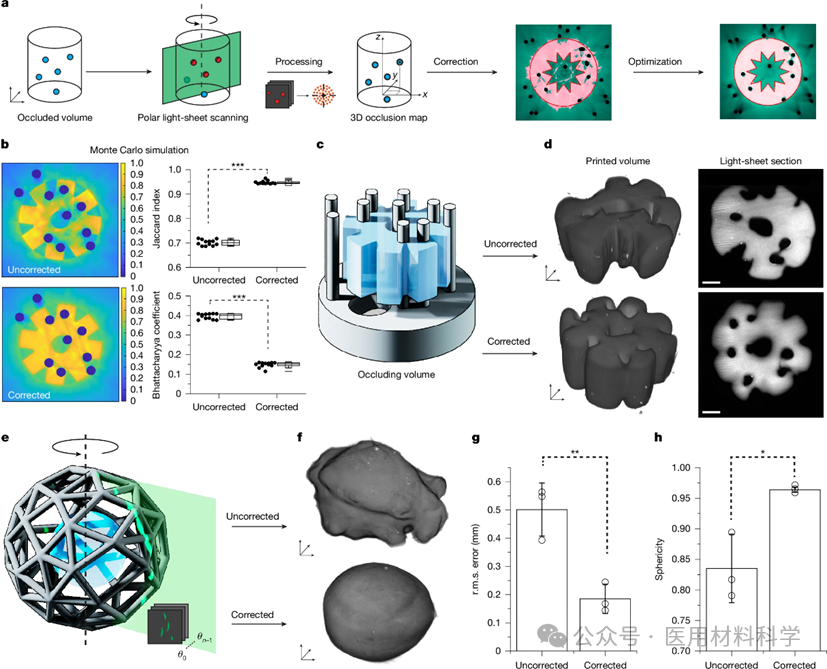 Light-sheet mapping and shadow correction of obstructive structures
-
Advancing Functional Breakthroughs in Bioprinting
Combining embedded extrusion volumetric printing (EmVP), an adaptive vascular network was generated around a toroidal structure containing pancreatic β-cells at a density of 5.0×10⁷ml⁻¹. After dynamic culture for 24 hours, the insulin secretion reached 3.2±0.3×10⁵ relative light units, significantly higher than the 2.0±0.4×10⁵ of the random channel group and 1.4±0.1×10⁵ of the no-channel bulk group. Additionally, it can construct bone-cartilage composite models, automatically aligning GelMA resin containing articular cartilage progenitor cells (ACPCs, 1.0×10⁷ml⁻¹) with bone marrow mesenchymal stem cells (MSCs, 5.0×10⁶ml⁻¹), where after 4 weeks, ACPCs differentiated into cartilage tissue and MSCs differentiated into mineralized bone tissue.
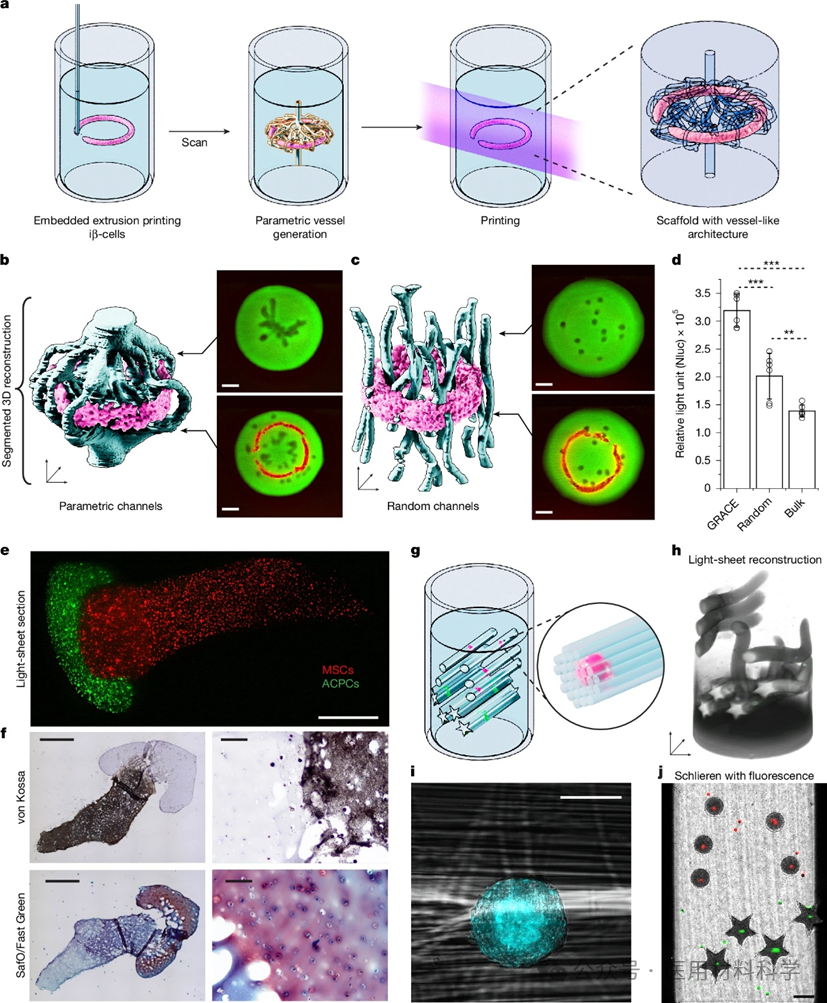
Functional living tissue bioprinting supported by GRACE, featuring cell localization-driven characteristics
-
Enhancing Automation and Compatibility in the Printing Process
Continuous printing automatic alignment is achieved through an iterative nearest point algorithm, such as accurately aligning a cartilage model to a randomly placed femur model, with alignment calculations taking less than 15 seconds. It is compatible with various printing modes, such as combining with FLight (filamented light) biomanufacturing technology, successfully identifying two differently stained MSC spheres and encapsulating them with circular and star-shaped structures, generating filamentous structures across the printing volume.
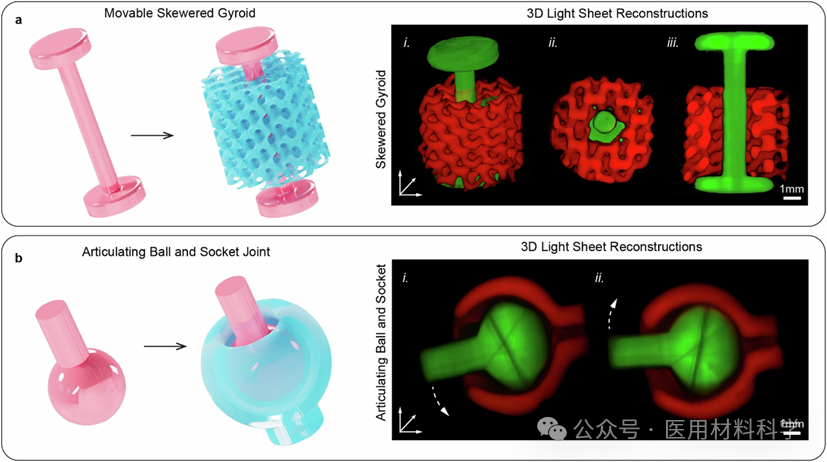 Sequential printed parts with GRACE hinge automatic alignment

Conclusion
The GRACE technology proposed in this research has achieved a breakthrough from “passive execution” to “active perception adaptation,” enabling the automatic generation of complex structures with multi-scale features that adapt to printing materials, such as the vascular network around alginate microspheres, correcting shadow artifacts to enhance precision, while optimizing cell functions in bioprinting, such as increasing insulin secretion from pancreatic β-cells. It is also compatible with various printing modes, providing a new solution for functional structure manufacturing.

Previous Recommendations

Wearable sensors upgraded! 3D printed negative Poisson’s ratio materials for sensitive wearable devices and prosthetics, capturing gait details in real-time.
Major discovery in Nature’s sub-journal: This β-amino acid polymer significantly increases the osseointegration rate of implants, far exceeding traditional peptides.
Disclaimer: Due to the author’s limited expertise, there may be omissions or inaccuracies in the text. Please leave comments or private messages for corrections!