Organic interface engineering has gained increasing attention as an effective strategy to regulate electrode surfaces and enhance electrocatalytic performance. However, a comprehensive understanding of its intrinsic mechanisms remains limited. This review delves into the design strategies and functional roles of organic interfaces in the field of electrocatalysis.
We categorize organic interfaces into three representative types: (i) small molecule functionalized surfaces, (ii) polymer-modified electrodes, and (iii) self-assembled monolayers (SAMs).
The article discusses various preparation methods and the different interaction mechanisms between organic components and electrode materials, such as covalent bonding, coordination effects, and van der Waals forces. We then focus on how organic interfaces can enhance catalytic performance by regulating local atomic arrangements, customizing electronic structures, and constructing favorable reaction microenvironments. These interface modifications provide new opportunities to optimize catalytic activity, selectivity, and operational stability in various electrochemical conversion processes. Finally, we outline the key challenges and future prospects when applying organic interface strategies to practical energy conversion technologies.
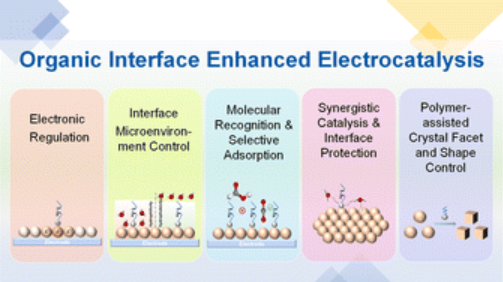
This review aims to bridge the existing knowledge gap and provide conceptual and methodological guidance for the rational development and design of high-performance electrocatalysts through molecular-level interface engineering.
Reference:
Hong, Q.-L., Xiao, X., Ai, X., Liu, H., Xu, G.-R., Xue, Q., Wang, X., Xia, B. Y., & Chen, Y. (2025). Organic interface enhanced electrocatalysis. Chemical Society Reviews. Advance online publication. https://doi.org/10.1039/D5CS00554J