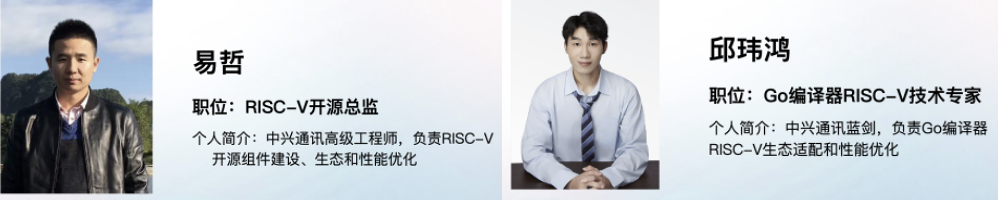
Speaker
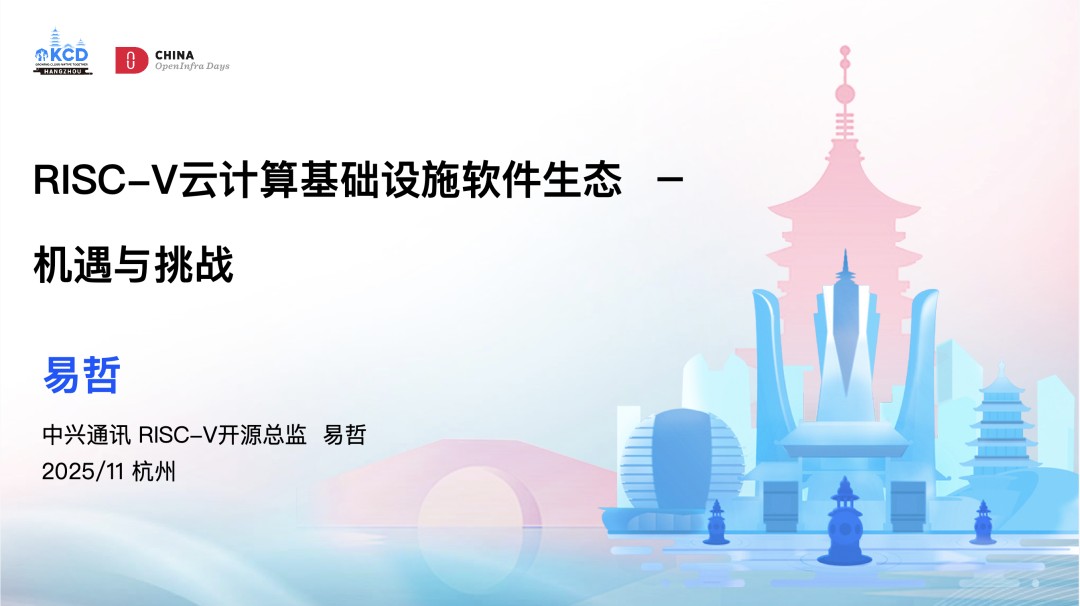
In the context of increasingly fierce global technological competition, the open-source RISC-V instruction set architecture is becoming an important choice for China to break through the bottleneck of the chip industry and build an autonomous and controllable computing power system. As the RISC-V Open Source Director at ZTE Corporation, my team and I have been deeply involved in the software ecosystem construction of RISC-V in the cloud computing infrastructure field in recent years, witnessing a development path filled with both opportunities and challenges.
ZTE has over twenty years of deep accumulation in the server field, with a broad market foundation in domestic telecommunications, finance, and internet industries. This rich industrial experience provides a solid foundation for our RISC-V ecosystem development.
As an open instruction set architecture, RISC-V’s greatest advantage lies in its modular design and complete openness. Its basic integer instruction set (RV32I/RV64I) is very concise and allows for flexible expansion through standard extensions or custom instructions, fundamentally addressing the risk of being “choked”. As Academician Ni Guangnan has repeatedly emphasized, RISC-V is an important opportunity for China’s chip industry to achieve independent innovation.
Initially, RISC-V was mainly applied in IoT and edge computing scenarios, but it truly gained the potential to enter data centers after the release of the RVA22 standard and its further refinement in RVA23. The RVA series Profile standards define the necessary instruction extensions for high-performance applications, including key features such as vectorization and virtualization, enabling RISC-V to meet the performance requirements of cloud computing infrastructure. Although a certain period is still needed from the release of the instruction set standard to chip mass production, the direction of industrial development is already clear.
At the operating system level, we are actively promoting the adaptation of RVA22/23 in the open-source community. Currently, openEuler has released a version that supports RISC-V, and major domestic open-source communities such as OpenAnolis and OpenCloudOS are also actively advancing support for the RVA standards. Based on newer kernel versions, we have ensured support for advanced features such as virtualization, and have also made significant optimizations in toolchains like GCC, clearing the foundational software obstacles for RISC-V in data centers.
The construction of the virtualization ecosystem has also made significant progress. The RISC-V standard provides a complete virtualization solution, including key technologies such as vector extensions, virtualization extensions, IOMMU, and AIA interrupt virtualization. The entire software stack, from the underlying hardware features to the upper virtualization layer and container layer, is rapidly improving. The support from the open-source community for RISC-V is continuously increasing, with most core components already completed or in the process of adaptation.
At the level of open-source software, middleware, and platforms, core platforms such as Kubernetes and OpenStack can now run on the RISC-V architecture, although the upstream community’s official support for RISC-V is still being continuously improved. Significant progress has also been made in adapting key components such as storage management and databases. We are actively porting key components to the RISC-V platform through source-level adaptation.
Performance optimization is a key link in ecosystem construction. We have achieved significant results in basic libraries such as encryption and decryption algorithms, and compression and decompression: through targeted assembly-level optimizations, the performance of certain national secret algorithms and general encryption and decryption algorithms in OpenSSL has increased several to dozens of times, with some basic libraries’ performance now comparable to or reaching levels of mature architectures.
As an important programming language in the cloud-native field, the level of support for RISC-V by the Go language compiler directly affects the completeness of the entire ecosystem. We have noticed that the community version’s support for newer RVA instruction set features is still evolving, with significant room for runtime optimization. Together with our partners, we have established a domestic Go language RISC-V open-source repository, accelerating the maturity of the Go language in the RISC-V ecosystem through a combination of self-optimizations and community contributions.
Looking ahead, RISC-V faces threefold opportunities in the data center field: the gradual maturity of chips and servers, the increasingly complete foundational software ecosystem, and the deep alignment of open architecture with open-source philosophy. In particular, the open characteristics of RISC-V are highly consistent with the open-source software philosophy, and this ideological consistency will provide continuous momentum for ecosystem development.
However, challenges cannot be ignored. Software performance still needs further enhancement, and there is room for optimization in the runtime performance of various programming languages; the application software ecosystem needs to mature, and there is a lack of large-scale commercial cases in data center scenarios; the risk of ecosystem fragmentation needs to be heeded, which requires the industry to strengthen collaboration and push truly valuable innovations to become standards.
We call for more open-source communities to support the RISC-V architecture. If mainstream open-source projects do not embrace RISC-V in a timely manner, it may lead to ecosystem fragmentation, increase migration costs, and limit its expansion potential in emerging markets. As the RISC-V ecosystem gradually matures, the lack of support may affect the long-term competitiveness of related open-source projects.
We firmly believe that the combination of the open RISC-V architecture and open-source cloud-native software will bring new development opportunities to the global computing industry. Although this path is long, the direction is clear, and it requires the joint efforts of all sectors of the industry to work together to build a bright future for the RISC-V cloud computing software ecosystem.
About OpenInfra Foundation
The OpenInfra Foundation is dedicated to building a community that writes and runs open-source infrastructure software in production environments. The foundation is supported by over 110,000 individuals from 187 countries and hosts open-source projects and community practices, including AI infrastructure, container-native applications, edge computing, and data center clouds. Join the OpenInfra movement: www.openinfra.org.