Star and follow ⭐️Exciting content won’t get lost
With the rapid development of the global semiconductor industry, the RISC-V architecture has gradually become an important force in the MCU/SoC design field due to its openness, flexibility, and low cost. Especially in the domestic market, more and more companies are adopting the RISC-V architecture to promote product innovation and enhance market competitiveness.
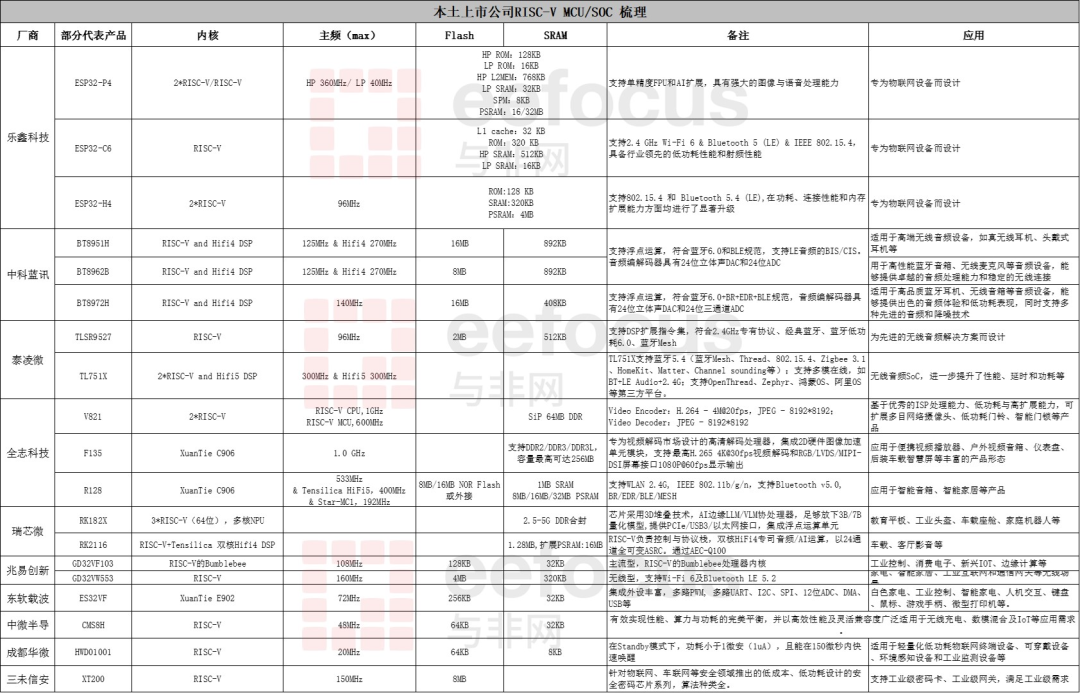
The author has compiled a list of some MCU/SoC products based on the RISC-V instruction set architecture launched by domestic listed companies, covering core performance parameters, features, and main application scenarios. Overall, downstream applications are mainly in consumer electronics, smart homes, and the Internet of Things. At the same time, it has been found that local companies represented by Rockchip have already laid out RISC-V products to meet the upgrade of AI computing power on the edge and the operation of large models. The following listed companies have been deeply involved in the RISC-V field for many years, each with breakthroughs worth exploring.
01
Espressif Technology
Before 2020, Espressif’s product core architecture was based on IP purchased from Cadence, and later the company fully transitioned to a self-developed architecture based on RISC-V. Currently, the company’s IP for Wi-Fi, low-power Bluetooth, AI, and voice products is all self-developed. With a fully self-developed underlying IP architecture to the operating system, it does not rely on the ARM ecosystem, thus avoiding homogenization competition and price war pressure, providing a certain degree of differentiation and pricing power. In addition, the company integrates its self-developed RISC-V instruction set-based MCU architecture into its products, which can reduce licensing fees and may ultimately lower the prices of IoT terminals.
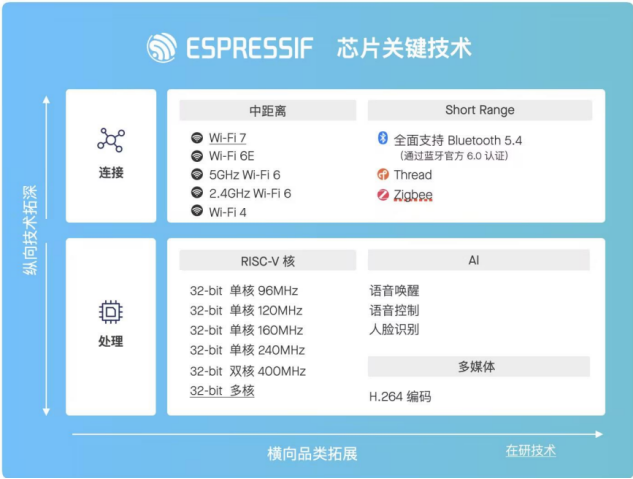
As the company develops, its chip products have expanded from the Wi-Fi MCU niche to the AIoT SoC field, focusing on “processing + connectivity,” where “processing” includes AI and RISC-V processors, and “connectivity” covers wireless communication technologies mainly based on Wi-Fi, Bluetooth, and Thread/Zigbee.
Since 2020, all new products released by the company have been equipped with self-developed RISC-V 32-bit processors:
RISC-V SoC ESP32-C6 supporting 2.4 GHz Wi-Fi 6 & Bluetooth 5 (LE) & IEEE 802.15.4;
RISC-V SoC ESP32-H2 supporting Bluetooth 5 (LE) & IEEE 802.15.4;
RISC-V SoC ESP32-C5 supporting dual-band 2.4 and 5 GHz Wi-Fi 6 & Bluetooth 5 (LE) & IEEE 802.15.4;
High-performance chip ESP32-P4 equipped with dual-core and single-core RISC-V processors, AI instruction extensions;
RISC-V SoC ESP32-C61 supporting 2.4 GHz Wi-Fi 6 & Bluetooth 5 (LE);
Low-power RISC-V SOC ESP32-H4 supporting 802.15.4 and Bluetooth 5.4 (LE).
Among them, the ESP32-P4, released in February 2024, marks Espressif’s entry into the purely high-performance processing market, being the first product without wireless connectivity features, equipped with a dual-core RISC-V processor, supporting single-precision FPU and AI extensions, providing all necessary computing resources.
Additionally, it is worth noting that Espressif’s first wireless communication chip supporting Wi-Fi6E has completed engineering sample testing and is planned for mass production in the second half of 2025. This chip is equipped with a self-developed dual-core 500MHz RISC-V processor, supporting 2×2 MU-MIMO and Beamforming, covering tri-band Wi-Fi6/6E at 2.4/5/6GHz.
Click to follow and star with Eefocus,
you can receive 20 industry reports and industry research collections.
02
Zhongke Lanyun
Zhongke Lanyun mainly engages in the research, design, and sales of wireless audio SoC chips, forming a product architecture centered on eight product lines: Bluetooth headset chips, Bluetooth speaker chips, smart wearable chips, wireless microphone chips, digital audio chips, toy voice chips, AIoT chips, and AI voice recognition chips.
Since its establishment, the company has adopted the RISC-V instruction set architecture as its technical development route for chip research and design. As a pioneer in the RISC-V industry, the company is a council member of the China RISC-V Industry Alliance and a strategic member of the RISC-V Foundation. Based on the open-source RISC-V instruction set architecture, combined with the open-source real-time operating system RT-Thread, the company has independently developed high-performance CPU cores and DSP instructions, achieving various audio algorithms.Here are some of the company’s representative products:
Xunlong Third Generation BT895X Chip has completed integration with the Volcano Ark MaaS platform, providing users with software and hardware solutions compatible with Doubao large models. The BT895X chip adopts a multi-core architecture of CPU + DSP + NPU, with high computing power and low power consumption, meeting the demands of AI headphones for voice processing and high-speed audio transmission. It has also been integrated into the FIIL GS Links AI high-quality open headphones.
Xunlong Third Generation BT896X Series Chips have been applied in Baidu’s newly launched Xiaodu Tiantian AI tablet robot’s smart speaker, which not only has Hi-Res gold standard dual certification, providing consumers with a high-quality vocal experience but also enables AI voice interaction. The company has launched an LE Audio solution based on BT896X, particularly the Auracast technology, to meet the market for mid-to-high-end speakers. It has mass-produced high-end Soundbar products for brands like Philips, achieving a Bluetooth SoC single-chip solution for high-end Soundbars through the powerful computing capabilities of BT896X.
BT897X Series Products are high-performance Bluetooth audio chips aimed at the mid-to-high-end market, exhibiting excellent audio performance and supporting various high-definition audio formats. The basic power consumption has been optimized to the 4mA level, and audio metrics have also been improved to industry-leading levels, widely used in various high-end audio devices and smart terminals.
Scan to reply“RISC-V“ to join the engineer exchange group
03
Tailin Microelectronics
Tailin Microelectronics focuses on cutting-edge technology development and breakthroughs in the field of wireless IoT chips, mainly focusing on low-power Bluetooth, dual-mode Bluetooth, Zigbee, Matter, WiFi, and other short-range wireless communication chip products. Its BLE chip shipment ranks third globally, with shipments exceeding 2 billion pieces in 2024. Tailin actively embraces the open-source RISC-V architecture instruction set in its products and is one of the earliest chip companies to adopt RISC-V architecture MCUs in the low-power IoT field, currently forming a rich product matrix based on RISC-V architecture processors. Here are some of the company’s representative products:
TLSR9 Series, with a built-in 32-bit RISC-V MCU, integrates DSP and floating-point operation extension instructions, and is equipped with an independent low-power AI engine for real-time processing of sensor and voice signals. It supports various advanced IoT connectivity technology specifications, including classic Bluetooth, Bluetooth Low Energy, Bluetooth Mesh, Zigbee, Apple HomeKit, Apple Find My, Thread, Matter, 2.4GHz proprietary protocols, and various RTOS, and can achieve partial multi-protocol parallel operation.
TL721X, TL751X, TL321X Series and other products also adopt the RISC-V architecture, among which the TL751X wireless audio SoC integrates two RISC-V cores with a maximum frequency of 300MHz and a HiFi 5 DSP core, showcasing the strong potential of RISC-V in multi-core heterogeneous computing. At the same time, TL751X is compatible with various mainstream audio formats, widely adapting to high-end headphones, smart speakers, in-car audio systems, etc., easily achieving high-quality audio output, demonstrating strong applicability and competitiveness in the audio market.
Tailin’s RISC-V-based chips, with their flexible instruction set, can be precisely optimized for different IoT application scenarios. Whether it is data interaction between consumer electronics and smart home devices or sensor data collection and processing in industrial IoT, they can easily cope, ensuring stable and efficient operation of devices.
04
GigaDevice
As early as 2019, GigaDevice launched the first 32-bit general-purpose MCU GD32VF103 series based on the RISC-V Bumblebee processor core. The Bumblebee processor core was jointly developed by GigaDevice and Chipone Technology, specifically designed for IoT and ultra-low power scenarios. This series of products features a 108MHz operating frequency, providing 16-128KB Flash and 6-32KB SRAM cache, and supports gFlash patented technology, ensuring high-speed data access.
In specific applications, the GD32VF103 series MCU has been widely used in multiple fields due to its high performance and low power characteristics. In the industrial control field, it is widely used in sensor networks and the smart hardware market; in the smart home field, GD32VF103 provides core momentum for the comprehensive intelligent upgrade of the home appliance industry.
In addition, GigaDevice’s wireless MCU GD32VW553 series adopts the RISC-V core, with a maximum frequency of 160MHz. This series of MCUs provides advanced RF performance, enhanced security mechanisms, large-capacity storage resources, and rich general-purpose interfaces, combined with a mature process platform and optimized cost control, providing mature solutions for market applications requiring efficient wireless transmission.
The GD32VW553 series supports Wi-Fi 6 and Bluetooth LE 5.2 wireless connection protocols, widely applicable to wireless application scenarios such as home appliances, smart homes, industrial Internet, and communication gateways, and is also very suitable for budget-constrained office equipment, payment terminals, and IoT products.
05
Rockchip
Rockchip is a leading domestic IoT and AI IoT processor chip enterprise. The company’s chips are currently mainly based on the Arm architecture, with some SoC chips partially using RISC-V modules to replace MCUs for internal control, achieving overall performance improvement of SoC chip systems and effectively controlling power consumption in certain scenarios. For example, Rockchip’s previously launched Arm + RISC-V multi-core machine vision processors RV1126 and RV1109 have good image processing capabilities and AI vision processing capabilities, suitable for machine vision applications in multiple scenarios.
It is worth mentioning that in July 2025, Rockchip will release a high-performance visual co-processor SoC RK1820 aimed at machine vision applications, especially AI-related applications, at the ninth developer conference. This chip is based on three independent 64-bit RISC-V cores (including FPU floating-point units), each equipped with a 32KB instruction cache (I-Cache), a 32KB data cache (D-Cache), and a 128KB second-level cache (L2 Cache).
At the same time, this edge computing co-processor is equipped with the company’s self-developed NPU and high-bandwidth embedded 2.5GB DRAM, effectively solving the dynamic balance problem of computing power, storage, and bandwidth for model edge deployment, suitable for AIoT smart devices to deploy and run edge models locally, and can communicate with the main processor through high-speed interfaces such as PCIe2.0 and USB3.0, applicable to scenarios such as AI toys, learning machines, emotional support assistants, terminal home toys, and even robots.
The already launched RK1820/RK1828 can efficiently support various mainstream text-based LLMs and multimodal VLMs at the 3B/7B parameter level to run smoothly on the edge. RK1828 is similar to RK1820 but equipped with 5GB RAM, suitable for 7B LLM models.
With the launch of the RK182X series, Rockchip has demonstrated strong technical strength and market competitiveness in the RISC-V architecture field, and will play an increasingly important role in the future AIoT market.
06
Conclusion
As the RISC-V architecture matures and becomes more widespread, more chip manufacturers are actively adopting this open standard to promote technological innovation and product diversification. For example, Unisoc is developing and promoting RISC-V smart security chips, while Peak Technology plans to launch a new generation of RISC-V dual-core products aimed at supporting more complex motor control algorithms by enhancing computing power and integrating AI acceleration units. RISC-V is rapidly expanding its advantages in smart homes, consumer electronics, and the Internet of Things, and is expected to be widely applied in more scenarios such as automotive electronics and data centers.
END
Industry Community


Like and share

Share

Recommend