As is well known, by the end of September, we will welcome two new flagship SoCs, MediaTek MT6993 (Dimensity 9500) and Qualcomm SM8850 (possibly named Snapdragon 8 Elite Gen5).
According to the currently circulating leaked information, this batch of new flagship SoCs is likely to continue the peak performance improvement of up to 35% or even 40% seen last year. In other words, following last year’s autumn flagship platform, which saw a performance leap equivalent to that of the past two years, this year’s flagship SoCs will once again maintain this significant performance enhancement pace.

However, as we have often mentioned in our discussions, when the “top flagship” makes significant progress, it is undoubtedly good news for the “high-end users” who can afford it. At the same time, if the mid-range and sub-flagship platforms do not achieve such a large improvement, it will mean that their performance will be further “left behind” by the flagship platforms.
Clearly, if such a situation arises, it will not only be detrimental to the cost-performance ratio of “non-flagship products” for mobile phone manufacturers, but when the performance of top flagship hardware is too “high and mighty,” it may also lead to software developers being caught in a dilemma between flagship and non-flagship products. This could result in flagship platforms being inadequately adapted, failing to truly demonstrate the performance advantages indicated by benchmark scores in everyday use.
In light of this situation, some may say, “Can’t I just buy an old flagship phone or a new mid-range phone equipped with an old flagship SoC?”
The former is indeed possible, but the latter may be a bit difficult.
Why do we say this? In fact, looking at some recent rumors, it is not hard to find that both Qualcomm and MediaTek seem to be intentionally “preventing” mobile phone manufacturers from directly using last generation flagship SoCs for new mid-range models.
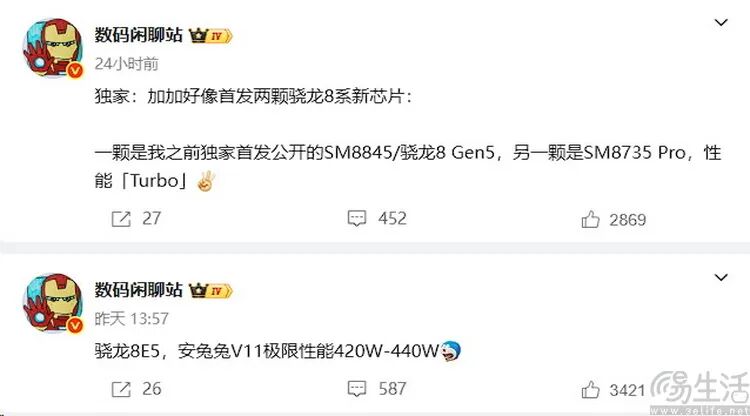
For example, Qualcomm is likely to launch the new flagship SM8850 alongside a sub-flagship SM8845 based on the previous generation Oryon architecture, but incorporating some new technologies (reportedly to be named Snapdragon 8 Gen5). Moreover, there are already rumors that the price of SM8845 will be lower than the current SM8750 (i.e., Snapdragon 8 Elite), while its performance will be roughly equivalent.
Additionally, there are claims that Qualcomm is considering launching the “SM8735 Pro.” From the model number, it is clear that it will likely be an overclocked version of Snapdragon 8s Gen4. Current rumors suggest it will likely become the new generation of “sub-sub-flagship,” targeting the performance-oriented segment around 2500 yuan, competing with MediaTek’s Dimensity 8000 series.

On the MediaTek side, there have been reports that a well-known brand’s “mid-range performance phone” is testing the “Dimensity 9400++” solution. Considering that MediaTek previously modified the Dimensity 9300+ to Dimensity 9400e as the new generation sub-flagship, it is not ruled out that the so-called “Dimensity 9400++” will also be “renamed” and presented not as an overclocked version of the old flagship, but as a “new flagship derivative model.”
So what does this mean? In simple terms, it seems that both Qualcomm and MediaTek do not mind, and even intentionally encourage, the new generation of “sub-flagships” to reach the performance level of the previous generation flagships. However, at the same time, they also seem to be intentionally or unintentionally “preventing” mobile phone manufacturers from directly using old flagship SoCs to launch the new generation of sub-flagships or mid-range phones.

Why is this happening? First, from the various phenomena mentioned earlier, it is not hard to see that these chip manufacturers are not trying to limit the performance of “sub-flagships” by doing this. Moreover, based on the current rumors, whether it is a completely newly developed “new sub-flagship” with performance equivalent to the previous generation flagship, or a “not-so-new sub-flagship” modified from the previous generation flagship, their prices are likely to be cheaper than directly using the previous generation flagship, thus offering better “cost performance.”
Secondly, from a technical perspective, although the new “sub-flagships” will incorporate some features of the new flagships, at least for the current Android camp, there are still significant architectural differences between the same generation sub-flagships and flagship SoCs. In other words, the promotion of “new sub-flagships” by chip manufacturers does not necessarily aim to accelerate the adoption of new architectures and instruction sets.

Thus, a reasonable explanation seems to be that chip manufacturers are unwilling to allow old flagships to be used in new mid-range models, likely to maintain the “value retention rate” of their product lines. To put it more bluntly, “old flagships, no matter how old, must maintain their flagship status.”
In fact, this is a completely understandable logic, because from the perspective of both chip manufacturers and mobile phone brands, using old flagship chips for new mid-range models may indeed lead to significant shipment volumes, but it could also harm the “emotional value” of users who have previously purchased old flagship models.

Therefore, for chip manufacturers, while “stopping” this behavior may lead to a short-term decline in the shipment volume of certain chips, in the long run, it can make the product line more “orderly,” which is beneficial for enhancing the “image” and overall profit margin of flagship product lines. This helps avoid the embarrassing situation where old flagship models are sold off at drastically reduced prices, leaving manufacturers “crying while counting money.”
[Images in this article are sourced from the internet]