
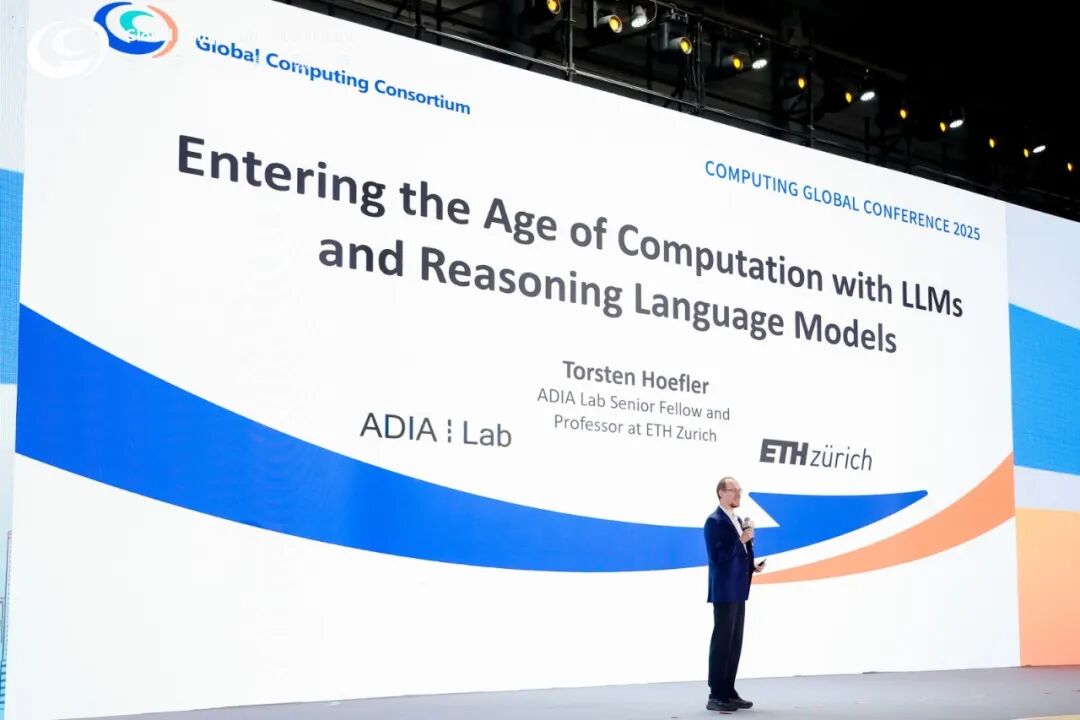
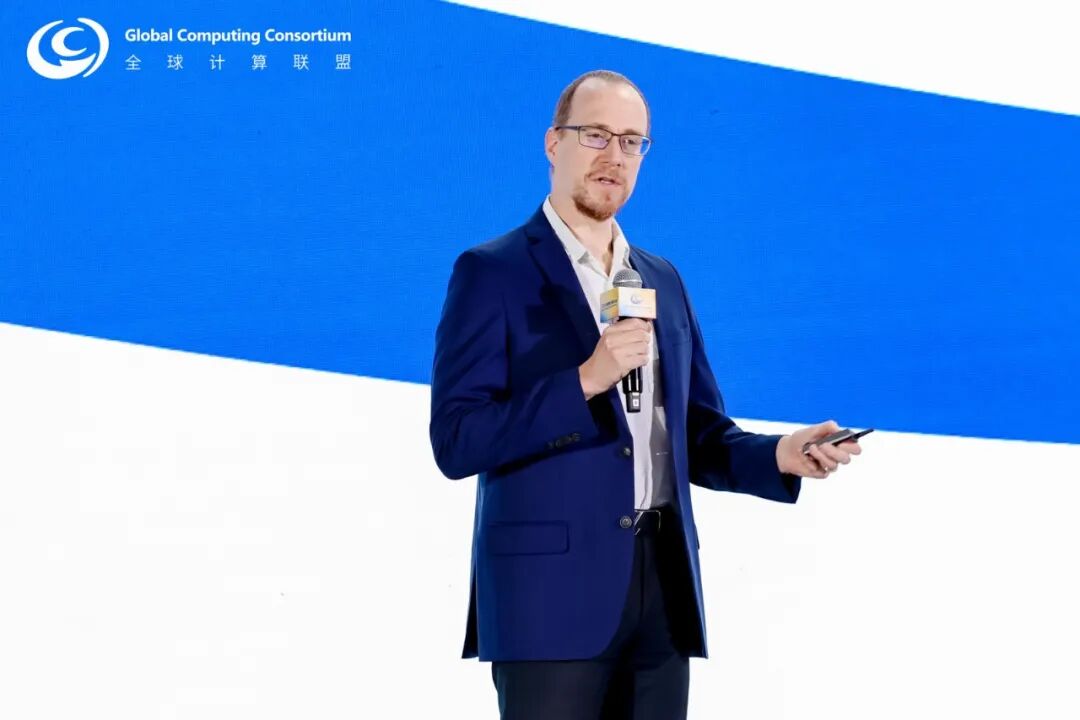
On November 7, the 2025 Global Computing Conference (CGC2025) was grandly held in Shenzhen. The conference, themed “Building New Foundations, Empowering New Energies, Embracing New Opportunities in AI,” invited six academicians from China and abroad, over 40 high-end industry experts, and more than 10 international guests, gathering over 1,000 elites from various sectors in the global computing field to create a high-end platform for technical exchange, achievement display, and industrial cooperation. During the conference, Torsten Hoefler, a member of the Global Computing Alliance (GCC) Strategic Advisory Committee (SAC), an academician of the European Academy, and a professor at ETH Zurich, delivered a keynote speech titled “Entering the Age of Computation with LLMs and Reasoning Language Models.”
During the conference, we specially invited Professor Torsten to enter the GCC Salon for an in-depth dialogue on key topics such as innovations in distributed AI algorithms, solving the challenges of supercomputing and AI collaboration, and future technology layouts, sharing his internationally insightful perspectives.
Click to view the interview video
Technical Breakthrough: The Triple Innovation Keys of Distributed AI Algorithms
In March of this year, Torsten Hoefler was awarded the 2024 ACM Prize in Computing for his pioneering work in high-performance computing and significant contributions to the AI revolution. His research has improved AI efficiency by thousands of times and is the cornerstone of many large models, profoundly impacting the development pattern of the global computing industry. When discussing the key innovations in algorithms, he stated that this is the result of the collective efforts of many researchers, primarily relying on three core technological supports.
First is Sparsification Technology, which efficiently utilizes resources by avoiding the need to call all model parameters at once, achieving up to 50 times speed improvement. This technological concept has been widely applied, such as in the “expert mixture technology” promoted by DeepSeek and the recently released Kimi model, both built on this technology.
Second is Quantization Technology, which enhances efficiency by reducing the number of bits required for parameter storage. Professor Torsten and his collaborators successfully compressed model precision from 32 bits to 4 bits using GPTQ (Accurate Post-Training Quantization for Generative Pre-trained Transformers), approaching the 4-bit operational precision of the human brain, achieving nearly 10 times compression and significantly reducing storage costs.
Finally, Parallel Systems focus on optimizing hardware and network costs. By constructing efficient parallel computing architectures and networks, machine costs can be reduced by 10 times, and the synergistic effect of the three ultimately achieves thousands of times improvement in AI efficiency, making the widespread application of large language models (LLMs) on portable devices possible.
Collaborative Solutions: Core Solutions for the Integration of Supercomputing and AI
Currently, during the collaborative development of supercomputing and artificial intelligence, issues such as slow data transmission and chaotic computing power scheduling have become common challenges faced by the industry. Professor Torsten believes that the key to solving these problems lies in building bridges between communities in different fields, achieving deep integration between the traditional high-performance computing community and the emerging AI community.
To address the data transmission challenges, he proposed that building a more robust interconnected network is the core path. The “Ultra Ethernet”, led by multiple global participants, has become an industry practice, achieving efficient connections between high-performance computing and AI through a unified interconnection network standard. Currently, Ultra Ethernet 1.0 has completed protocol standardization, providing a foundational guarantee for cross-platform communication.
In response to the chaotic computing power scheduling issue, Professor Torsten’s team is developing a “Data-Centric Parallel Python” tool that schedules computing tasks through intelligent algorithms combining static and dynamic methods. This solution can achieve reverse differentiation of simulation code, allowing traditional supercomputing simulation code to function like AI models, enabling end-to-end training and achieving true integration of supercomputing and AI. Currently, the related technology is still in the continuous research and improvement stage.
Future Layout: Technological Turning Points and Key Focus Areas
Looking ahead to the next 3-5 years, Professor Torsten believes that the technological turning points in high-performance computing and AI will focus on the optimization and upgrading of two core components: accelerators and networks. These two components are interdependent and work synergistically to drive breakthroughs in the industry.
In the accelerator field, it is necessary to follow AI computing principles, focusing on specialized data types, dedicated sparse patterns (i.e., accelerators need to support this pattern), and “spatial computing”—for example, the application of wafer-scale computing and other large chip technologies will solve issues such as pipeline idling in equipment layout scheduling. Additionally, in the innovation of simulation devices, such as the Analog Dot Product Engine from Axelera AI, which improves efficiency by a hundred times compared to standard computing, will become an important direction for enhancing accelerator performance.
In the network field, building the Ultra Ethernet ecosystem has become a key challenge. Although the protocol standards have been established, how to manufacture compatible network switches and network cards, and build a globally universal ecosystem to achieve efficient communication between devices from different companies and regions is a goal that the industry needs to tackle together. Professor Torsten suggests that global computing partners focus on these two core areas to seize industry development opportunities.
Conclusion
From achieving thousands of times efficiency improvement through the triple innovation of distributed AI algorithms, to exploring technical solutions for the integration of supercomputing and AI, and looking ahead to the layout of accelerator and network technologies, Professor Torsten, with his profound research foundation and cutting-edge vision, provides valuable insights for the development of the global computing field. At the end of the interview, Professor Torsten emphasized again that: breakthroughs in the computing field are not the result of one person’s efforts, but the achievements of collaborative innovation by global colleagues, and expressed his expectations and wishes for GCC.
As a high-end communication platform built by the Global Computing Alliance (GCC), the GCC Salon is committed to gathering top global wisdom to promote technological breakthroughs and ecological co-construction in the computing field. In the future, GCC will also carry this expectation, continuing to work with industry elites and member units to jointly solve technical challenges and contribute to the high-quality development of the global computing industry, writing a new chapter in the era of intelligent computing.
Welcome to reprint! Please contact the WeChat backend for authorization confirmation before reprinting, and the original source must be indicated when reprinting. If prior contact is not made, please ensure that the content remains consistent with the original; if there are substantial differences or misleading statements, GCC and the author of this article reserve the right to pursue legal action.
Further Reading

·Column Introduction·
“Leaders’ Words”
Guiding industry development trends
Output core viewpoints on industry development direction
“CXO Path”
Decoding the stories behind strategic layouts
Sharing new thoughts on industry development frontiers
“Industry Voices”
Showcasing the prosperous ecosystem of the industry
Discussing pain points, sharing experiences, and presenting cases from the customer perspective
Welcome to scan the code to schedule an interview in the GCC Salon!
👇👇👇

Teacher Ju

Teacher Xue