Published in the “Journal of Electronics and Information Technology” Issue 169
Original article published in the Journal of Electronics and Information Technology, 2025, Issue 10 Paper
Read the original article Free download, comments and shares will randomly receive a copy
The efficient interconnection and intelligent management of large-scale industrial IoT devices are crucial for the digital, networked, and intelligent transformation and upgrading of China’s manufacturing industry, as well as for high-quality development. Due to limited communication, computing, and network resources, complex transmission environments, and the separation of perception, transmission, and control systems, traditional industrial networks face severe challenges such as low perception and transmission efficiency, poor interoperability of heterogeneous systems, and difficulty in efficient collaboration. The key technologies for the integration of perception, transmission, and control (ISTC) based on new generation information technologies such as artificial intelligence, 5G/B5G/6G, and industrial IoT have significant potential value in achieving comprehensive and accurate perception of information in industrial scenarios, reliable and efficient transmission, and agile feedback control, promoting intelligent interaction among people, machines, objects, and environments, as well as enhancing intelligent management across production lines.
Associate Professor Zhang Mingqiang from Qufu Normal University and his collaborative team, based on detailed research and summary of the core needs and bottlenecks in the development of industrial IoT, focus on key technical issues such as the industrial network architecture for intelligent perception, methods for intelligent perception in industrial IoT, cognitive intelligence-driven industrial semantic communication, and the joint design of edge intelligent perception, efficient transmission, and optimal control. They discuss the research progress in the integration of intelligent perception, transmission, and control in industrial IoT, and finally summarize future research directions that have significant meaning and development potential, such as industrial large models and industrial intelligent agents, Industry 5.0, cross-modal collaborative interaction in industry, and industrial digital twins.
Original:
Zhang Mingqiang, Ma Xiaocong, Yang Yajuan, Li Dongyang, Li Tiantian, Wang Lei, Zhang Haixia, Yuan Dongfeng. Integration of Intelligent Perception, Transmission, and Control in Industrial IoT: Key Technologies and Future Prospects[J]. Journal of Electronics and Information Technology, 2025, 47(10): 3410-3425. doi: 10.11999/JEIT250305.
1. Research Background
With the implementation of the fifth generation mobile communication, artificial intelligence, and industrial IoT in industrial scenarios and the gradual deepening of the transformation and upgrading of the manufacturing industry, a large number of edge devices and terminals with perception and execution capabilities are integrated into industrial networks/information physical systems through industrial IoT. The data from the entire lifecycle of industrial production has rapidly upgraded to become the most valuable strategic resource and key production factor for the development of the manufacturing industry. The rapid transmission of data and the efficient extraction of value have also become key to reducing costs, improving quality, and increasing efficiency for enterprises. The efficient interconnection and intelligent management of large-scale industrial devices are crucial for the green, low-carbon, efficient, and sustainable development of China’s manufacturing industry. In the future, the sixth generation mobile communication network (6G) enabled by edge intelligence aims to build a perception-driven, interconnected, and wisdom-embedded network oriented towards human-machine-object integration, continuing the trend of rapidly extending 5G to vertical industries. The design of industrial network systems must simultaneously meet the threefold demands of perception, transmission, and control, in line with the human-centered and large-scale personalized customization requirements of Industry 5.0.
Traditional perception theory focuses on efficient information collection, traditional control theory usually considers perfect transmission conditions, while traditional communication theory is dedicated to reliable data transmission without regard to its content and purpose. The aforementioned separation of design for perception, transmission, and control has led to existing industrial networks and information systems based on ISA-95 still facing multiple challenges such as low perception and transmission efficiency, poor interoperability of heterogeneous systems, and difficulty in efficient collaboration, severely restricting the overall performance and service capability of industrial network systems. In particular, for numerous new important scenarios such as real-time status and network situation awareness of devices, fault warning and predictive maintenance of devices, intelligent quality control of products, control of production processes and process parameters, intelligent decision-making for production scheduling, and virtual-real integrated digital twins, the demand for comprehensive and accurate perception of information, robust and efficient transmission, and agile feedback control through industrial IoT has become extremely urgent. The integrated design of perception, transmission, and control has also evolved into a key factor for enhancing the level of intelligence in industrial scenarios.
2. Industrial Network Architecture for Intelligent Perception, Transmission, and Control Integration
For typical task demand scenarios such as quality control and equipment fault diagnosis, the design of a cloud-edge-end efficient collaborative network architecture is an important guarantee for the integration of perception, transmission, and control. This architecture includes three layers of networks: industrial IoT perception collection devices/industrial controllers, industrial intelligent gateways (edge data aggregators, edge servers), and industrial clouds. Within this framework, a large number of edge terminal devices such as sensors, actuators, lightweight edge computing nodes, and programmable logic controllers (PLCs) are deployed at specific locations on the production line to collect data and execute control commands. Intelligent sensors continuously perceive industrial environmental data, data aggregators complete data collection, aggregation, fusion, semantic encoding, and feature extraction, edge servers are responsible for executing edge intelligent detection, and based on the semantic recognition and inference results of AI models, generate decisions or feedback to drive PLCs and other actuators to control the operation of the production line. The industrial cloud is responsible for data storage, global AI model training, semantic knowledge base construction and collaboration, and making global decisions to support various industrial applications and services. The above core architecture and system model can be extended to the closed-loop scenarios of perception, transmission, and control in industrial IoT, achieving intelligent management of multi-dimensional resources such as perception, communication, computing, and storage, and closed-loop intelligent management of production line equipment under an efficient collaborative mechanism of cloud-edge-end.
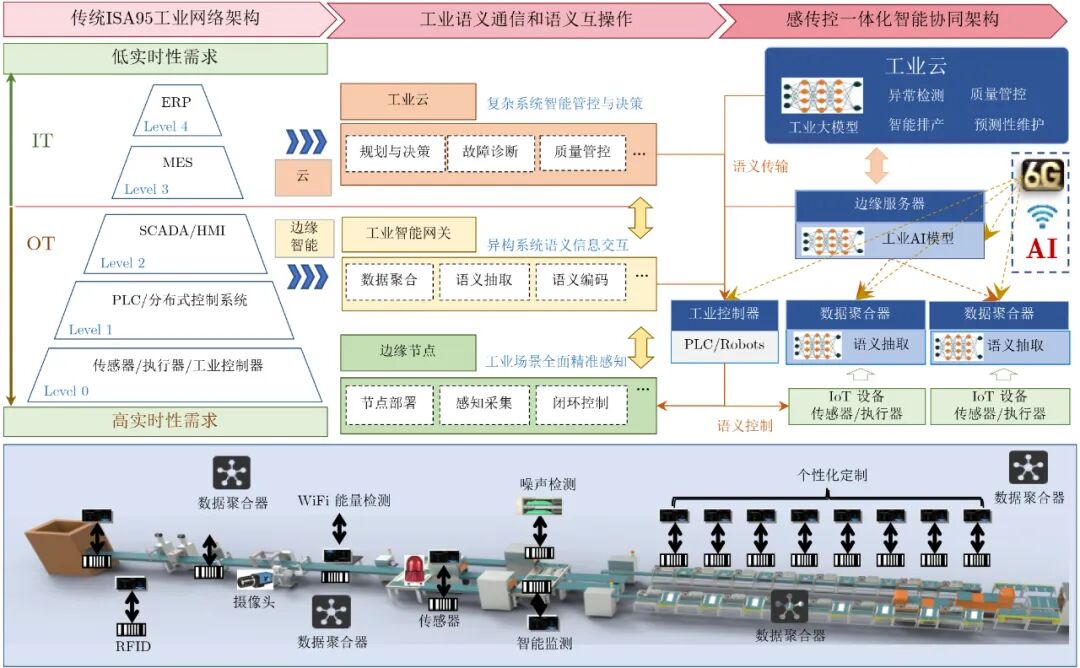
▎Figure 1: Cloud-edge-end collaborative industrial IoT intelligent perception-transmission-control integration architecture
3. Intelligent Perception Methods in Industrial IoT
3.1 Deep Compressed Sensing
The intelligent perception of massive industrial data in industrial IoT is the primary prerequisite and key to achieving industrial intelligence. The multi-source heterogeneous data for product services, equipment, and environmental state monitoring in industrial scenarios not only shares the characteristics of big data such as large volume, fast speed, diversity, and low value density but also has characteristics such as cross-space, multi-modal, temporal, strong correlation, and closed-loop. Due to the combined limitations of these complex data characteristics and the capacity of information transmission, the classical Shannon information theory-based signal perception, acquisition, and compression reconstruction methods cause significant waste of storage, computing, and network resources due to excessively high sampling rates and computational complexity, making it difficult to meet the demand for efficient perception and transmission of massive heterogeneous industrial data, which has been listed as one of the top ten challenges in the post-Shannon era of information and communication technology. Compressed Sensing (CS) breaks through the limitations of the Nyquist-Shannon sampling theorem, significantly reducing the amount of network data transmission through sparse coding and nonlinear reconstruction methods, becoming an effective means for lightweight perception and efficient aggregation transmission of massive industrial data. However, existing CS schemes rely on three major criteria: sparsity transformation, incoherent sampling, and nonlinear reconstruction, making it difficult to overcome shortcomings in compression ratio, reconstruction accuracy, and algorithm complexity. Additionally, the heterogeneous nature of perception terminals in industrial production sites, the diversity of device interface forms, and the uneven level of automation on production lines make comprehensive and accurate perception and efficient transmission of heterogeneous massive data in complex industrial environments a significant bottleneck issue restricting the transformation and development of China’s manufacturing industry.
In recent years, the Deep Compressed Sensing (DCS) method has gained widespread attention from scholars at home and abroad by jointly optimizing the compression measurement and nonlinear reconstruction process using deep neural networks from a data-driven perspective, achieving simultaneous improvements in reconstruction speed and performance while effectively alleviating transmission pressure. The precise perception of network situation, environmental, and equipment state information in industrial IoT is a prerequisite for forming an agile and accurate control loop. However, the deep learning models trained by existing DCS methods typically only work at specific compression ratios, severely affecting the flexibility of the application process of this method. In most applications, communication networks or edge devices impose dynamic limits on the maximum bit rate, and usually, reducing the bit rate means that distortion becomes more severe. To meet these demands, the compression encoder should have the ability to adaptively adjust the compression ratio, achieving a specific R-D (Rate-Distortion) trade-off through joint optimization of rate and distortion.
3.2 Interpretable Deep Compressed Sensing White Box Networks
Many existing DCS models rely on nonlinear network structure design, loss function design, and network parameter tuning, which challenge the robustness and interpretability of deep learning black box models. Scholars at home and abroad have further focused on the design of interpretable white box networks, aiming to construct mathematically interpretable, human-understandable, and verifiable deep neural network designs. Although DCS methods have made significant progress in fields such as machine vision, the research on DCS methods for efficient perception and transmission of industrial IoT data is still progressing slowly due to the complex sparse characteristics of heterogeneous multi-source data in industrial scenarios, the complexity of perception, acquisition, and transmission environments, and the limited capabilities of nodes. How to design high-precision, high-compression ratio, and interpretable white box DCS models with low-latency data transmission characteristics under resource-constrained conditions still requires in-depth exploration and research.
3.3 Physics Information Driven Methods
Due to the inherent limitations of deep learning methods, DCS models struggle to effectively solve the problems of accurate perception and robust transmission of semantic information. In recent years, Physics-Informed Neural Networks (PINN) have incorporated known physical laws and constraints into the design process of machine learning and artificial intelligence models, providing new ideas for reducing the black box characteristics of deep learning and the cost of data acquisition, enhancing the perception and sparse expression capabilities of multi-modal industrial semantic information fusion, and improving the interpretability and flexibility of DCS models.
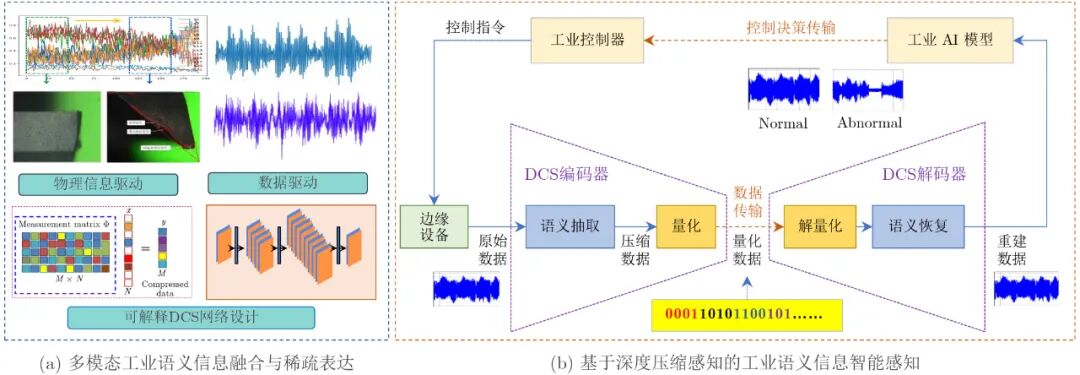
▎Figure 2: Intelligent perception and transmission of multi-modal industrial semantic information based on interpretable deep compressed sensing
4. Cognitive Intelligence Driven Industrial Semantic Communication
4.1 Semantic Interoperability of Heterogeneous Industrial Systems
The semantic interoperability of heterogeneous industrial systems is a core bottleneck in the design of integrated perception, transmission, and control. Modern industrial IoT systems typically integrate multiple information technology (IT) and operational technology (OT) parallel subsystems, forming natural interoperability barriers that make it difficult to achieve efficient interoperability and expected collaborative operation across vendors and systems, severely limiting large-scale network interconnection and data exchange. Therefore, exploring new semantic information interaction and interoperability methods for resource-constrained environments in industrial IoT can effectively reduce system resource consumption, improve system interaction delay performance, and enhance energy utilization efficiency. The core difficulty lies in how to achieve efficient extraction of semantic information from raw data while effectively removing semantic noise that causes semantic ambiguity or model disturbance.
4.2 Industrial Semantic Communication
As a new communication paradigm and a potential key technology for future 6G, semantic communication is based on universally applicable human knowledge and semantic systems. It constructs a shared semantic knowledge base between the communicating parties and designs semantic-level information encoding and transmission solutions, driving the transformation of communication networks from traditional data transmission to intelligent meaningful communication. The core of semantic communication is to extract the “meaning” of information at the sender’s end, which can be successfully “interpreted” at the receiver’s end with the help of matching knowledge bases.
Industrial semantic communication, aimed at modern industrial scenarios, provides a new way to ensure efficient communication between machines with the goal of “precise meaning delivery”. It is expected to enhance the semantic interoperability of heterogeneous industrial systems and support various types of human-machine-object intelligent interactions such as M2M, H2M, and H2H (M: Machine, H: Human). However, due to the different business models of machine communication in industrial scenarios compared to human communication, the multi-source multi-modal, heterogeneous unstructured, and complex sparse characteristics make it challenging to accurately quantify high-dimensional data semantics, and the extraction and unified representation of semantic features are exceptionally difficult. The extreme fragmentation of industrial scenarios and specific demands, along with the incompleteness of semantic knowledge bases, pose significant challenges for the reliable transmission of industrial semantics.
4.3 Industrial Knowledge Graphs and Semantic Knowledge Bases
In recent years, knowledge graphs have provided a powerful tool for constructing semantic knowledge bases. It is worth noting that the massive industrial data perceived by industrial IoT systems mainly includes static data such as technical documents and dynamic time-series data perceived in real-time by devices (including various forms such as text, images, sounds, videos, etc.). Typically, the contextual relationship between static and dynamic data is poor, and although collaborative interaction is becoming increasingly complex, there is currently a severe lack of unified modeling methods to integrate these two types of data into a unified semantic knowledge base. Despite significant progress in constructing industrial knowledge graphs and semantic knowledge bases, the construction of a complete semantic knowledge base for complex scenarios in Industry 4.0 still faces enormous challenges.
4.4 Robust Transmission of Industrial Semantic Information
The electromagnetic environment in industrial IoT scenarios is complex, with severe interference, leading to existing data transmission methods and models not only having low transmission efficiency but also being highly susceptible to minor disturbances, resulting in poor stability. Inaccurate observation of system states and incomplete transmission of information will severely affect the accuracy of control decisions. Therefore, industrial semantic information transmission requires communication systems to have strong anti-interference capabilities and to ensure high robustness during data processing and transmission. Currently, research on semantic information interaction in industrial heterogeneous systems is still in its infancy, and how to design industrial semantic knowledge bases/knowledge graphs, as well as semantic-level information compression encoding and robust transmission solutions, requires further in-depth exploration.
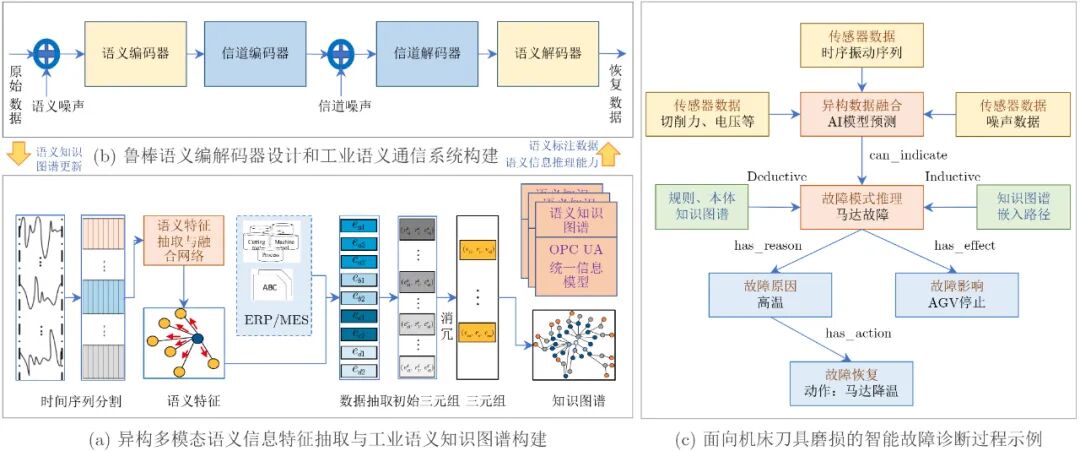
▎Figure 3: Robust transmission of industrial semantic information driven by cognitive intelligence and industrial intelligent applications
5. Joint Design of Edge Intelligent Perception, Efficient Transmission, and Optimal Control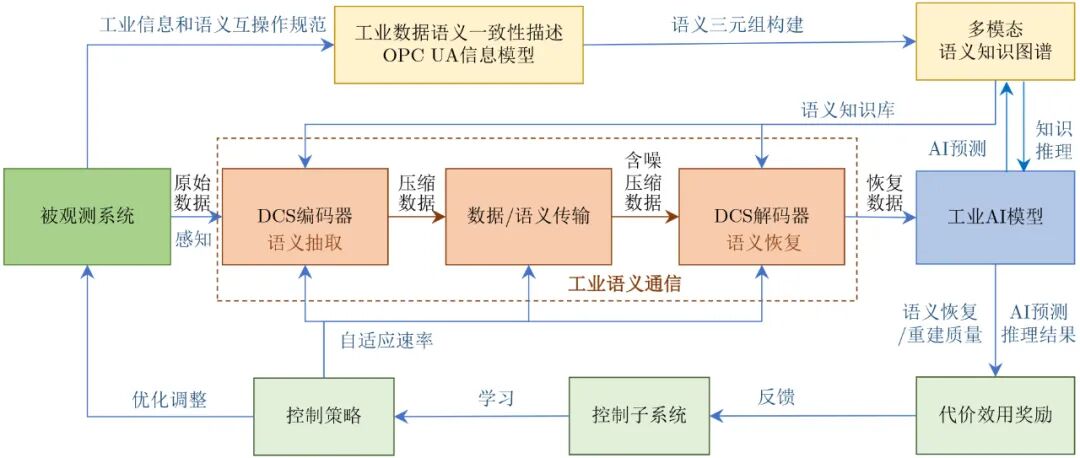
▎Figure 4: Integrated joint design framework for edge intelligent perception, efficient transmission, and optimal control based on industrial semantic communication
The integrated joint design of perception, transmission, and control is the future development trend in the field of intelligent manufacturing. In intelligent manufacturing scenarios, cross-network interactions between multiple networks such as 5G/B5G/future 6G, industrial IoT, industrial internet, and enterprise private networks will become the norm for a long time, leading to complex nonlinear characteristics in the coupling relationships among perception, transmission, and control. Currently, research on the closed-loop joint design of perception, transmission, and control is still very lacking, primarily because the functions of perception, transmission, and control are often designed independently, and the deep coupling relationships among them have not been fully explored. The core technical indicators of industrial intelligent management systems, such as perception sampling rate, transmission rate, transmission reliability, control accuracy, and stability, have inherent deep coupling relationships.
Based on the integrated joint design framework for edge intelligent perception, efficient transmission, and optimal control, which includes industrial semantic communication systems, semantic knowledge bases, application-oriented industrial AI models, and perception-transmission-control closed-loop optimization mechanisms, the goal is to minimize the total cost of perception, transmission, and control. In industrial IoT scenarios with limited network bandwidth, transmission rates, and delays, the collaborative design of perception, transmission, and control within limited objectives has the feasibility to achieve high-precision perception, efficient and reliable transmission, and real-time precise control, while its realization also relies on the innovative evolution of existing industrial network architectures and the strong support of AI computing power and models.
6. Future Prospects and Challenges
6.1 Industrial AI Large Models and Industrial Intelligent Agents
Deployable industrial AI is key to the integrated design of intelligent perception, transmission, and control. Autonomous perception of the environment, decision-making, and execution of corresponding actions to achieve specific goals are current development trends. As the “source of wisdom” for intelligent agents, large AI models such as DeepSeek provide the foundational base for industrial intelligence. However, since tacit knowledge occupies a core position in industrial knowledge, which is difficult to quantify and structure, the high consumption of large model training and the significant difficulty of semantic mining of tacit knowledge in the industrial field pose great challenges for constructing intelligent agents based on large models. In specific industrial scenarios, especially in highly complex and dynamically changing environments, the performance of large models is still unsatisfactory, and the path to deploying industrial AI for integrated perception, transmission, and control still heavily relies on the performance of dedicated industrial AI models.
6.2 Industry 5.0
The core demand of Industry 5.0 is “human-centered, sustainable, and resilient”. Its goal is to achieve flexible, efficient collaboration between humans and intelligent systems and equipment, leveraging human wisdom and machine efficiency to realize resilient and personalized production modes, rather than simply replacing humans with machines. Industry 5.0 is an organic combination of various technologies such as artificial intelligence, digital twins, collaborative robots, augmented reality, and real-time communication, which poses new and higher demands for the integrated design of intelligent perception, transmission, and control, while still facing multi-level technical integration challenges such as controllability, effectiveness, and generalization.
6.3 Cross-Modal Collaborative Interaction in Industry
With the diversification of perception device types in industrial scenarios, the data acquired by systems presents high heterogeneity, covering various modalities such as images, sounds, videos, and texts, often existing in fragmented and multi-modal forms. Traditional single-modal processing methods struggle to meet the demands for precise perception and efficient control in complex industrial environments, failing to capture the dynamic changes in various aspects of the production process. Cross-modal collaborative interaction can enhance the accuracy of information perception, optimize data transmission efficiency and decision accuracy, and achieve deeper information fusion, thereby promoting the development of industrial IoT systems towards greater intelligence, efficiency, and stability. However, there are also significant challenges in the multi-modal data fusion and synchronization across different perception channels, as well as the real-time nature of models.
6.4 Industrial Digital Twins
Industrial digital twins align closely with the demands of intelligent manufacturing, Industry 5.0, and other technologies, providing a more economical and efficient solution for real-time management of physical assets and processes in industrial scenarios, further promoting the development of integrated design of intelligent perception, transmission, and control. Facing complex industrial scenarios and physical mechanisms, digital twins for industrial IoT continue to evolve from virtual imitation to virtual-real symbiosis at different maturity levels, still facing significant challenges in high-precision semantic perception, real-time efficient interaction, and adaptive fault-tolerant control. The urgent need for efficient simulation of virtual-real systems will drive the rapid development of integrated design of intelligent perception, transmission, and control.
7. Conclusion
Developing key technologies for the integration of intelligent perception, transmission, and control in the next generation of industrial IoT is an important measure to promote the digital, networked, and intelligent transformation and upgrading of the manufacturing industry and has significant theoretical value and practical significance. This article summarizes the core bottleneck issues in the development of industrial IoT, reviews the current research progress and potential key technologies from the perspectives of network architecture for integration of perception, transmission, and control, intelligent perception methods, industrial semantic communication, and integration of perception, transmission, and control, and discusses future research directions of significant importance. With the continuous evolution of theoretical research and industrial development in fields such as artificial intelligence, industrial large models, and Industry 5.0, the semantic-level intelligent perception, transmission, and control integration design methods based on industrial IoT will provide new ideas for the implementation of the next generation of information technology in industrial scenarios, effectively promoting the intelligent upgrade of industrial IoT and the high-quality development of the manufacturing industry.
Author Information
Zhang Mingqiang: Male, PhD, Associate Professor, Master’s Supervisor, research direction includes intelligent communication and networks, industrial semantic communication, industrial IoT, etc.;
Ma Xiaocong: Female, Master’s student, research direction includes physics-informed neural networks, industrial semantic communication, industrial IoT, etc.;
Yang Yajuan: Female, Master’s student, research direction includes industrial semantic communication, deep learning, industrial IoT, etc.;
Li Dongyang: Male, PhD, Master’s Supervisor, research direction includes intelligent communication, wireless intelligent caching;
Li Tiantian: Female, PhD, Associate Professor, Master’s Supervisor, research direction includes ultra-reliable low-latency communication, integrated design of communication-perception-computation, etc.;
Wang Lei: Male, PhD, Assistant Researcher, research direction includes intelligent communication, drone communication;
Zhang Haixia: Female, Professor, Doctoral Supervisor, research direction includes intelligent communication and networks;
Yuan Dongfeng: Male, Professor, Doctoral Supervisor, research direction includes artificial intelligence, big data, cloud/edge computing, wireless communication, digital twins.
▌This article is sourced from the WeChat public account of the Journal of Electronics and Information Technology (ID: dzyxxxb)
Editor-Ma Proofreader-FM Review-Chen
This article is an exclusive manuscript of the Journal of Electronics and Information Technology, and the content is for learning and exchange only, with copyright belonging to the original author. Comments and reprints are welcome, please contact this account for authorization, and indicate the original author and source information.
The information published by this account aims to promote communication. If there are any issues related to text, images, copyright, etc., please contact this account within 20 days, and we will handle it promptly.
Previous Reviews
2025-2026 Special Issue Call for Papers Collection丨Journal of Electronics and Information Technology
Virtual Album丨Intelligent Metasurface Technology (RIS) 2024-2025
Table of Contents for Issue 10 of 2025丨Journal of Electronics and Information Technology
Wei Jibo, Zhao Haitao Team丨Chinese Semantic Communication System Based on Word-Level and Sentence-Level Semantics
Zhu Qiuming Team丨Research Progress and Challenges of Wireless Channel Hardware Twin Technology
Han Yinhe Team丨“DI-DA” Chip Integration Architecture and Integrated Collaborative Design New Model丨Leading Column
Wang Yu Team: Research Review on Hybrid Expert (MoE) Large Language Model Systems and Architecture Optimization Technology
Hong Wei Team: New Beamforming Array Architecture Empowering Millimeter-Wave Ultra-High-Speed Communication Applications
Call for Papers丨“Artificial Intelligence Chips and Infrastructure” Special Issue
Call for Papers丨“AI and 6G Bidirectional Empowerment: Theory, Technology, and Standardization” Special Issue
Weak Supervised Maneuver Recognition Method Driven by Contrastive Learning in Aerial Confrontation Scenarios丨250495
Design of Non-Orthogonal Matching Algorithm for Intelligent Metasurface in Satellite-Ground Collaborative Communication System丨Paper Card
Realizing New Transient Execution Attacks Using Cyclic Prediction Execution Mechanism丨Paper Card
Good News! The Journal of Electronics and Information Technology has been selected as an “Outstanding Action Chinese Leading Journal
Good News丨The Journal of Electronics and Information Technology has been selected as a T1 class high-quality scientific journal in the CCF Computing Field Quality Journal Directory (2025)