01
Implementing Entities

Jiangxi Provincial Expressway Network Management Center, Beijing Zhongjiao Guotong Intelligent Transportation System Technology Co., Ltd., Jiangling Motors Corporation, East China Jiaotong University, Shenzhen Chenggu Technology Co., Ltd., China Mobile Communications Group Jiangxi Co., Ltd.
02
Background of Achievement Cases
To actively respond to the Ministry of Transport’s “13th Five-Year Plan for the Development of Transportation Information”, which proposes to “build a new generation of traffic control networks and smart highway demonstration projects”, and in conjunction with the national 5G strategy, the current state of intelligent highway development, and the trends in autonomous driving, a smart highway “human-vehicle-road” collaborative management and control system based on advanced technologies such as the Internet of Vehicles, vehicle-road collaboration, 5G networks, big data, and artificial intelligence was developed. This project combines advanced technical architecture with practical business operations to construct a traffic collaborative management and control platform for smart highways that integrates traffic operation status perception, big data mining for decision support, and travel assistance information release. It deepens the organic integration of technologies such as the industrial Internet and 5G, focusing on the actual needs of highways to achieve vehicle platooning, marking the first demonstration of operational vehicle platooning on expressways in China.
03
Main Innovations and Platform Functions
(1) Platform Functions
1. Design of the Smart Highway Management and Control System Architecture Based on Vehicle-Road Collaboration
Based on technologies such as wireless communication and sensing detection of the Internet of Vehicles, information about vehicles, roads, and the environment is collected. Through vehicle-to-vehicle and vehicle-to-road information interaction and sharing, intelligent collaboration and coordination between vehicles and infrastructure are achieved, thus realizing an integrated network for smart traffic management control, vehicle intelligent control, and smart dynamic information services.
2. 5G Continuous Coverage Cellular Network and Internet of Vehicles Support System for Demonstration Sections
Using new methods under the 5G Massive MIMO multi-transmit and multi-receive coverage gain. Through 5G AAU mechanical downtilt and electronic downtilt interference control methods, combined with mechanical downtilt, electronic downtilt, and antenna power adjustments to effectively suppress co-frequency interference and inter-flow interference within expressway sections, maximizing network performance; achieving 5G NSA high-speed scenario 4/5G network coverage synergy, effectively enhancing smart traffic network performance.
3. Internet of Vehicles/Vehicle-Road Collaboration Application Technology Based on Multi-Mode Wireless Communication
Based on 5G/DSRC/LTE-V multi-mode communication technology, the overall architecture of the Internet of Vehicles wireless communication platform is designed to achieve performance of multi-mode communication technologies and access technologies for 5G/LTE-V/DSRC.
4. Autonomous Vehicle System Integration and Platooning Capability
Utilizing autonomous driving technology based on computer vision and laser point cloud deep learning as input, while leveraging V2X vehicle-road collaboration technology to complete the fusion processing of vehicle-end V2X related information, while upgrading simulation service capabilities and expanding simulation scenarios under vehicle-road collaborative environments. Achieving autonomous driving within a single lane on the Changjiu Expressway demonstration section and V2I and V2X platooning autonomous driving functions.
Autonomous Driving Function
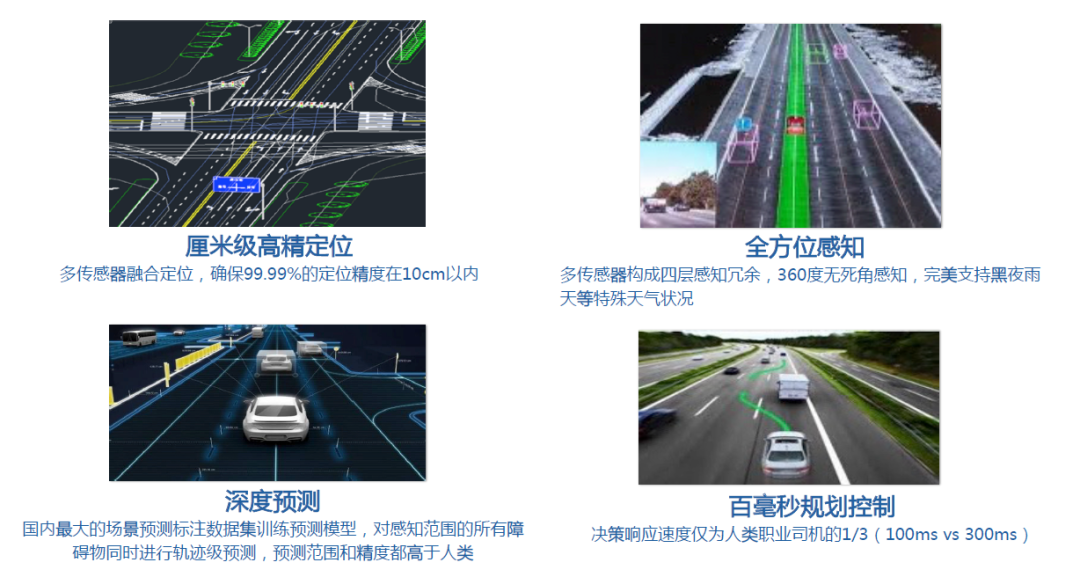 5. Road Traffic Situation Assessment Based on Artificial Intelligence and Traffic Big Data Integrating expressway video monitoring, radar, microwave vehicle detectors, floating vehicle GPS data, and ubiquitous perception information of the Internet of Vehicles to construct a smart road traffic situation assessment and control platform. Based on massive traffic big data, recognizing relationships and deeply analyzing multi-source traffic big data, including traffic entities, behaviors, situations, road network topology, and the high-dimensional ecosystem closed space between environments, as well as nonlinear, randomness, and dynamic coupling relationships. 6. Smart Road Human-Vehicle-Road Collaboration Based on 5G Mobile Broadband Internet Based on 5G, the Internet of Vehicles, and vehicle-road collaboration technology, demonstration applications and tests are carried out on the Changjiu Expressway demonstration section, designing and developing 14 typical intelligent connected vehicle V2X and autonomous driving demonstration application scenarios, covering safety, efficiency, and information services in three major categories.
(2) Technical Route
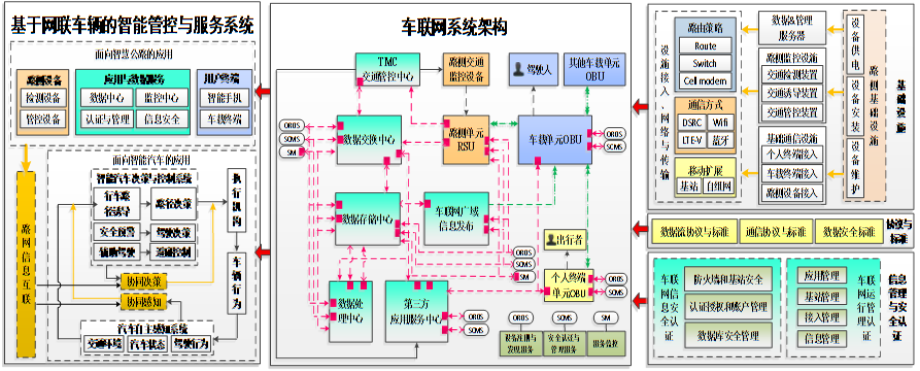
This project is based on advanced 5G mobile communication, traffic big data, artificial intelligence, and other technologies and methods to construct new technologies for the next generation of national traffic control networks.
Overall Research Technical Route
(3) Innovations
1. Proposed a Smart Highway Human-Vehicle-Road Collaboration System Architecture and Standards for the National Traffic Control Network Through vehicle-to-vehicle and vehicle-to-road information interaction and sharing, intelligent collaboration and coordination between road facilities and vehicles are achieved, thus realizing an integrated network for smart traffic management control, vehicle intelligent control, and smart dynamic information services, improving the construction of smart highway infrastructure, network communication environment, traffic monitoring, information services, and other systems. 2. Multi-Source Perception Data Fusion Technology for Autonomous Vehicles Addressing the current limitations of single sensor autonomous driving under different weather and lighting conditions, which cannot comprehensively cover various road conditions and weather, proposes deep fusion of sensors such as LiDAR, millimeter-wave radar, and cameras. Each sensor has its advantages and deficiencies; their mutual fusion, complementary functions, and mutual backup provide a complete unmanned driving system. Therefore, multi-sensor fusion is adopted to achieve optimal aggregation performance. 3. 5G MEC Network Edge Computing Technology Based on 5G/DSRC/LTE-V communication, the Internet of Vehicles, vehicle-road collaboration, and other advanced technologies, upgrades and optimizes expressway infrastructure. By enriching the data sources of traffic information, applying information fusion and automatic control technologies, the application efficiency of highway infrastructure is improved. In the 5G network, MEC is optimized for deployment, establishing edge technology models for Internet of Vehicles application scenarios, reducing the cost of autonomous vehicles and accelerating the commercial deployment of services.
04
Application Effects
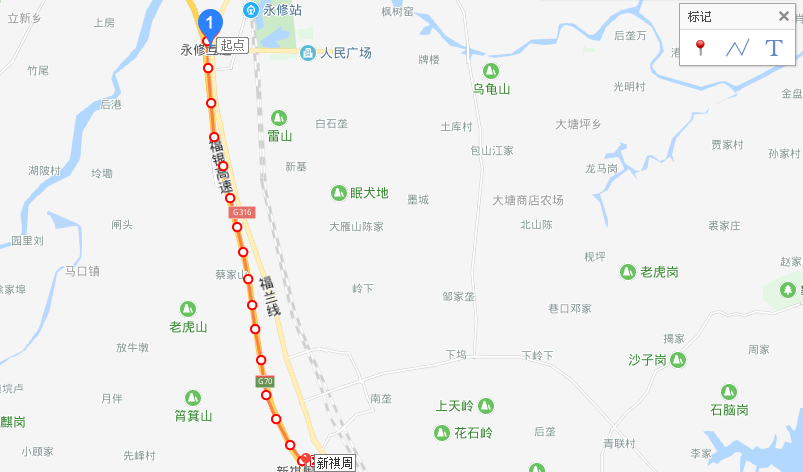
Smart Highway Schematic
(1) Build the Jiangxi Changjiu Expressway Intelligent Connected Testing Base Referencing the operational experiences of testing bases in Beijing, Shanghai, etc., single product model for autonomous vehicles is estimated at 4 million/year. With the development of the intelligent driving industry, it is expected that no less than 10 product models will be tested annually, with an expected annual revenue of 40 million. Smart highway high-precision maps, vehicle-road collaboration, and IoT product testing are expected to charge a standard of 100,000/year per product model, with an expected annual revenue exceeding 10 million. After the completion of the third phase of the project, according to the average revenue level of the industrial base, it is expected to generate tax revenue of 300,000/acre. (2) Possess Broad Market Prospects and Huge Market Development Potential According to the average deployment density of roadside intelligent devices in Jiangxi Province’s new generation national traffic control network and smart highway demonstration project of 150,000-200,000/set, 1 set/km; onboard terminals at 20,000/unit calculated at a unit price, based on a penetration rate of 30% during the 14th Five-Year Plan period, the promotion of roadside intelligent devices in this province is expected to exceed 350 million in output value, with vehicle-mounted terminals at 1.8 billion. If promoted and applied nationwide, the market scale could reach hundreds of billions. (3) Build a Green Transportation Ecosystem, Implementing National Energy Saving and Emission Reduction, and Green Transportation Initiatives According to statistical data verified by domestic and international tests, taking freight heavy truck vehicle platooning as an example, fuel savings of over 25% can be achieved. It can achieve a reduction of 2.1% and 2.6% in energy consumption and carbon dioxide (CO2) emission intensity per unit transport turnover for operational passenger vehicles, and a reduction of 6.8% and 8% in energy consumption and carbon dioxide (CO2) emission intensity per unit transport turnover for operational freight vehicles. (4) Build a Demonstration Base to Break Down Industry Barriers, Achieving Industrial Transformation and Upgrading This project breaks down the technical barriers of cross-industry integration among communication, transportation, and automotive sectors, further deepening the cooperation mechanism of “production, learning, research, and application”, greatly expanding the cooperation breadth among research institutions, enterprises, and universities, enhancing international competitiveness, technological innovation capabilities, and forming a research ecosystem of theoretical research and technological innovation.