
Temperature
Drop
Awareness







Sudden drop in temperature
Pay attention to keeping warm
Take care of your health



Shall we elaborate?

I’m currently designing an outdoor device, and this issue is critical.
First, let’s discuss the basic material issues:

1. Sudden temperature changes: The “brittleness” crisis of materials
The commonly used PCB substrate, such as FR-4, will exhibit significant thermal expansion and contraction when the temperature drops sharply. This is similar to an ordinary plastic ruler, which becomes exceptionally brittle in extremely cold environments and may break with a slight bend. More concerning is that the copper foil on the circuit board and the substrate have different coefficients of thermal expansion, which may generate internal stress during repeated temperature fluctuations, leading to delamination or even cracking.

This is akin to a glass suddenly encountering hot water in winter.
A vivid metaphor! However, there are more challenging issues.

2. Condensation: The invisible “killer” of circuits
When a circuit board suddenly enters a warm and humid indoor environment from a cold outdoor environment, if its surface temperature is below the dew point, tiny water droplets will condense on the board and components. These seemingly small droplets can cause signal transmission anomalies, circuit leakage, and in severe cases, short-circuit incidents, and long-term exposure can lead to copper foil corrosion.

No wonder when I took my action camera from the snow into the house, the screen flickered a few times when I turned it on!
This is a typical condensation phenomenon. Besides:

3. Component performance: “Strikes” in low temperatures
In low-temperature environments, crystal oscillators may experience frequency drift, capacitors may significantly degrade in value, semiconductor devices may slow down in response speed, and even the chemical activity of batteries may decrease. These collective deviations in critical parameters often lead to abnormal operation of the entire electronic system.

It seems I need to reassess my design plan.

By the way, those devices used in polar scientific research…
Polar equipment typically uses military-grade or automotive-grade components, which are specially designed to withstand extreme temperatures of -40°C or even lower.

These are “reinforced”—not only are the components carefully selected, but they also use sealed structures, thermal conductive materials, and even temperature control systems.


It seems this small circuit board has quite a few concerns to address in winter!


The “cold sensitivity” of PCBs is essentially a fascinating game between the physical limits of materials and the demands of real-world environments. As electronic engineers, we must respect the laws of nature while also skillfully applying processes and designs to overcome the challenges of temperature ranges—such as using conformal coatings to isolate moisture, configuring heating films for temperature compensation, and even laying thermal conductive silicone pads around critical chips, just like giving electronic components their own “heating pads”!
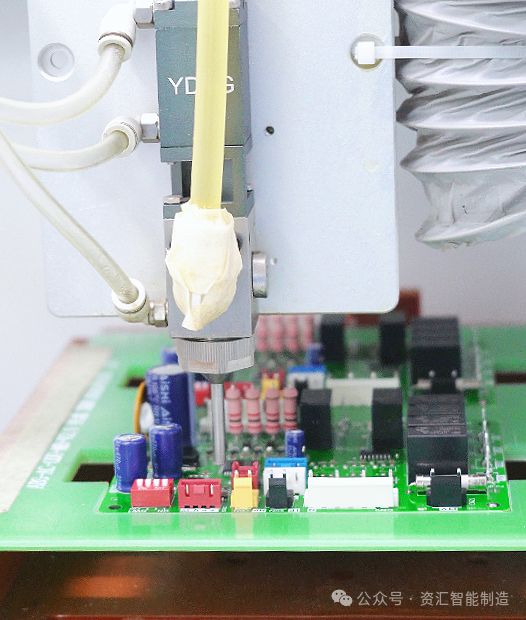
Mechanical spraying of conformal coatings
In fact, the “cold resistance” of every circuit board reflects a miniature universe of human technology:Stability in extreme cold requires precise collaboration between materials science, thermodynamics, and circuit design.
Isn’t this similar to our lives?
It is akin to our practice in the cold currents of life: using internal order to combat external entropy. When the circuit design of the soul is precise, and the current of passion flows endlessly, we need not fear any temperature difference, shining brightly and clearly.

Click the blue text to follow us

ZiHui Technology